To Be Friend of the Bridegroom - Daily Devotions with the Dean

Wednesday • 1/21/2026 •
Wednesday of 2 Epiphany, Year Two 

This morning’s Scriptures are: Psalm 38; Genesis 9:18–29; Hebrews 6:1–12; John 3:22–36 

This morning’s Canticles are: following the OT reading, Canticle 11 (“The Third Song of Isaiah,” Isaiah 60:1-3,11a,14c,18-19, BCP, p. 87); following the Epistle reading, Canticle 16 (“The Song of Zechariah,” Luke 1:68-79, BCP, p. 92)  

Welcome to Daily Office Devotions, where every Monday through Friday we ask how God might direct our lives from that day’s Scripture readings, as given in the Book of Common Prayer. I’m Reggie Kidd, and I’m grateful to be with you this Wednesday in the Second Week After Epiphany. Our readings come from Year 2 in the Daily Office Lectionary.  

Genesis 9: a hitch in the new beginning. “Noah, a man of the soil, was the first to plant a vineyard. He drank some of the wine and became drunk, …” — Genesis 9:20. The translation “Noah was the first to plant a vineyard” is misleading. The text would be better rendered as “Noah planted a vineyard for the first time.” Likely he is both an inexperienced vintner and an inexperienced drinker. Wise is biblical counsel to enjoy wine, but not to excess (see Psalm 104:15; Proverbs 23:29–35).  

“…and he lay uncovered in his tent. And Ham, the father of Canaan, saw the nakedness of his father…” — Genesis 9:21a–22. The biblical language of “seeing the nakedness” of one’s father is delicate. While we don’t know the specific details of Ham’s sin against his father Noah, what he does is profoundly and inexcusably dishonoring. Yahweh covered Adam and Eve’s shame with clothes; Shem and Japheth do so with a garment for their father (Genesis 3:21; 9:23). Noah’s curse of Ham and his son Canaan accounts for the enmity throughout the Old Testament between Israelites (descendants of Shem) and the surrounding peoples: the Canaanites, Egyptians, Babylonians, and Assyrians.  

The lines drawn here are not of race, but rather a matter of faith versus unfaith. Messiah will come from Israel, of the line of Shem. And through Messiah, all peoples will be blessed. That reality comes to fruition at Pentecost where all nations are represented at the outpouring of the Holy Spirit, and in the terms of the Great Commission, where the disciples are instructed to make disciples of all the nations. But the Old Testament, too, is replete with promises of the ultimate reconciliation of all people groups in the age of and through Israel’s Messiah: for example, “On that day there will be a highway from Egypt to Assyria, and the Assyrian will come into Egypt, and the Egyptian into Assyria, and the Egyptians will worship with the Assyrians” (Isaiah 19:23), and “Among those who know me I mention Rahab and Babylon; Philistia too, and Tyre, with Ethiopia—'This one was born there,’ they say” (Psalm 87:4).  

Image: iStock 

John 3: “He must increase, but I must decrease.” John the Baptist stands at the summit of the history of the prophetic ministry that had been pointing forward to the coming of Messiah. John the Baptist is the culmination of that ministry, for the “forward” to which he points happens to be “now” to him! “Behold the Lamb of God who takes away the sin of the world,” he had declared (John 1:29). While John’s Gospel deftly and discreetly points to the arrest (and therefore to the subsequent martyrdom) of John the Baptist (John 3:24), this Gospel emphasizes John the Baptist’s realization of the monumental transition in the staging of God’s plan to redeem the world: “He must increase, but I must decrease” (John 3:30).  

Beautifully, gloriously, wonderfully, John the Baptist realizes that the Divine Bridegroom long anticipated and longed for in Scripture has come. The Bride, the church, has been prepared through the millennia of human history and Israel’s struggles. Now begins the celebration foreshadowed in Hosea’s ministry and Solomon’s Song of Songs, and even symbolized by Jesus’s “sign” at the Wedding of Cana (John 2). How can John be jealous that people are following Jesus, not him? The friend of the bridegroom is at the wedding to share in the bridegroom’s joy!  

There’s a good word here for all of us who participate in church life. Our job is not to point to ourselves, the splendor of our buildings, the beauty of our music, the refinement of our gifts, much less the cultivation of our brand or the measuring of our following. We exist to point, constantly and faithfully, to the Bridegroom, and to rejoice in the honor of being called “Friend of the Bridegroom.”  

Hebrews 6: Don’t even think about turning back. The congregation to whom the Epistle to the Hebrews is written is in danger of letting other things “increase” and Jesus “decrease.” The Greek of this epistle (or treatise) is the most complex in the New Testament, and its argumentation the most sophisticated.  

There’s probably good reason for the writer to chide his readers about how they ought to be teachers (Hebrews 5:12). They’ve let themselves get sidetracked and nearly derailed because their view of Jesus has become diminished. What’s become more important to them is preservation of their national heritage: saving the earthly Jerusalem, protecting the temple, renewing its sacrifices, and reverting to an eschatological expectation that has more to do with angelic powers than with Messiah’s rule.  

Here in Hebrews 6, the writer says he thinks “better things concerning you” when it comes to their grip on salvation (Hebrews 6:9). He nonetheless feels compelled to show them the absurd potential results of a drift into apostasy. It’s important for them firmly to hold onto truths they are in danger of forgetting. In Christ they have come to the heavenly Jerusalem (Hebrews 12:22). They are beyond the need of the physical temple that is on the verge of passing away (Hebrews 8:13). They need no sacrifices beyond the once for all sacrifice that Jesus has performed for them (Hebrews 10:10). And they are not to look forward to a day when angels will rule, because, in fact, when Christ comes back they will rule with him (Hebrews 2:5–13).  

I think the anonymous writer should be taken at his word: he genuinely thinks better of this congregation than that they would overthrow their faith in Christ for something less. Nonetheless, he wants them to see what an impossible position they would put themselves in if they turned their back on their once-crucified, now-risen-and-mediating, and one-day-returning Prophet, Priest, and King!  

I pray we never ever lose sight of what a wonderful gift it is that we have in Jesus, what an honor it is to be not just “Friend of the Bridegroom,” but his Bride. And what a joy it is, even as the Bride of the Bridegroom from Heaven, to say, “He must increase, but I must decrease.” 

Be blessed this day,  

Reggie Kidd+  

God's Beautiful Rainbows - Daily Devotions with the Dean

Tuesday • 1/20/2026 •
Tuesday of 2 Epiphany, Year Two  

This morning’s Scriptures are: Psalm 26; Psalm 28; Genesis 9:1–17; Hebrews 5:7–14; John 3:16–21 

This morning’s Canticles are: following the OT reading, Canticle 13 (“A Song of Praise,” BCP, p. 90); following the Epistle reading, Canticle 18 (“A Song to the Lamb,” Revelation 4:11; 5:9–10, 13, BCP, p. 93)  


Welcome to Daily Office Devotions, where every Monday through Friday we draw insights from that day’s Scripture readings, as given in the Book of Common Prayer. I’m Reggie Kidd, and I’m grateful to be with you this Tuesday in the Second Week of Epiphany. Our readings come from Year 2 in the Daily Office Lectionary.  

Genesis 9: “Double rainbow!” Sometimes when I get a bit down, I go to YouTube and pull up Yosemitebear’s video: “Double rainbow! What does it meeeeeean?” It makes me smile every time.  

God’s beautiful rainbows, what, indeed do they mean? Why do they evoke awe, wonder, and joy?  

With the entrance of evil into the world, life on earth devolves into chaos. Adam and Eve listen to the serpent’s hiss. Cain kills Abel, and Genesis 4 through the first part of Genesis 6 depicts an unrelenting slide into violence and degradation.  

The Bible’s message, however, is that God is not content to let chaos win. He intervenes, to borrow a phrase from the writer to the Hebrews, “at many times and in various ways,” to reverse the tendency to pandemonium.  

The flood account in Genesis 6–9 is the Bible’s way of saying that after the inexorable, irresistible slide into darkness that ensues with Adam and Eve’s cosmic treason, God begins to make a new start, with a new humanity. A new humanity rescued from destruction by their association with the one righteous man, Noah (Genesis 6:9). A new humanity consisting of eight family members simply willing to get on the ark with him.  

When the flood subsides, God establishes with them (and through them with the whole earth) a covenant (Genesis 9:9). Their part in that covenant is a reprise of the instructions God originally gave to Adam and Eve: fill the earth, tend it, care for it, draw out its potential for order and life — this time, with the momentous responsibility of acting against evil instead of just watching things go from bad to worse (Genesis 9:1–7).  

God’s part in this covenant is to place his bow in the sky (the Hebrew term for “rainbow” is the word for “bow and arrow”). Instead of having the “bow” pointed downward, aimed at us in judgment, with arrow notched, God points his “bow” upwards, no arrow, in peace. A sign that God is establishing peace and reconciliation between himself and the errant humanity he loves, among humans themselves, and between us and the animal kingdom we are called to steward.  

“Double rainbow! Awesome!!! What does it mean??!!” Here’s what it means: as part of God’s new creation, we take God’s side in resisting the rule of sin and death and decay. As long as there are rainbows in the sky, there’s work for you and me to do, from firefighters rescuing kittens, to teachers turning back illiteracy, to students sorting out their place in this world, to anybody in law trying to make things right (or at least a little less wrong).  

Whatever you are called to do to make this world a better place, you are commissioned by God’s covenant with Noah.  

John 3: God so loved… For each covenant God establishes with us he provides a “sign,” a visible, tangible promise from him and reminder to us that his relationship with us is real. Each “sign” carries with it a sacramental power, that is, it acts as something like a portal that brings God’s world of promise and provision and our world of desperate need together.  

To Noah God provides a rainbow, to Abraham circumcision, to Moses the Sabbath, to David, well, David himself—and in the New Covenant, God provides his own Son as the visible, tangible connection point between himself and us. “God so loved the world that he gave his only begotten Son that whosoever believes in him should not perish but have everlasting life” (John 3:16). God gives the Son who is himself the sign, seal, and sacrament of his commitment to us and of our corresponding obligation to him. Jesus is Bread from Heaven, and True Vine and Cup of Salvation (see John 6 and 15).  

Hebrews 5: “with loud cries and tears.” “In the days of his flesh, Jesus offered up prayers and supplications, with loud cries and tears, to the one who was able to save him out of death (Greek ek thanatou), and he was heard because of his reverent submission. Although he was a Son, he learned obedience through what he suffered; and having been made perfect, he became the source of eternal salvation for all who obey him” (Hebrews 5:7–9a, my rendering). What it takes for Jesus to bring God’s world and ours together, to restore communion between heaven and earth, is for him to walk a hard path.  

It’s a path of “learning obedience,” not (like us) from disobedience to obedience, but from one level of obedience to another as he undergoes the entire gamut of human experiences: from potty-training through adolescent desire to adult assumption of calling — all just like us, “yet without sin” (Hebrews 4:15). It’s a path that has him praying as a human. Unlike any other human, however, he does so throughout his life with cries and tears and groans for the tragedy of others’ lives distorted and devastated and destroyed by the power of sin. All the while he also anticipates shouldering all of it on the Cross that lies before him from Day One of the Incarnation; and so, he prays to be delivered “out of death” for us. Today’s passage opens a precious window onto its cost to him, making his walk all the more treasurable to us.  

Be blessed this day, 

Reggie Kidd+ 

The Promise of New Creation - Daily Devotions with the Dean

Monday • 1/19/2026 •
Monday of 2 Epiphany, Year Two  

This morning’s Scriptures are: Psalm 25; Genesis 8:6–22; Hebrews 4:14–5:6; John 2:23–3:15 

This morning’s Canticles are: following the OT reading, Canticle 9 (“The First Song of Isaiah,” Isaiah 12:2–6, BCP, p. 86); following the Epistle reading, Canticle 19 (“The Song of the Redeemed,” Revelation 15:3–4, BCP, p. 94) 


Welcome to Daily Office Devotions, where every Monday through Friday we explore that day’s Scripture readings, as given in the Book of Common Prayer. I’m Reggie Kidd. Thanks for joining me this Monday in the Second Week After Epiphany, in Year Two of the Daily Office Readings.  

The utter wonder of the life God has for us is on display in today’s images of Noah’s dove returning with an olive leaf, Moses’s serpent lifted in the wilderness, and the writer to the Hebrews’ vision of Jesus representing us in the heavenly courts.  

The dove returns bearing a leaf of an olive tree.  

The leaf of an olive tree. The leaf brings the promise of new creation. It signals a new start for humanity. Noah and his family are told to “Go out of the ark” (Genesis 8:16a). Having passed through waters of judgment, they emerge into a world made new. They release the animals to “be fruitful and multiply on the earth,” echoing Genesis 1 (compare Genesis 1:20–25,28–30 with 8:17b). The dove and the olive leaf mark the re-inauguration of the project of “being fruitful and multiplying, of filling the earth and subduing it” that was aborted in the Garden of Eden (see Genesis 1:28).  

Anointing oil. Oil from olive trees becomes a symbol in Scripture of God’s anointing. In the Old Testament, Yahweh anoints prophets to bring his Word, priests to cover sin through sacrifice, and kings to establish justice and equity. Finally, God anoints his own Son to be the great Prophet, Priest, and King. It is Jesus who definitively and perfectly, as the BCP’s Eucharistic Prayer B, puts it, brings us “out of error into truth, out of sin into righteousness, out of death into life.”   

The dove of peace. From the earliest interpreters on, the dove has symbolized peace. Along with the rainbow (tomorrow’s Devotional), the dove of peace signals that Yahweh’s warfare against sinful humanity has ended. He has saved a remnant made righteous by their union with their family head, Noah.  

Noah’s response is to worship: “Then Noah built an altar to the  Lord, and took of every clean animal and of every clean bird, and offered burnt offerings on the altar. 21 And when the Lord smelled the pleasing odor…” (Genesis 8:20–21a). By virtue of the sacrificial worship that Noah institutes, Yahweh sustains a relationship of grace and favor with the fallen creatures while he prepares for their ultimate deliverance from sin’s destructive grasp, the work of Jesus Christ.

Today’s New Testament readings provide profound pictures of the way the atoning and fellowship aspects of the sacrificial system culminate in Jesus. 

John: a serpent lifted up. In his conversation with Nicodemus, Jesus references a foreshadowing of his own being lifted up on the Cross. “And just as Moses lifted up the serpent in the wilderness, so must the Son of Man be lifted up, that whoever believes in him may have eternal life” (John 3:14–15). Sinful people in the wilderness are succumbing to poisonous snakes until Moses commands that a serpent of bronze be lifted up on a pole. Whoever looks upon the serpent hanging from the pole is healed (Numbers 21).  

Jesus’s message for Nicodemus (and for us) is that our sin-sickness means we need new birth (“You must be born again/from above” — John 3:3). That sin-sickness which is a walking spiritual death, will be healed when, and only when, God’s dear Son is lifted up on the Cross. Hanging from the Cross, Jesus draws all the venom of human sin into himself, and away from every person who looks upon him in faith. Jesus invites Nicodemus, and every one of us who is aware of the terminal disease of our spiritual condition, to look up at the Cross. What a powerful picture of Christ’s atoning work! 

Hebrews: Jesus escorts us to the throne of grace. What a correspondingly powerful picture of Christ’s work to restore us to fellowship with God! Jesus didn’t come just to offer a sacrifice to clear us of the guilt of sin (though he did do that! — see Hebrews 10:10,14). He rose from the dead and “passed through the heavens” (Hebrews 4:14) so he can represent us in the heavenly courts. He is there, as Hebrews 7:25 says, to intercede for us. Because Jesus is there, it’s as if we were there ourselves. From there, having endured everything we endure living in a fallen, frustrating world, Jesus offers help “in time of need” (Hebrews 4:16b).  

When we need consolation in a time of loss, he is there for us. When guilt and shame threaten to overwhelm us, he is there to say, “Father, remind them I’ve cleansed their conscience, and they are mine!” (see Hebrews 8–10). When the cares and concerns of the day keep us awake at night, he is there for us. When we seem to have lost our “voice” and nobody seems to “see” us, he is there to hear and see us. When we need an “attaboy,” he is there for us.  

Be blessed this day,  

Reggie Kidd+ 

Radiant Presence - Daily Devotions with the Dean

Friday • 1/16/2026 •

Welcome to Daily Office Devotions. I’m Reggie Kidd. Thanks for joining me. 

We’re taking a detour from the Daily Office readings this week. Instead, we’re thinking through various facets of worship and how our Lord provides meaningful communion with him through our formal corporate worship as well as in individual worship in our daily devotions. The thoughts offered here are excerpts (sometimes lightly edited) from articles I wrote for Worship Leader magazine a few years ago.  

They come from a season in my life when I was on a journey from more generic free-form worship to worship shaped by the classic liturgy. I hope these observations help you in your own quest to love God and your neighbor. We’ll resume our reflections on the Daily Office next week. 


Rediscovering the Trinity and Spirit-led Worship, Part Three of Three 

The Holy Spirit and Worship 

There have sometimes been Sundays when a conversation at my house goes like this: 

“What’s the matter?” 

“I just want to quit.” 

“Why?” 

“Why? Easy. You were there. Didn’t you sense it?” 

“Sense what?” 

“The lack of worship. We were putting out all we had from up front, and nothing was coming back. Worship just wasn’t happening.” 

“How do you know? Because maybe people weren’t singing the way you thought they should be? You know the Spirit’s presence is about more than that. You can’t always see what God is doing. Sitting in my row I saw something you didn’t see: a woman who stopped singing because she had begun crying. I think the Spirit may be doing things His way, not yours.”  

Hmmm.  

What characterizes Spirit-led worship? Are there marks of the breath of the Spirit?  

Image: H. Zell, CC BY-SA 3.0, via Wikimedia Commons. Stained glass window Holy Spirit in the nothern wall of the Iglesia de San Bartolomé de Tirajana, San Bartolomé de Tirajana, Gran Canaria, Canary Islands, Spain 

The Spirit Creates Life 

Jesus came back from the dead to breathe God’s very life into us. I’ve arrived at the place where I’m simply thankful to have been given eternal life in Christ, and to be allowed to share that life with others whom the Spirit has graciously made alive as well. I challenge myself to be more amazed at the presence of faith than depressed over possible signs of lack of faith. In other words, what I’m looking for as a prime marker of the Spirit’s presence in worship is this: by God’s grace, redeemed sinners show up seeking more grace.  

I believe that there is a radiantly alive presence in our midst when we worship. That presence is Jesus who has become “life-giving Spirit.” While bodily he is in heaven constantly advocating for us before the Father (Heb 7:25), he is simultaneously among us by the Spirit, breathing God’s presence into us, proclaiming the Father’s name, and orchestrating our praise (Heb 2:12).  

He’s there whether I feel him or not. He’s in charge and is working his good pleasure, whether I hit all my marks or not. He’s constantly compensating for all my weaknesses and mistakes, and perhaps more importantly, for all my strengths and the things I get “right.”  

I have to remind myself the “condensation on the sunglasses” is not necessarily about any of the things I do or don’t do. Chesterton suggests that the only way to explain the fact that the church hasn’t died over time as one cultural, political, or philosophical support after another has fallen away, is that there is a Presence in the church that won’t go away. If Arianism, Gnosticism, Pelagianism, imperial patronage, humanism, scientism, modernism, and postmodernism can’t make the Holy Spirit go away, I probably can’t either.  

The Spirit Makes One out of Many  

The worship of God now takes place not in a single, localized house of brick and mortar where the songs of Zion are sung in but one tongue. God’s house of worship — where “Spirit and Truth” reside — is worldwide! It consists of a near infinity of “living stones” who happen to sing in many tongues. Beginning with the likes of respectable Nicodemus and the fallen woman at the well, the Holy Spirit has been making a worldwide community of worship that is greater than the sum of its parts. Amazingly, under the baton of the Spirit of Christ, those many tongues make “one voice” (Rom 15:6).   

“Make every effort to keep the unity of the Spirit through the bond of peace,” says Paul (Eph 4:3). The Spirit’s unity is most evident, I’ve come to believe, precisely where there is diversity rather than uniformity. Unity is not difficult to sustain when everyone shares the same preferences/musical tastes, an “age and stage” affinity, compatible theological nuance, congruent Myers-Briggs profiles. When there’s unity despite differing penchants, a unity that is born out of heroic forbearance and costly deference, it seems more likely that it is the Spirit who is at work.  

The Spirit Exalts Others  

Fourth century theologian Basil the Great’s defense of the deity of the Holy Spirit is skillful because it is indirect. Basil observes that Scripture has many direct statements about the divinity of God the Father, fewer about the divinity of God the Son, and precious few about the divinity of God the Holy Spirit. You can’t help but conclude, he insists, that the Holy Spirit is God in the same way that the Father and the Son are — otherwise, to baptize in the name of Father, Son, and Holy Spirit would be blasphemous. Nonetheless, it’s almost as though there is in Scripture a modesty about the Spirit’s identity.  

A fundamental characteristic of the Holy Spirit is that he does not call attention to himself: “He will glorify me, for he will take what is mine and declare it to you,” said Jesus (John 14:16).  

Some people walk into a room and they make everybody else feel larger. Some walk in and make everybody else feel smaller. The first breathe life into the room because they make everybody else the center of their attention. The latter suck the life out of the room because they make themselves the center of attention. Here is a principal way of knowing when it’s the Spirit at work, and when it’s the flesh.  

That was Paul’s problem with the church at Corinth. He wanted those brothers and sisters to understand that worship is always about the exaltation of Jesus and the edification of others, not the exaltation of self and the display of personal giftedness (1 Corinthians 14). That’s why Paul encouraged them — and he would, I’m certain, encourage us likewise — to promote in worship the real way of the Spirit, the way of love (see 1 Corinthians 13).  

Breathe in. Breathe out.  

Of course, there’s so much more to say about the Spirit and worship — about the mission, about the gifts, about uniting old and new. But for now, this will have to suffice: not unlike that lifeless puppy I saw on the side of the road, we were dead to intimacy with our Maker, and dead to the way our relationships with one another were to mirror the eternal communion within the Trinity — until the Son came, died, rose, and breathed the breath of God into us. 

As a worship leader there’s probably nothing greater that I can contribute to worship than making sure that I keep breathing God’s breath myself. In the Word daily — breathe in. In prayer daily — breathe out. Confess “my stuff” — breathe in. Lift his name in praise and adoration — breathe out. Come to the Table — breathe in. Wish my neighbor Christ’s peace — breathe out. Ponder the wonder of his grace to me — breathe in. Find the lost, tell the story, feed the hungry — breathe out.   

Be blessed this day, 

Reggie Kidd+ 

The Spirit - Daily Devotions with the Dean

Thursday • 1/15/2026 •

Welcome to Daily Office Devotions. I’m Reggie Kidd. Thanks for joining me. 

We’re taking a detour from the Daily Office readings this week. Instead, we’re thinking through various facets of worship and how our Lord provides meaningful communion with him through our formal corporate worship as well as in individual worship in our daily devotions. The thoughts offered here are excerpts (sometimes lightly edited) from articles I wrote for Worship Leader magazine a few years ago.  

They come from a season in my life when I was on a journey from more generic free-form worship to worship shaped by the classic liturgy. I hope these observations help you in your own quest to love God and your neighbor. We’ll resume our reflections on the Daily Office next week. 


Rediscovering the Trinity and Spirit-led Worship,” Part Two of Three 

The Spirit in John’s Gospel 

If we reflect on some of Jesus’s sayings and conversations in John’s gospel we get a glimpse into the vision that animated Jesus that day he cleansed the Temple.  

The Spirit must remake the innermost parts of us, he tells Israel’s preeminent (but clueless) teacher, Nicodemus (John 3). The Spirit will bring together in worship of the Father both a respectable, over-educated Jew like Nicodemus and a promiscuous, disreputable non-Jew like the woman at the well in Samaritan Sychar (John 3 and 4). The Spirit will create such worship through the One who is the Truth (4:24), but who also is the Way and the Life (14:6).  

Image: Guercino (1591-1666), Public domain, via Wikimedia Commons 

Besides the Passover, the one named festival in John’s gospel is the harvest-time Feast of Tabernacles, a celebration of God’s provision in the wilderness during the exodus. On the last day of the Feast, celebrants pour out water to remember the way God had taken care of his people’s thirst in the wilderness. While that is taking place on one such occasion, Jesus steps forward and declares that anybody who is really thirsty needs to come to him. Conjuring Ezekiel 47’s image of rivers flowing out from the threshold of the Temple, Jesus says that he himself will provide the Spirit for everyone who comes to drink from him (John 7:37-39).  

In his Final Discourse, Jesus outlines the transfer of life from himself, to the Spirit, to his followers, and then to the world (John 13-17).  

Jesus explains that his disciples will experience an absence that, incongruously, makes his presence nearer. They will do greater works (14:12). All the time that Jesus has been “alongside them” (14:25) the Holy Spirit has also been “alongside them” (14:17). The Spirit who came upon the Son “and remained on him” (1:32) at his baptism has been accomplishing the Father’s works through Jesus. Because Jesus goes away, that divine presence — the divine breath — will not be just alongside, but “inside them” (14:17). After Jesus’s bodily departure, the Holy Spirit coming inside them will be the means by which Jesus himself comes back “to them” (14:18) — with a presence that is better than his pre-death and pre-resurrection presence. A closeness emerges that some have called “coinherence,” a mutual indwelling: “I in my Father and you in me and I in you” (14:20).  

Spirit Representing Trinity 

What is so utterly characteristic of the Holy Spirit, “the Spirit of Truth,” is that he does not come to represent himself, but the Son and the Father who have sent him (15:26; 16:12-15). In this, the Spirit reflects the Son, who has come not to serve his own ends, but his Father’s (see John 5:19,30; 14:28). As the Son has glorified the Father, the Spirit will glorify the Son (17:4; 16:14a). He will do so by explaining the things of the Son to us and by convicting the world of sin and righteousness and judgment (16:14b, 8).  

What the Spirit does is create among us a communion of love that externalizes in time and space the eternal communion of love that has existed from before time and space. What the Spirit creates among us is a life of mutual deference — a life Jesus models at the beginning of the Final Discourse in the foot washing (John 13) and prays for at the Discourse’s close: “… that all of them may be one, Father, just as you are in me and I am in you. May they also be in us so that the world may believe that you have sent me” (17:21).  

With literary artistry, John describes Jesus’ arrest, suffering, death, and resurrection, but then announces Jesus’ ascension without ever describing it (20:17). Instead, John provides a number of vignettes illustrating the way Jesus prepared his followers for life without his physical presence. The vignettes are lessons in how to worship now under this new regime of “in Spirit and Truth” (4:24).  

The promise of a new order of worship that Jesus had announced at the Temple cleansing receives fulfillment when Jesus first appears in his risen body — the very body that he said would be the beginning of the building of a new house for worship. Pointedly, Jesus tells his gathered disciples: “As the Father has sent me, so I am sending you” (20:21). Dramatically, he breathes on them, and says, “Receive the Holy Spirit.” By his breath, mere disciples become apostles, equipped to build God’s house and to lead worship “in Spirit and Truth.” 

The Book of Acts has its own way of telling the same story, first, with the transfer of Jesus’ ministry here on earth (the Gospel According to Luke) to his ministry at the right hand of God by means of the Holy Spirit (Acts 2:29-36), and second, with Pentecost’s amazing manifestations of the new life rippling from Jerusalem to the ends of the earth.  

The apostle Paul, too, tells the same story through his developed theology of how the “Last Adam” became “Life-Giving Spirit” (1 Cor 15:45) in order to make dead people come to life (Eph 2:1-10) and to unite once estranged people into a dwelling for God (Eph 2:11-22).  

But John’s gospel has taken us to the heart of what the Spirit of God effects in our worship.  

Tomorrow, the third installment of thoughts on the ministry of the Holy Spirit in worship… 

Be blessed this day, 

Reggie Kidd+ 

The Four Voices - Daily Devotions with the Dean

Wednesday • 1/14/2026 •

Today we close out a two-week detour from the Daily Office. Instead, we’ll be thinking through various facets of worship and how our Lord provides meaningful communion with him through our formal corporate worship as well as in individual worship in our daily devotions. The thoughts offered here are excerpts from articles I wrote for Worship Leader magazine a few years ago.   


“With Four-Part Harmony and Feeling”  

Maybe you’re like me? On any given Sunday, I may show up for worship worn out or close to giving up or guilty and ashamed – or ready to celebrate. I know there’s an even more diverse range of moods among the people I’m called to lead. How can the worship of Jesus’ people rise from such disparate hearts? How can worship leaders orchestrate such discordant voices?  

“With four-part harmony and feeling.” That’s how Arlo Guthrie introduces the last chorus of his classic story-song “Alice’s Restaurant.” To me, it’s an apt summary of God’s gift to us of the four voices through which he tells us Jesus’ story: Matthew, Mark, Luke, and John. In his “four part, one song” gift, God provides hope that Jesus can make sweet music of our disparate voices.  

It’s not a given that we would have access to Jesus through precisely these four gospels. Some people in the early days of the church experimented with something else. Marcion (mid-2nd century, Rome) championed an edited Luke over the other three — and wound up pitting a New Testament God of love against the Old Testament God of wrath. Epic fail. Tatian (mid-2nd century, Assyria) tried to amalgamate the four gospel accounts into a single narrative — the result was a mish-mash. Less epic, but fail nonetheless.  

Nor have other sources been that helpful. Historians like the Roman Tacitus (2nd century) and the Jewish Josephus (a turncoat during the 1st century war with Rome) do little more than note that Jesus lived. The Gospel of Thomas (2nd century, Egypt) gives us sayings (many quite odd), but little of the story. The Gospel of Judas (2nd century, Egypt) gives us story, but one that just didn’t ring true.  

For the last 200 years or so, scholarship has tried to get behind “the Christ of the Gospels” in quest of “the Historical Jesus.” The problem is that scholarship is done by scholars, and scholars are people. Consistently, those scholars’ quests lead them to a Jesus that looks just like them. Churches have their own reductionistic bent. Protestants filter Jesus through the apostle Paul. Catholics favor the Synoptics (Matthew, Mark, and Luke) because of the Synoptics’ ethical teachings. The Orthodox favor John because of his perceived otherworldliness.  

But the reality is that the four Gospels pressed themselves in concert upon the early church; and the early church wisely let each sing its own part of the song.  

The four-winged creatures of the book of Revelation gave the early church its most powerful metaphor for the singular message and fourfold voice of the Gospels: “the first living creature like a lion, the second … like an ox, the third … with the face of a man, and the fourth … like an eagle in flight” (Rev 4:7). Each has eyes for sight, and wings for flight. Each ceaselessly worships: “Holy, holy, holy, is the Lord God Almighty” (4:8).  

Each winged creature became associated in the early church’s mind with a particular gospel. Each became a metaphor for its gospel’s angle of vision, its aspect of Christ’s message to be taken to the nations, and its facet of worship.  

Matthew is the winged man because Matthew begins with Christ’s genealogy. Beyond that, Matthew presents Jesus as “gentle and lowly in heart,” and as one especially attuned to the burdens of “all who labor and are heavy laden” and who need “rest for your souls” (11:28,29). Matthew’s Jesus is Emmanuel (“God with us,” 1:23) who teaches in the Sermon on the Mount what our true humanity looks like.    

Mark is the winged lion because Mark begins with John the Baptist roaring like a lion in the desert. Beyond that, in his focus on Christ’s coming “not to be served but to serve, and to give his life as a ransom for many,” Mark shows Christ’s true, Aslan-like power.  

Luke is the winged ox because Luke begins with Zachariah fulfilling priestly duties in the Temple. As Irenaeus (2nd century, Gaul) notes, “For now was made ready the fatted calf about to be immolated for the finding again of the younger son.” Luke, Paul’s traveling companion, is the only Gentile author in the NT. His two volume Luke/Acts is rooted in “secular” history and the ethical sensibilities of the Gentile world. He understands especially well that humanity experiences redemption through Jesus fulfilling OT sacrificial requirements and promises.  

John is the winged eagle because the eagle is a good symbol for Christ’s coming from above as the divine Logos. With his seven “I am” statements (6:35; 8:12; 10:7; 10:11; 11:25; 14:6; 15:1) and Jesus’ crowning claim, “Before Abraham was I am” (8:58), John offers the most exalted view of Christ in the NT. Doubting Thomas speaks for all of us when he confesses: “My Lord and my God.”  

As Jesus reveals himself through his fourfold gospel, he speaks to the diverse needs of his people. Some hear him say, “You will find rest for your souls.” Some hear the Father rejoicing because the fatted calf has been sacrificed and they are welcomed home. Some hear that Christ is their Lion-protector. And we all find ourselves bowing before the one who is the great “I am.”  

Be blessed this day,  

Reggie Kidd+ 

Fly, Kessie, Fly! - Daily Devotions with the Dean

Tuesday • 1/13/2026 •

Instead, we’ll be thinking through various facets of worship and how our Lord provides meaningful communion with him through our formal corporate worship as well as in individual worship in our daily devotions. The thoughts offered here are excerpts from articles I wrote for Worship Leader magazine a few years ago.   


“Fly, Kessie, Fly!” 

One measure of leadership is whether people are following you. 

A better measure is whether you are helping people “take wing.”  

That’s a lesson Rabbit has to learn in the award-winning episode “Find Her, Keep Her,” in Disney’s The New Adventures of Winnie the Pooh.  

Rabbit rescues a female baby bird named Kessie during a snowstorm in the Hundred Acre Wood. For months, Rabbit nurses and cares for Kessie. Unfortunately, he becomes overly protective when she wants to learn to fly. Rabbit understands Kessie will eventually want to “fly south.” He will be left alone once more.  

Yet flying south is what birds do. And helping others take wing is what responsible caregivers do.  

As all Pooh stories do, this one ends the way it should. Rabbit learns, even though reluctantly, to let go. 

Hitting Home 

My wife recalls this story when our children make changes that reveal they are taking a new step towards independence, and away from us and from our influence. She finds letting go is not easy. And so, at these times, she still mutters to me under her breath, “Fly, Kessie, fly!” She understands what it is to forgo her own interests for the benefit of someone else. 

Leadership in God’s family is not much different.   

Kevin is a new senior pastor, with little background in worship ministry. He calls his old friend Ryan, an experienced worship pastor, and asks: “There’s been a lot of conflict over worship here, and I’ve inherited a pretty fragmented worship team. Would you work for me for a season and help me bring stability and unity, and earn my wings with this congregation in worship?” 

Over several months, a new-old team comes together, worship stops being a battle zone, and fans of “tradition” and fans of “freshness” begin deferring to one another.  

Great Idea 

At a meeting in the spring, Ryan, the worship pastor, offers: “Maundy Thursday is coming up. Historically, Maundy Thursday is a night the church remembers the ‘new commandment’ to love one another as Christ has loved us, and often celebrates that love with a foot washing service. We’ve seen a lot of cooperating and healing in this church. Why don’t we offer a foot washing service to affirm the love, unity, and healing this body has been experiencing?”  

Kevin, the senior pastor, responds, “That’d be a new thing for me, but it sounds like a great idea.” 

“The foot washing services I’ve led have provided powerful moments for brothers and sisters to experience the priesthood of all believers as they minister Christ’s love to one another,” Ryan adds. 

“Yeah, OK,” answers Kevin, “But what I think we need here is for the people in church to get the message that the leaders really love them. So I want only the pastors and the elders to do the washing of the congregation’s feet. I’ll tell the elders about my idea at our next meeting.” 

Suddenly, Ryan feels like he’s in the middle of a Dilbert comic strip. The pointy-haired boss is hijacking his idea, taking credit for it, and, in the process, ruining the whole concept. Ryan visualizes a thought bubble above his own head:  “Excuse me, but whose idea is this anyway!? You’ve never even seen a congregational foot washing, much less led one….” 

Then Ryan remembers there’s the Dilbert way of seeing things, and there’s the Jesus way of seeing things. He envisions a new thought bubble: “Hold on a minute! Where did that attitude come from? If washing feet is about kneeling to serve, about putting my brother’s interests ahead of my own, maybe that’s what I’m supposed to do in this case.” 

The words that manage to come out of Ryan’s mouth are, “Sounds like a plan! Let’s do it!!” 

Sink or Soar 

During the Maundy Thursday service four weeks later, Ryan, despite his best intentions, is still having internal thought-bubble conversations. The logistics that Kevin the senior pastor has insisted on require the worship team to lead music throughout communion and the foot washing. They will not get to receive communion or participate in the foot washing itself. 

Ryan’s thought bubble begins to complain, “It figures. I should have insisted on more control….”  

Ryan stops himself and looks around. Many in the congregation, profoundly moved by seeing pastors and elders taking the posture of servants, have eyes brimming with tears.  Ryan notices, too, a glistening in Kevin’s eyes as he imitates Jesus’ leadership example. 

And so a better thought bubble has the final say: “Pay attention, Ryan. A most awesome service is unfolding right in front of you. Jesus is in this house. And look at Kevin – you can almost see him growing softer and kinder with every foot he washes. He’s finding his wings.” 

After the service, it is discovered that Jesus has provided, by some happy accident, a small amount of bread and wine backstage. Ryan and his team share an intimate and amazing communion together before going home – and, of course, they wash each other’s feet. 

Best of all, Ryan realizes he has already been privileged to do a bit of foot washing – just not the way he had at first envisioned. Foot washing takes many forms.  

The strongest kind of leadership is the kind that helps others take wing: “Fly, Kessie, fly!”  

Be blessed this day, 

Reggie Kidd+ 

How Can I Keep from Singing? - Daily Devotions with the Dean

Monday • 1/12/2026 •

We’ll be thinking through various facets of worship and how our Lord provides meaningful communion with him through our formal corporate worship as well as in individual worship in our daily devotions. The thoughts offered here are excerpts from articles I wrote for Worship Leader magazine a few years ago.   

I Know Why the Prisoner Sings * 

For two millennia, Christians have sung their theology—from catacombs to dorm rooms, and from cathedrals to football stadiums. Every distinctive shape the faith takes – each its own “Jesus Movement” – finds its own musical voice. Ambrose’s robust trinitarianism both created and was supported by the florid hymnody of the church of fourth-century Milan. Gregorian chant both bespoke a quest of a spiritual music for the church and announced the ascendancy of the medieval church. In the sixteenth century, Martin Luther trumpeted his newfound grace as much through broadsheets and hymns as through sermons and books.  

Along the way, preachers and songsters have paired off, and sometimes the songsters have shaped the message as much as the preachers: John Calvin and Louis Bourgeois, John and Charles Wesley, Dwight Moody and Ira Sankey, Billy Graham and George Beverly Shea, Louie Giglio and Chris Tomlin. The evangelical uprising that began right after World War II, gained new life in the Jesus Movement of the 1960s, and persists into the beginning of the third millennium is characterized as much by its “praise and worship” as by anything else. When groups think about starting new churches, they are as anxious to establish their “sound” as they are their message. 

Image: Pixabay 

Hopeful Abandon 

God is in the process of reclaiming our lost planet, so singing fits the way things are. As a result, Christians have been irrepressible singers from day one. What J. R. R. Tolkien said is true: every fairy tale echoes the biblical drama—we were lost, and then we were found. Praise and thanks come unbidden to the surface of our being—and in the unbiddenness of our singing lies its rightness. 

A song will illustrate. One of my coworkers teases me: “I always know it’s you coming down the hall, because I hear the music first.” I am an incorrigible singer, hummer, and whistler. The one song that forces itself into my consciousness more than any other is this: 

My life goes on in endless song, above earth’s lamentations. 
I hear the real, though far-off hymn, that hails a new creation. 
Above the tumult and the strife, I hear its music ringing. 
It sounds an echo in my soul. How can I keep from singing? 

When tyrants tremble, sick with fear, and hear their death-knell ringing, 
When friends rejoice both far and near, how can I keep from singing? 
In prison cell and dungeon vile our thoughts to them are winging. 
When friends by shame are undefiled, how can I keep from singing? 

What though my joys and comforts die, the Lord my Saviour liveth. 
And though the darkness round me close, songs in the night he giveth. 
No storm can shake my inmost calm while to that Rock I’m clinging. 
Since Christ is Lord of heaven and earth, how can I keep from singing? 

Anne Warner composed this folk hymn in the middle of a most uncivil Civil War, and Doris Plenn reshaped it during the Cold War and its attendant paranoia. It is a hymn of courage in the face of tempest and darkness and tyrants.  

Trembling Courage 

My absolute favorite version of the song is Eva Cassidy’s kicking “gospel” rendering. She sang it while she was trying to fight off the malignant melanoma that would eventually take her life. Perhaps that’s why she sings with an urgency most who take up this song don’t have. I know that there are different kinds of “prison cells” and “dungeons vile,” and that melanoma—which I too contracted—is one of them. I know therefore that the gift of a song in the night does keep the darkness back, if barely—“Dear God, do not let my children grow up without a father.” And I know that a response of unbidden song rings true because, and only because, Christ is indeed “Lord of heaven and earth.” I hope this was Eva Cassidy’s hope—it is mine, for though my cancer was found at a much earlier stage than hers and appears to have been treated successfully, I know that the “far-off hymn” isn’t as far off as it was pre-cancer. I know in a way I didn’t before that Christ’s victory over the grave promises “new creation.” More importantly, I know that in the worst of my fears I can’t keep from singing; Christ has plundered death and hell. 

This hymn is a parable of the entire history of song in the church. It explains why we are such a singing lot. From the very beginning, God has been orchestrating a grand drama, the reclamation of his lost creation—and in operatic fashion, he has used the singing to his Jesus Movements to carry the story line.  

Be blessed this day,  

Reggie Kidd+ 

* Today’s post is adapted from Reggie M. Kidd, With One Voice: Discovering Christ’s Song in Our Worship (Grand Rapids, MI: BakerBooks, 2005), pp. 17–20.  

The Bible's Six-Word Story - Daily Devotions with the Dean

Friday • 1/9/2026 •

We’re in week two of a two-week detour from the Daily Office. Instead, we’ll be thinking through various facets of worship and how our Lord provides meaningful communion with him through our formal corporate worship as well as in individual worship in our daily devotions. The thoughts offered here are excerpts from articles I wrote for Worship Leader magazine a few years ago.   

“Psalms Keep Us in God’s Story” 

There’s a story that Ernest Hemingway won a bet that he could write a six-word novel:  

“Baby shoes. For sale. Never used.”  

It’s hard to imagine so much punch being packed into so few words. But there it is. The story recently prompted a “flash fiction” movement, along with books like Larry Smith & Rachel Fershleiser’s Not Quite What I was Planning and a website (smithmag.net) offering collections of life stories in six words:   

“Birth, childhood, adolescence, adolescence, adolescence, adolescence…” 

“Bad brakes discovered at high speed.” 

“Stole wife. Lost friends. Now happy.” 

“Barrister, barista, what’s the diff, Mom?” 

“I still make coffee for two.” 

Many six-word stories make me pensive. Somehow, they remind me that the most common funeral inscription of the Roman world in which Christianity emerged was just such a six-word memoir: “Non fui. Non sum. Non curo.” (“I wasn’t. I’m not. … Don’t care.”) They also remind me that what got imprinted in me growing up was a similarly despairing six-word formula: “Expect bad. You won’t be disappointed.” 

Psalm 136’s Six-Word Story 

In the ESV, RSV, and NRSV, the second half of every verse of Psalm 136 is the six-word chorus: “For his steadfast love endures forever.” Over the course of 26 verses, we extol the glory of Yahweh as creator of the universe, then rescuer of his people. Twenty-six times we interrupt the flow of the psalm’s story with praise of Yahweh’s “steadfast love.”  

The universe, the psalm explains, didn’t have to be there. Everything that exists does so, not as the result of sheer randomness, nor for any other explanation than the steadfast love of the Lord. The only reason our world—and we in it!—are here is God’s steadfast love. 

Image: Pixabay 

The psalm skips over the fall, the flood, and the call of Abraham, and goes directly to a celebration of the rescue of Israel and the violent takeover of “lands for an inheritance.” The rescue and the takeover happen, we are invited to sing, because of God’s steadfast love.  

Through the obscure nation of Israel, seemingly doomed to expire in Egyptian captivity, God intends to right all that has gone wrong under the heavens he made “by wisdom.” The Bible’s whole storyline—from creation through re-creation—is a long study in steadfast love. So, even while we puzzle over the mysteries of creation, the enigmas of the texts that tell Israel’s tale (such as including the deaths of Egypt’s firstborn and of “great” and “mighty kings”), we take the long view. In God’s story, Psalm 136 reminds us, everything will be made right. 

Psalm 103’s Six-Word Story  

The first two verses of this psalm have an unusual audience: me. The psalm tells me to tell my soul to bless the Lord—which, of late, Matt Redman and the whole Church are echoing—and not to forget his benefits. It seems to know that such may not be my default mode of being. Several of my preacher friends talk about “preaching the gospel to myself.” I’d rather sing it—and this psalm shows me how.  

Verses three through five recount to my soul God’s six-word story for my life: “Forgiven. Healed. Redeemed. Crowned. Satisfied. Renewed.”   

Sometimes I chant those verses in plainsong (in his Plainsong Psalter, James Litton renders the psalm in Tone VIII.2). Sometimes I hum Paul Baloche’s “Praise the Lord, O My Soul.” Regardless, it’s as though the psalmist understood my “Expect bad…” mantra. It’s as though he had his own despairing six-word story: “Sinful. Sick. Doomed. Ashamed. Dissatisfied. Decaying.” And it’s as though he perceived that writing a psalm to the Lord was the only way to reverse it: “Bless the Lord, O my soul.” 

I’m glad Paul said to sing “psalms, hymns, and spiritual songs” (Eph 5:19; Col 3:16); they’re the way we keep telling the true story about our lives. Each kind of singing can have a particular effect. “Spiritual songs” remind us of the freshness of the Lord’s moving ... in our lives right now, in our particular church right here. “Hymns” unite us in the whole church’s celebration of the fact that Jesus Christ is the center of history. “Psalms” keep our own stories centered in God’s story. Thank you, Lord, for your six-word exhortation: “With psalms, hymns, and spiritual songs.” 

Be blessed this day,  

Reggie Kidd+ 

"Most Freaking Awesome!" - Daily Devotions with the Dean

Thursday • 1/8/2026 •

We’re in week two of a two-week detour from the Daily Office. Instead, we’ll be thinking through various facets of worship and how our Lord provides meaningful communion with him through our formal corporate worship as well as in individual worship in our daily devotions. The thoughts offered here are excerpts from articles I wrote for Worship Leader magazine a few years ago.   

Worship That Is “Most Freaking Awesome!” 

One year, I had to miss Father’s Day because of an out of town speaking engagement. I got home so late that night, I dropped my bags in the front hallway and went to bed. The next morning I got up at my usual zero-dark-thirty, made coffee, and headed for my study.  

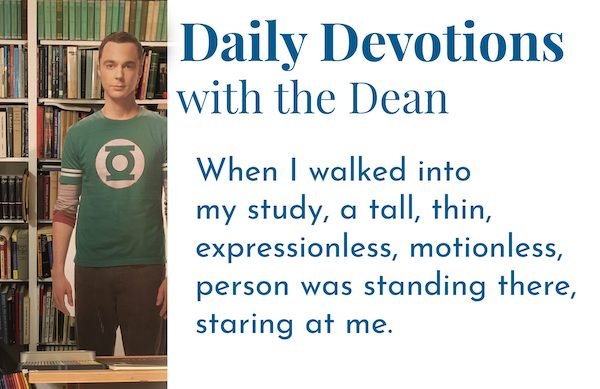
When I walked bleary-eyed into my study, I caught a “presence” in my peripheral vision. I turned to look, and … Yikes! My coffee went everywhere. Freak out! Goosebumps! A tall person – thin, expressionless, motionless – Was.Standing.There.Staring.At.Me.  

After a few seconds, I realized that the “person” was a life-sized cardboard cutout of Sheldon Cooper from the TV series The Big Bang Theory. It turns out my wife thought this would be a fun welcome home surprise. BAZINGA! I laughed and laughed.   

Ultimate Awe 

When heaven and earth converge – or perhaps better – when the thin veil between them gets drawn back, it’s the sort of thing that makes your hair stand on end. God covers Mt. Sinai with “a blazing fire, and darkness, and gloom, and a tempest, and the sound of a trumpet, and a voice whose words made the hearers beg that not another word be spoken to them” (Heb 12:18 NRSV).  

According to the writer to the Hebrews there is a “Presence” among us even more more goosebump-raising than Mt. Sinai’s “blazing fire … darkness  … gloom … tempest … trumpet … voice.” “In these last days,” he says, “God has spoken through his Son, the reflection of God’s glory and the exact imprint of God’s very being” (Heb 1:2-3 NRSV).  

Supremely Amazing 

Not only that, but “through the eternal Spirit,” this Son has “offered himself without blemish to God” … to “purify our conscience from dead works to worship the living God!” (Heb 9:14 NRSV).  He could do so because he is the true Melchizedek, a priest and king whose ministry could not be cut short by death (Heb 7). As a result, he is now able to be in two places at once: physically in heaven at the Father’s right hand where he is – as the new Melchizedek – “Liturgist (or Worship Leader) in the sanctuary and the true tent” (Heb 8:2), and Spiritually (note the capital S) among us leading us in that worship. There and here at the same time, he pulls back the veil between heaven and earth and creates a reality that is truly goosebump-raising. That is what we taste in worship.  

The fourth century Greek-speaking church created a word for Christ’s goosebump-causing presence among us as our Liturgist and Worship Leader: phrikodestates (pronounced approximately “freak-oh-des-TAH-tays”). It’s an adjective in the superlative degree, based on a verb (phrisso) that means, literally: “shudder,” “get goose bumps,” or metaphorically, “be overcome with awe.” It wouldn’t be far off in modern vernacular to render phrikodestates as “most freaking awesome!” 

Commune 

For over 1,000 years the locus of awesomeness was the presence of the Lord at the Table. Thus, the 4th century’s Cyril of Jerusalem said that at the Eucharist we “Lift up our hearts to the Lord” because we have come to a “phrikodestates hour.” And rightly has the church celebrated that awesomeness, because our great Liturgist, the new Melchizedek, has brought us to an altar from which “those who serve the tent have no right to eat” (Heb 13:9) – but from which we do!  

Faith by Hearing 

In the Reformation of the 16th century, the locus of awesomeness became the presence of the Lord in the proclamation of the Word and the rediscovery of the Bible in worship. And rightly has the Church celebrated that awesomeness, because Our Great Liturgist is among us declaring the Father’s name to us (Heb 2:12a).  

Intercessory Evangelism  

In the great “awakenings” and “revivals” of the 18th, 19th and 20th centuries, the locus of awesomeness became the presence of the Lord in the conversion of the soul – and by extension in the mission to the world. And rightly has the church celebrated that awesomeness because Our Great Liturgist is at the Father’s right hand, “ever interceding” that the lost will be found and the found will be cleansed, preserved, and gathered to the Father at the end (Heb 7:25).  

Inhabited Praise 

In the wake of the Charismatic Renewal, the locus of awesomeness has become the Lord’s “habitation in the praises” (Psalm 22:3). And rightly has the church celebrated that awesomeness because the Risen Christ – Chief Musician in the new order of Melchizedek – “sings hymns” to the Father in the assembly (Heb 2:12b).  

Holy Convergence 

Oh for the day when we all know Christ’s phrikodestates presence in all aspects of worship: at the Table, in the Word, in intercession, and in praise! 

Be blessed this day,  

Reggie Kidd+ 
Knowing that Christ is King - Daily Devotions with the Dean

Wednesday • 1/7/2026 • 

We’re taking a two-week detour from the Daily Office readings for a few days. Instead, we’ll be thinking through various facets of worship and how our Lord provides meaningful communion with him through our formal corporate worship as well as in individual worship in our daily devotions. The thoughts offered here are excerpts from articles I wrote for Worship Leader magazine a few years ago.   

Dude! Bach is Bodacious! 

If I could borrow Bill & Ted’s most excellent time-traveling phone booth, one of my first stops would be Leipzig, Germany, January 6, 1735. That’s the time and place one of the greatest worship leaders of all time worked some of his deepest magic.  

Beginning on Christmas Day that 1734-1735 Christmas season, Johann Sebastian Bach had treated his congregation in Leipzig to five different cantatas celebrating different aspects of Christ’s birth. Now, on the Day of Epiphany (celebrating Christ’s “manifestation” as Savior of the world), Bach closes out his Christmas Oratorio with a sixth cantata.  

This last cantata in the Christmas cycle is an extended meditation on the Gentile magi bringing tribute to Israel’s — and their — newly born King. That’s standard Epiphany fare, with, of course, desperately power-mad King Herod playing the churlish foil, a pretend king resisting the coming of the true King. Yeah, we’ve all heard it before. So had Bach’s congregants.  

Image: Pixabay license

How to get their attention? How to keep the sublime truth of the magnificent reign of King Jesus and the stunning overthrow of faux-sovereigns like Herod from becoming just so much background music for our distracted lives?  

I wish I could have been there to hear the closing piece of the Christmas Oratorio BVW 248, “Nun seid ihr wohl gerochen” (English translation below).* For the first thirty seconds of the final piece of the cantata, the orchestra blasts out a bright baroque trumpet fanfare. They’re in the key of D major — the brightest and most triumphant of keys. Suddenly, the choir breaks in. The feel is still triumphant, and the key is still D major, but the tune is “O Sacred Head Now Wounded” — a melody that people had associated with Jesus’s suffering for our sins long before Bach made it the centerpiece of his St. Matthew’s Passion seven years earlier. The text the choir is singing now, though, is not about Jesus’s suffering. It’s about his victory over all that is evil, and about our resuming our rightful place at God’s right hand: 

Now are You well avenged 
Upon your enemies, 
For Christ has broken asunder 
All might of adversaries. 
Death, Devil, Sin, and Hellfire 
Are vanquished entirely; 
In its true place, by God’s side 
Now stands the human race. 

Jaws must have been dropping. I know I would have been in tears. The precious truth of Jesus’s mission to die as our substitute can so easily become a coping mechanism at best, a prompt to morbid self-absorption at worst. The complementary truth of Jesus’s mission as our “Christus Victor” calls us to do more than merely put up with life’s tough stuff. Somehow King Jesus empowers us to share in his reclamation of life. Knowing that Christ is King “fortifies” us, as Calvin says, “with courage to stand unconquerable against all the assaults of spiritual enemies” (Institutes 2.15.4).  

Worship is a place where we get to enjoy the whole package deal. Worship craftsmanship calls forth from us — as it did from master worship leader J. S. Bach — the most faithfully imaginative ways of expanding our spirits to take in the fullness of God’s story. Christ is our substitute. We sob. Christ is our champion. We dance. He bears our sins. We drop to our knees. He breaks our bondage to sin. We rise with hands uplifted. He suffers for the world. We intercede. He empowers us to make the world different. We go to tell and live the story — excellently, even bodaciously.  

Be blessed this day,  

Reggie Kidd+ 

Sidebar — Resources 

We’re all called to exercise the craft of worship leadership in different settings. Regardless of your setting, you personally may find Bach a worthy docent. No one has ever embodied theology more profoundly in music. Before we get too far past Christmas and Epiphany, his Christmas Oratorio would be worth a listen.  

Let me also recommend church historian Jaroslov Pelikan’s brilliant little book, Bach Among the Theologians (Wipf & Stock, 1986, 2003). Read about — and, of course, listen to — the way Bach fleshed out the twin portraits of “Christ our Substitute” in his Saint Matthew Passion and of “Christus Victor” in his Saint John Passion.  

* The YouTube rendering here is by Canzona and the Pacific Baroque Orchestra, 12/24/2020