
In Christ We Are Loved - Daily Devotions with the Dean

Thursday • 2/23/2023 •
Week of Last Epiphany 

This morning’s Scriptures are: Psalm 37:1–18; Deuteronomy 7:6–11; Titus 1:1–16; John 1:29–34 

This morning’s Canticles are: following the OT reading, Canticle 8 (“The Song of Moses,” Exodus 15, BCP, p. 85); following the Epistle reading, Canticle 19 (“The Song of the Redeemed,” Revelation 15:3–4, BCP, p. 94) 


Welcome to Daily Office Devotions, where every Monday through Friday we consider some aspect of that day’s Scripture readings, as given in the Book of Common Prayer. I’m Reggie Kidd, and I’m grateful to be with you. This is Thursday of the last week of Epiphany, the “manifestation” of God’s glory in Jesus Christ, and the beginning of Lent.   

“What do I have to do to get her to love me?” That was the soundtrack of my early- and mid-teen years. I never seemed to be good looking enough, cool enough, or … I don’t know … whatever.  

Finally, a minister friend wondered aloud if perhaps I had made a god (maybe a goddess?) out of finding someone to love me. He prompted me to consider that maybe, just maybe, I had been looking for perfect love where it couldn’t be found. And in the meantime, maybe, just maybe, I had been trying to manufacture from within myself worthiness of love, but was coming up with something that was just the opposite. Maybe, just maybe, I was becoming a taker rather than a giver.  

That conversation was a fork in the road that led me soon thereafter to finding the love of God in Jesus Christ. Here was a love that came as pure gift, unearned, unmerited. A love I didn’t have to charm my way into, be cool enough to attract, or good enough to merit. It was so freeing, and still is.   

Deuteronomy. Yahweh expresses his desire that his people understand he has this kind of freely given, unearned, unmerited love for them. He loves them not because they are so numerous (and, of course, he could have listed any number of possible attributes—Deuteronomy 7:7). Rather, he loves them because, well, because he loves them. There’s no deeper reason. There’s no hidden agenda. There’s simply his love. He responded to their cries in slavery because he loves them. He leads them because he loves them. He will give them an inheritance because he loves them. He commands them because he loves them, and because his commands bring their character into sync with his and make possible a reciprocal, intimate relationship…of love.  

Titus. People on the island of Crete, where Paul has sent Titus, were as confused about love as I was in my teens. They looked for love in a god who was a projection of themselves. When Paul quotes the Cretan prophet, “Cretans are always liars” (Titus 1:12), he has one particular lie in mind. Around the Mediterranean basin, Cretans were famous for claiming that the Greek god Zeus had originally been a man whose birthplace and tomb were on Crete. A famous (non-Cretan) prayer to Zeus says, “Cretans are always liars. For a tomb, O Lord, Cretans build for you; but you did not die, for you are forever” (Hymn to Zeus 8–9).  

This Cretan prophet whom Paul quotes admits that his fellow Cretans have refashioned God in their own image, and in loving him are loving an image of themselves. The result is not just confusion about the true nature of God, but loveless cruelty among themselves (thus, “vicious brutes”) and appetites that are out of control (thus, “lazy gluttons”—Titus 1:12). They claim to know God, Paul says, but by their actions they deny him (Titus 1:16).  

In this first chapter, Paul begins his letter to help Titus communicate to the Cretans that religion based on a lie will not help them. They need leaders who can teach and model the truth (Titus 1:5–10). They need to stop listening to false teachers who are using even the stories of the Hebrew Scriptures to fabricate myths about great heroes (“Jewish myths”). Instead, as Paul will show in chapters 2 and 3, they need to hear about the promises God had made through Israel for a redeemer who would show God’s “grace,” and his “goodness and loving kindness” (Titus 2:11–14; 3:4–8). By knowing Christ, they will know “the hope of eternal life that God, who never lies, [had] promised before the ages began” (Titus 1:2).  

There is one very important practical takeaway from reading this first chapter of Titus during Lent. This chapter invites us all to reflect on whether we love the God who truly is, or a god of our own fashioning. This chapter is a call to reflect on and repent of an approach to God that smacks of self-adoration, of wish-fulfillment, of self-help, or of loving ourselves in an image of our own fantasy.  

John. Jesus is the perfect antidote for our attempts to make ourselves worthy of love or to pretend that God is merely us, only imagined as bigger. He is that antidote because he is “the Lamb of God who takes away the sin of the world” (John 1:29). And because it is upon him that the Spirit of God descends and remains (John 1:32); for he then bestows that same gift—the living presence of the Living God—upon those who love and follow him (John 1:33). Here, in Jesus, is what it is to be loved and to love. Here, in Jesus, is what it is to live.  

Be blessed this day,  

Reggie Kidd+  
He Shows Us Joy on the Far Side - Daily Devotions with the Dean

Wednesday • 2/22/2023 
Ash Wednesday 

This morning’s Scriptures are: Psalm 32; Jonah 3:1–4:11; Hebrews 12:1–14; Luke 18:9–14 

This morning’s Canticles are: following the OT reading, Canticle 11 (“The Third Song of Isaiah,” Isaiah 60:1–3,11a,14c,18–19, BCP, p. 87); following the Epistle reading, Canticle 16 (“The Song of Zechariah,” Luke 1:68–79, BCP, p. 92) 


Welcome to Daily Office Devotions, where every Monday through Friday we ask how God might direct our lives from that day’s Scripture readings, as given in the Book of Common Prayer. I’m Reggie Kidd, and I’m grateful to be with you this Ash Wednesday, the beginning of Lent, here, in the middle of the last week of Epiphany. We are in Year 1 of the Daily Office Lectionary. 

The juxtaposition could not be more exquisite. At the beginning of the epistle to the Hebrews, Jesus is the “Son” who is the radiance and representation of God’s very being (Hebrews 1:1,3). Here, towards the end of the epistle, Jesus is the exemplar of a kind of faith that will despise the shame of the cross, and yet endure it for joy on the far side. As though he were a disobedient son (which he is not), Jesus undergoes a death that at one and the same time purifies others’ sin, and models for them how to endure a training in obedience that comes only through suffering. The writer to the Hebrews presents us with a staggering complex of truth. His Jesus is truly God and truly man, the only One who can meet us right where we are and take us where we need to go.  

During Lent, we focus on the way that, in his sufferings, Jesus meets us where we are.  

Throughout this epistle, the writer to the Hebrews treats Jesus’s suffering as necessary to the cleansing of the conscience of guilty sinners (Hebrews 10:22). He became like us in all respects, except sin (Hebrews 2:11,14,17; 4:15), for one overriding purpose. He did so in order that his sacrificial death could be a once-and-for-all perfect covering of the transgressions of people who know they are otherwise worthy of eternal separation from God. “But when Christ had offered for all time a single sacrifice for sins, ‘he sat down at the right hand of God,’ … For by a single offering he has perfected for all time those who are sanctified. … he also adds, ‘I will remember their sins and their lawless deeds no more.’ Where there is forgiveness of these, there is no longer any offering for sin” (Hebrews 10:12,14,17,18).  

Like him, we learn the obedience of “sons” (for whether we are male or female, we are all adopted as favored “sons”). Unlike us, however, his learning of obedience was from one level of obedience to another: “Although he was a Son, he learned obedience through what he suffered; and having been made perfect, he became the source of eternal salvation for all who obey him…” (Hebrews 5:8–9). Unlike him, we have to learn (sometimes through hard discipline) obedience on the far side of disobedience.  

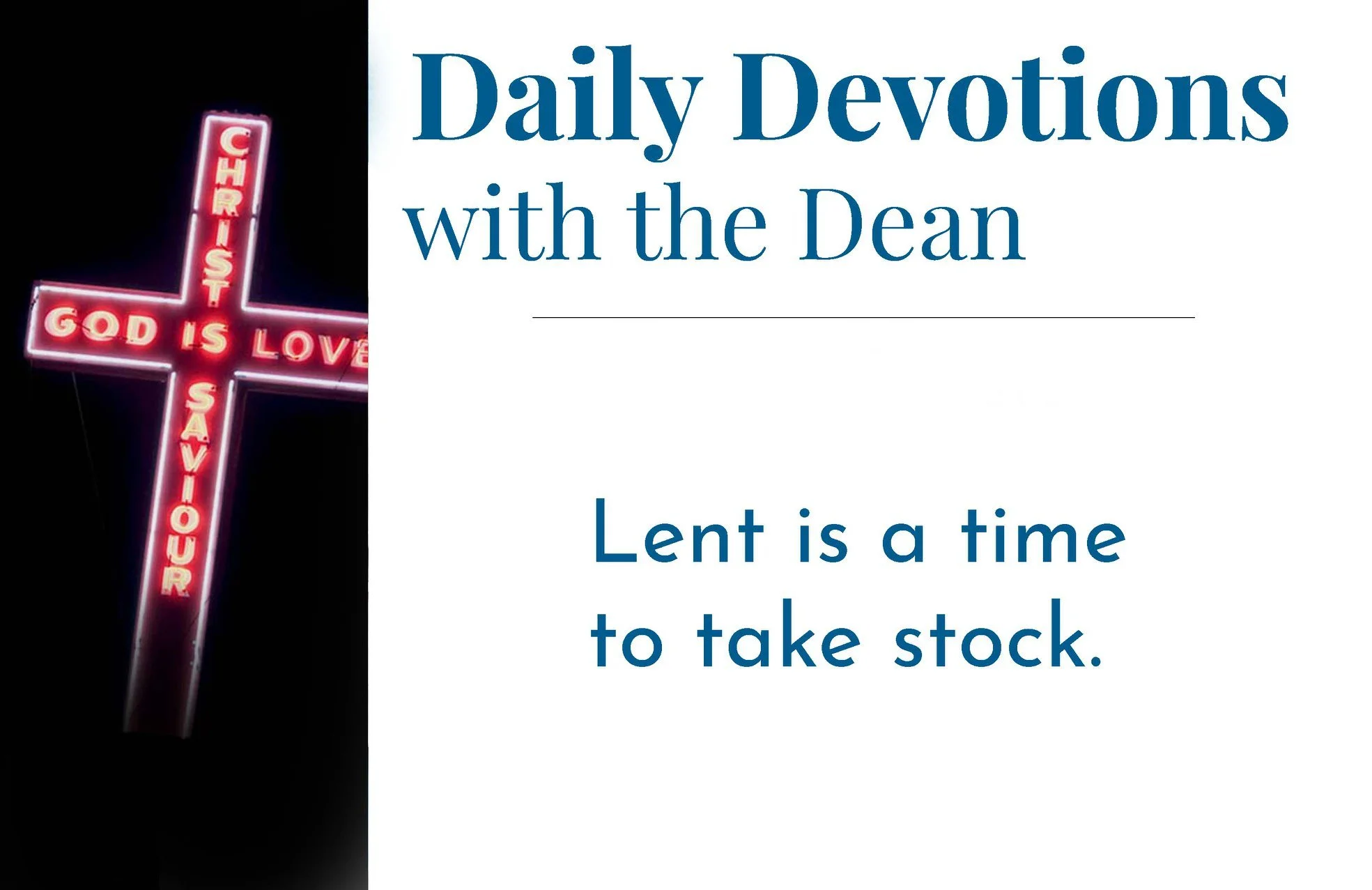
Lent is a time to take stock. Thus, Psalm 32’s “Blessed are they whose transgressions are forgiven, and whose sin is put away! … Then I acknowledged my sin to you, and did not conceal my guilt” (Psalm 32:1,5). And also, the eloquent and powerful “Litany of Penitence” in the Ash Wednesday service: “We confess to you, Lord, all our past unfaithfulness: the pride, hypocrisy, and impatience of our lives, We confess to you, Lord….” In its totality, Ash Wednesday’s “Litany of Penitence” gives us specific words to name our pride, our self-indulgence, our anger, our envy, our intemperance, our dishonesty, our sloth, our indifference, our lovelessness, and our wastefulness (BCP, pp. 267–269).  

Prayer along these lines is perfect for those of us who recognize ourselves to be in need of the disciplining work of “the Father of spirits.”  It is perfect for those of us who long for the life that he is more than willing to give (Hebrews 12:9). Praying this way is to adopt that posture which befits those who are looking for help to “lift … drooping hands and strengthen … weak knees,” so that we run the race towards that “holiness without which no one will see the Lord” (Hebrews 12:14). When we pray this way, we find Jesus right alongside us, holding us, strengthening us, and pointing us to the same joy he has come to know on the far side of his own sufferings.  

Be blessed this Ash Wednesday, 

Reggie Kidd+  

A Greater Salvation - Daily Devotions with the Dean

Tuesday • 2/21/2023 •
Week of Last Epiphany 

This morning’s Scriptures are: Psalm 26; Psalm 28; Deuteronomy 6:16–25; Hebrews 2:1–10; John 1:19–28 

This morning’s Canticles are: following the OT reading, Canticle 13 (“A Song of Praise,” BCP, p. 90); following the Epistle reading, Canticle 18 (“A Song to the Lamb,” Revelation 4:11; 5:9–10, 13, BCP, p. 93) 


Welcome to Daily Office Devotions, where every Monday through Friday we draw insights from that day’s Scripture readings, as given in the Book of Common Prayer. I’m Reggie Kidd, and I’m grateful to be with you. This is Tuesday of the last week of Epiphany, and we are in Year 1 of the Daily Office Lectionary.   

Deuteronomy: a great salvation. How appropriate, on this last day after Epiphany, to be reminded of that great epiphany of God that took place at the exodus. Moses reminds the children of Israel of the “great and awesome signs and wonders” by which Yahweh had delivered them: the plagues, the parting of the waters, his protection of them, and his provision for them during the wilderness journey. Moses, accordingly, urges obedience to the “commandments of the Lord your God, and his decrees, and his statutes that he has commanded” (Deuteronomy 6:17). In the land promised to their forebears, the well-being of Yahweh’s people depends on their faithfulness to his covenant with them. “If we diligently observe this entire commandment before the Lord our God, as he has commanded us, we will be in the right” (Deuteronomy 6:25).  

John: but that salvation was doomed to failure. The people, as we know, did not “observe this entire commandment,” and did not show themselves to be “in the right.” Israel’s life fell into an extended dysfunctional pattern of rebellion, punishment, repentance, rescue, restoration. Throughout the period of the judges, the period of the united monarchy, the period of the divided monarchy, the period of the Assyrian exile, the period of the Babylonian captivity, the period of the Second Temple, it was “Wash, rinse, repeat.”  The pattern extended all the way to the time of John the Baptist. Here was a new voice in the wilderness, calling yet again for an exodus: “I am the voice of one crying out in the wilderness, ‘Make straight the way of the Lord’” (John 1:23).  

Image: "Fire flower" by @Doug88888 is licensed under CC BY-NC-SA 2.0  

John the Baptist’s mission was to point to a greater Epiphany with a greater salvation, a better exodus: “I baptize with water. Among you stands one whom you do not know, the one who is coming after me; I am not worthy to untie the thong of his sandal” (John 1:26–27).  

Hebrews: a greater salvation. As great as was the mediation through angels under Moses, the mediation of the Son is greater. As great as was the parting of the waters in the exodus, greater is Christ’s tasting death for everyone at Calvary on Good Friday. As great as was the power demonstrated over Egyptian false gods in the plagues, so much greater is Jesus’s resurrection at Easter. Breaking the bonds of death, Jesus has destroyed the power of the one who, since the Garden, has robbed us of the proper dominion over “all things” for which we were created (Hebrews 2:14–15). As Twila Paris used to sing, “All that has been taken, it shall be restored. This eternal anthem, for the glory of the Lord.” The beautiful thing is that the glory of the Lord is manifest in the “bringing [of] many children to glory” by the making of “the pioneer of their salvation perfect through sufferings” (Hebrews 2:10).  

It follows, then, that as weighty as was the obligation under the covenant of Moses to “trust and obey” (to use the language of an old hymn), so much weightier is the responsibility, says the writer to the Hebrews, to “pay greater attention to what we have heard, so that we do not drift away” from “so great a salvation” (Hebrews 2:1,3).  

I pray that during this upcoming season of Lent, we step more deeply into what Paul calls “the fellowship of [Christ’s] sufferings” so that we may taste more wonderfully “the power of his resurrection” (Philippians 3:10).  

Be blessed this day,  

Reggie Kidd+ 

Jesus Carries Our Burdens - Daily Devotions with the Dean

Monday • 2/20/2023 •
Week of Last Epiphany 

This morning’s Scriptures are: Psalm 25; Deuteronomy 6:10–15; Hebrews 1:1–14; John:1–18 

This morning’s Canticles are: following the OT reading, Canticle 9 (“The First Song of Isaiah,” Isaiah 12:2–6, BCP, p. 86); following the Epistle reading, Canticle 19 (“The Song of the Redeemed,” Revelation 15:3–4, BCP, p. 94) 

Welcome to Daily Office Devotions, where every Monday through Friday we explore that day’s Scripture readings, as given in the Book of Common Prayer. I’m Reggie Kidd. Thanks for joining me. This is Monday of the last week of Epiphany, and we are in Year 1 of the Daily Office Lectionary. 

I don’t know anybody who has not experienced the past few years as tumultuous and challenging. Some of us have buried loved ones. Some of us have lost friends over politics. Some of us have lost jobs or fortunes. All of us have had the opportunity to find new depths in today’s psalm: 

To you, O Lord, I lift up my soul; 
my God, I put my trust in you; * 
let me not be humiliated, 
nor let my enemies triumph over me (Psalm 25:1).  

In two days, we come to Ash Wednesday and the beginning of Lent, forty days of preparation for the Passion’s solemnity and Easter’s joy. Lent prepares us to experience anew Christ’s humiliation on our behalf and his triumph over our enemies of sin and death. Lent invites us to “self-examination and repentance; … prayer, fasting, and self-denial; and … reading and meditating of God’s Word” (BCP, p. 265).  

This year’s readings in the Daily Office provide some of the richest material in all of Scripture for the Lenten journey.  

Deuteronomy. This week and next week, the early chapters of Deuteronomy take us back to Moses’s final instructions to Israel as they prepare to enter the Promised Land. God’s servant reminds the children of Israel just how much Yahweh’s love has been on display for them in his powerful deliverance of them from slavery and in his provision for them in their wilderness wanderings. Moses reminds them of their covenantal obligation to love Yahweh in return, to heed his instructions, and to form their lives to mirror his holiness and justice.  

In today’s passage, in particular, Moses warns against forgetfulness and presumption. When they enter the Promised Land, they will find themselves in possession of cities they had not built, houses they had not filled, cisterns they had not dug, and vineyards and olive trees they had not planted (Deuteronomy 6:10–12). It’s possible—in fact, it’s likely—that they will wrongly credit themselves or alien gods for their good fortune (Deuteronomy 6:13–14). Moses says, in effect, “Don’t do that! Don’t forget that it’s all Yahweh’s gift. Don’t presume to take credit for yourselves, or to attribute it to gods that are no gods!”  

Image: "Fire flower" by @Doug88888 is licensed under CC BY-NC-SA 2.0  

Hebrews. Moses’s reminder was one of the “many and various ways” that, according to the writer to the Hebrews, God had spoken to his people in times past (Hebrews 1:1). The epistle to the Hebrews is an extraordinary docent for our Lenten journey because it reminds us that “in these last days [God] has spoken to us” even more directly. He has spoken to us by his Son, “the reflection of God’s glory and the exact imprint of God’s very being”—that is to say, by one who both partakes of God’s own being, and also represents him perfectly (Hebrews 1:2–3).  

Looking ahead in this extraordinary epistle, we will be reminded that because he came in our very likeness, Jesus is able to shoulder our infirmities and bear our weaknesses (Hebrews 2:17). But in this first chapter of Hebrews, the writer reminds us that Jesus is truly God, and therefore worthy of our worship. If angels must worship him (Hebrews 1:6), how much more must we! If he founded the earth and sustains its existence, and if he will outlast its present form (Hebrews 1:3,10–11), how much more is it incumbent upon us to render him the full service of our lives and care for his creation? 

John has his own way of making the same point that Hebrews makes: as God’s living Word, Jesus is both very God and in relationship to God: “In the beginning was the Word, and the Word was with God and the Word was God” (John 1:1). Same as God, and in communion with God. A holy mystery, resolved in the love that is shared between the persons of the Father and of the Son, as they are bound together by the person of the Spirit who is love.  

I pray that during this Lent, we receive the grace to bring the tumult and the challenges of our lives to Jesus Christ. He entered the valley of the shadow of death for us. He did so back then, and he continues to do so even now. Together, Hebrews and John will show that Jesus is completely one with us in his humanity—and he is completely here for us in the power of his divinity.  

Be blessed this day, 

Reggie Kidd+ 

Radiant Presence - Daily Devotions with the Dean

Friday • 2/17/2023 •

Welcome to Daily Office Devotions. I’m Reggie Kidd. Thanks for joining me. 

Although this is the sixth week of Epiphany, we’re taking a detour from the Daily Office readings this week. Instead, we’re thinking through various facets of worship and how our Lord provides meaningful communion with him through our formal corporate worship as well as in individual worship in our daily devotions. The thoughts offered here are excerpts (sometimes lightly edited) from articles I wrote for Worship Leader magazine a few years ago.  

They come from a season in my life when I was on a journey from more generic free-form worship to worship shaped by the classic liturgy. I hope these observations help you in your own quest to love God and your neighbor. We’ll resume our reflections on the Daily Office next week. 


Rediscovering the Trinity and Spirit-led Worship, Part Three of Three 

The Holy Spirit and Worship 

There have sometimes been Sundays when a conversation at my house goes like this: 

“What’s the matter?” 

“I just want to quit.” 

“Why?” 

“Why? Easy. You were there. Didn’t you sense it?” 

“Sense what?” 

“The lack of worship. We were putting out all we had from up front, and nothing was coming back. Worship just wasn’t happening.” 

“How do you know? Because maybe people weren’t singing the way you thought they should be? You know the Spirit’s presence is about more than that. You can’t always see what God is doing. Sitting in my row I saw something you didn’t see: a woman who stopped singing because she had begun crying. I think the Spirit may be doing things His way, not yours.”  

Hmmm.  

What characterizes Spirit-led worship? Are there marks of the breath of the Spirit?  

Image: H. Zell, CC BY-SA 3.0, via Wikimedia Commons. Stained glass window Holy Spirit in the nothern wall of the Iglesia de San Bartolomé de Tirajana, San Bartolomé de Tirajana, Gran Canaria, Canary Islands, Spain 

The Spirit Creates Life 

Jesus came back from the dead to breathe God’s very life into us. I’ve arrived at the place where I’m simply thankful to have been given eternal life in Christ, and to be allowed to share that life with others whom the Spirit has graciously made alive as well. I challenge myself to be more amazed at the presence of faith than depressed over possible signs of lack of faith. In other words, what I’m looking for as a prime marker of the Spirit’s presence in worship is this: by God’s grace, redeemed sinners show up seeking more grace.  

I believe that there is a radiantly alive presence in our midst when we worship. That presence is Jesus who has become “life-giving Spirit.” While bodily he is in heaven constantly advocating for us before the Father (Heb 7:25), he is simultaneously among us by the Spirit, breathing God’s presence into us, proclaiming the Father’s name, and orchestrating our praise (Heb 2:12).  

He’s there whether I feel him or not. He’s in charge and is working his good pleasure, whether I hit all my marks or not. He’s constantly compensating for all my weaknesses and mistakes, and perhaps more importantly, for all my strengths and the things I get “right.”  

I have to remind myself the “condensation on the sunglasses” is not necessarily about any of the things I do or don’t do. Chesterton suggests that the only way to explain the fact that the church hasn’t died over time as one cultural, political, or philosophical support after another has fallen away, is that there is a Presence in the church that won’t go away. If Arianism, Gnosticism, Pelagianism, imperial patronage, humanism, scientism, modernism, and postmodernism can’t make the Holy Spirit go away, I probably can’t either.  

The Spirit Makes One out of Many  

The worship of God now takes place not in a single, localized house of brick and mortar where the songs of Zion are sung in but one tongue. God’s house of worship — where “Spirit and Truth” reside — is worldwide! It consists of a near infinity of “living stones” who happen to sing in many tongues. Beginning with the likes of respectable Nicodemus and the fallen woman at the well, the Holy Spirit has been making a worldwide community of worship that is greater than the sum of its parts. Amazingly, under the baton of the Spirit of Christ, those many tongues make “one voice” (Rom 15:6).   

“Make every effort to keep the unity of the Spirit through the bond of peace,” says Paul (Eph 4:3). The Spirit’s unity is most evident, I’ve come to believe, precisely where there is diversity rather than uniformity. Unity is not difficult to sustain when everyone shares the same preferences/musical tastes, an “age and stage” affinity, compatible theological nuance, congruent Myers-Briggs profiles. When there’s unity despite differing penchants, a unity that is born out of heroic forbearance and costly deference, it seems more likely that it is the Spirit who is at work.  

The Spirit Exalts Others  

Fourth century theologian Basil the Great’s defense of the deity of the Holy Spirit is skillful because it is indirect. Basil observes that Scripture has many direct statements about the divinity of God the Father, fewer about the divinity of God the Son, and precious few about the divinity of God the Holy Spirit. You can’t help but conclude, he insists, that the Holy Spirit is God in the same way that the Father and the Son are — otherwise, to baptize in the name of Father, Son, and Holy Spirit would be blasphemous. Nonetheless, it’s almost as though there is in Scripture a modesty about the Spirit’s identity.  

A fundamental characteristic of the Holy Spirit is that he does not call attention to himself: “He will glorify me, for he will take what is mine and declare it to you,” said Jesus (John 14:16).  

Some people walk into a room and they make everybody else feel larger. Some walk in and make everybody else feel smaller. The first breathe life into the room because they make everybody else the center of their attention. The latter suck the life out of the room because they make themselves the center of attention. Here is a principal way of knowing when it’s the Spirit at work, and when it’s the flesh.  

That was Paul’s problem with the church at Corinth. He wanted those brothers and sisters to understand that worship is always about the exaltation of Jesus and the edification of others, not the exaltation of self and the display of personal giftedness (1 Corinthians 14). That’s why Paul encouraged them — and he would, I’m certain, encourage us likewise — to promote in worship the real way of the Spirit, the way of love (see 1 Corinthians 13).  

Breathe in. Breathe out.  

Of course, there’s so much more to say about the Spirit and worship — about the mission, about the gifts, about uniting old and new. But for now, this will have to suffice: not unlike that lifeless puppy I saw on the side of the road, we were dead to intimacy with our Maker, and dead to the way our relationships with one another were to mirror the eternal communion within the Trinity — until the Son came, died, rose, and breathed the breath of God into us. 

As a worship leader there’s probably nothing greater that I can contribute to worship than making sure that I keep breathing God’s breath myself. In the Word daily — breathe in. In prayer daily — breathe out. Confess “my stuff” — breathe in. Lift his name in praise and adoration — breathe out. Come to the Table — breathe in. Wish my neighbor Christ’s peace — breathe out. Ponder the wonder of his grace to me — breathe in. Find the lost, tell the story, feed the hungry — breathe out.   

Be blessed this day, 

Reggie Kidd+ 

The Spirit - Daily Devotions with the Dean

Thursday • 2/16/2023 •

Welcome to Daily Office Devotions. I’m Reggie Kidd. Thanks for joining me. 

Although this is the sixth week of Epiphany, we’re taking a detour from the Daily Office readings this week. Instead, we’re thinking through various facets of worship and how our Lord provides meaningful communion with him through our formal corporate worship as well as in individual worship in our daily devotions. The thoughts offered here are excerpts (sometimes lightly edited) from articles I wrote for Worship Leader magazine a few years ago.  

They come from a season in my life when I was on a journey from more generic free-form worship to worship shaped by the classic liturgy. I hope these observations help you in your own quest to love God and your neighbor. We’ll resume our reflections on the Daily Office next week. 


Rediscovering the Trinity and Spirit-led Worship,” Part Two of Three 

The Spirit in John’s Gospel 

If we reflect on some of Jesus’s sayings and conversations in John’s gospel we get a glimpse into the vision that animated Jesus that day he cleansed the Temple.  

The Spirit must remake the innermost parts of us, he tells Israel’s preeminent (but clueless) teacher, Nicodemus (John 3). The Spirit will bring together in worship of the Father both a respectable, over-educated Jew like Nicodemus and a promiscuous, disreputable non-Jew like the woman at the well in Samaritan Sychar (John 3 and 4). The Spirit will create such worship through the One who is the Truth (4:24), but who also is the Way and the Life (14:6).  

Image: Guercino (1591-1666), Public domain, via Wikimedia Commons 

Besides the Passover, the one named festival in John’s gospel is the harvest-time Feast of Tabernacles, a celebration of God’s provision in the wilderness during the exodus. On the last day of the Feast, celebrants pour out water to remember the way God had taken care of his people’s thirst in the wilderness. While that is taking place on one such occasion, Jesus steps forward and declares that anybody who is really thirsty needs to come to him. Conjuring Ezekiel 47’s image of rivers flowing out from the threshold of the Temple, Jesus says that he himself will provide the Spirit for everyone who comes to drink from him (John 7:37-39).  

In his Final Discourse, Jesus outlines the transfer of life from himself, to the Spirit, to his followers, and then to the world (John 13-17).  

Jesus explains that his disciples will experience an absence that, incongruously, makes his presence nearer. They will do greater works (14:12). All the time that Jesus has been “alongside them” (14:25) the Holy Spirit has also been “alongside them” (14:17). The Spirit who came upon the Son “and remained on him” (1:32) at his baptism has been accomplishing the Father’s works through Jesus. Because Jesus goes away, that divine presence — the divine breath — will not be just alongside, but “inside them” (14:17). After Jesus’s bodily departure, the Holy Spirit coming inside them will be the means by which Jesus himself comes back “to them” (14:18) — with a presence that is better than his pre-death and pre-resurrection presence. A closeness emerges that some have called “coinherence,” a mutual indwelling: “I in my Father and you in me and I in you” (14:20).  

Spirit Representing Trinity 

What is so utterly characteristic of the Holy Spirit, “the Spirit of Truth,” is that he does not come to represent himself, but the Son and the Father who have sent him (15:26; 16:12-15). In this, the Spirit reflects the Son, who has come not to serve his own ends, but his Father’s (see John 5:19,30; 14:28). As the Son has glorified the Father, the Spirit will glorify the Son (17:4; 16:14a). He will do so by explaining the things of the Son to us and by convicting the world of sin and righteousness and judgment (16:14b, 8).  

What the Spirit does is create among us a communion of love that externalizes in time and space the eternal communion of love that has existed from before time and space. What the Spirit creates among us is a life of mutual deference — a life Jesus models at the beginning of the Final Discourse in the foot washing (John 13) and prays for at the Discourse’s close: “… that all of them may be one, Father, just as you are in me and I am in you. May they also be in us so that the world may believe that you have sent me” (17:21).  

With literary artistry, John describes Jesus’ arrest, suffering, death, and resurrection, but then announces Jesus’ ascension without ever describing it (20:17). Instead, John provides a number of vignettes illustrating the way Jesus prepared his followers for life without his physical presence. The vignettes are lessons in how to worship now under this new regime of “in Spirit and Truth” (4:24).  

The promise of a new order of worship that Jesus had announced at the Temple cleansing receives fulfillment when Jesus first appears in his risen body — the very body that he said would be the beginning of the building of a new house for worship. Pointedly, Jesus tells his gathered disciples: “As the Father has sent me, so I am sending you” (20:21). Dramatically, he breathes on them, and says, “Receive the Holy Spirit.” By his breath, mere disciples become apostles, equipped to build God’s house and to lead worship “in Spirit and Truth.” 

The Book of Acts has its own way of telling the same story, first, with the transfer of Jesus’ ministry here on earth (the Gospel According to Luke) to his ministry at the right hand of God by means of the Holy Spirit (Acts 2:29-36), and second, with Pentecost’s amazing manifestations of the new life rippling from Jerusalem to the ends of the earth.  

The apostle Paul, too, tells the same story through his developed theology of how the “Last Adam” became “Life-Giving Spirit” (1 Cor 15:45) in order to make dead people come to life (Eph 2:1-10) and to unite once estranged people into a dwelling for God (Eph 2:11-22).  

But John’s gospel has taken us to the heart of what the Spirit of God effects in our worship.  

Tomorrow, the third installment of thoughts on the ministry of the Holy Spirit in worship… 

Be blessed this day, 

Reggie Kidd+ 

Spirit-Led Worship - Daily Devotions with the Dean

Wednesday • 2/15/2023 •

Welcome to Daily Office Devotions. I’m Reggie Kidd. Thanks for joining me. 

Although this is the sixth week of Epiphany, we’re taking a detour from the Daily Office readings this week. Instead, we’re thinking through various facets of worship and how our Lord provides meaningful communion with him through our formal corporate worship as well as in individual worship in our daily devotions. The thoughts offered here are excerpts (sometimes lightly edited) from articles I wrote for Worship Leader magazine a few years ago.  

They come from a season in my life when I was on a journey from more generic free-form worship to worship shaped by the classic liturgy. I hope these observations help you in your own quest to love God and your neighbor. We’ll resume our reflections on the Daily Office next week. 


Rediscovering the Trinity and Spirit-led Worship, Part One of Three 

One minute the puppy was playing on the side of the street. The next, he darted into traffic. That was it. I saw him spin off a passing car’s wheel and collapse in a lump at the side of the road. A police officer happened by and stopped to see if he could help. I expected him to feel for a heartbeat. Instead, he took off his sunglasses and held them to the puppy’s nose.  

Image: Millenium Singh, CC BY-SA 4.0, via Wikimedia Commons 

“No breath,” he said to me, “he’s gone. Poor guy.”  

Worship Leaders and the Spirit 

Worship leaders are always on the lookout for condensation on the sunglasses. We develop an acute sense for when we think the Lord is in the house and when he’s not. When he’s there, there’s life — maybe loud life, maybe quiet life, maybe joyful life, maybe sorrowful life. When it feels dead, it seems like he’s not there.  

The thing worship leaders fear the most? The absence of God’s breath. It’s the thing we work hardest not to allow: if we’re liturgical, by making sure we’ve got every prescribed element in the right place; if we’re Reformed, by making sure we’re not doing anything Scripture doesn’t require; if we’re “praise and worship,” by following the worship funnel’s progression from loud to soft; if we’re “emergent,” by giving everybody unlimited, unprogrammed, authentic options. All along, though, if we have any sense at all, we’re aware that Jesus says, “The wind (the Spirit) blows where it will” (John 3:8).  

Worship Leaders and the Trinity 

Because the theology of the trinity seems to be more implicit than explicit, we Christians have struggled mightily to explain the triune God we know. Writer G. K. Chesterton observes that at the bottom of everything is a “holy family.” Instead of Judaism’s or Islam’s single god-entity, we find an eternal communion of love. Instead of polytheism’s riot of competitive god-egos, we find a harmony of mutual deference. 

Orthodox theologian Alexander Schmemann describes the godhead this way: there is an “eternal Lover” (the Father), an “eternally Beloved” (the Son), and “eternal Love itself” (the Holy Spirit). As Love itself, the Holy Spirit’s role is to make that eternal communion between Lover and Beloved present to us. It’s no accident that the biggest clue Scripture provides for the identity of the Holy Spirit is the metaphor of “breath.” Hebrew uses the same word for “breath” and for “spirit.” Greek does the same. The Holy Spirit’s job is to breathe into us that great Loving that exists between Lover and Beloved, drawing us into something early church fathers described as a dance.  

Leading worship is the privilege it is because it amounts to cooperating with the Holy Spirit in inviting people back into the dance.  

The One Worship Leader and the Spirit 

One of the most gripping moments in all of Scripture takes place when Jesus declares a new pattern of worship from the Temple in Jerusalem in the second chapter of John’s gospel. This is the day the one genuine Worship Leader comes to church and applies the sunglasses test. Here stands the One who bears the title “Liturgist of the Holy Things and of the True Tent (Gk, skēnē)” (Heb 8:1). Here is God’s presence “tenting” among us — that’s literally what John 1:14 says: “the Word became flesh and dwelt (Gk., skēnoun) among us.” The eternally Beloved has come to the eternal Lover’s house to see if there’s a hint of Love’s breath in the place, and he does not find what he’s looking for.  

Jesus stands there in the Jerusalem Temple. It is, significantly, the Passover (John 2:13). Where now is the Presence that had rescued the children of Israel from Egypt and then walked beside them in the figure of cloud and fire, escorting them to the land of promise (Exodus 13:12)? Where is the Presence that had taken up residence in the original Tabernacle-tent, the “mobile field unit” God had commissioned for himself while his people were on the move (Exodus 40:34-38)? Where is the Shekinah Glory that at its dedication so filled this building’s predecessor — the Temple Solomon had built to give God a more permanent residence — that the priests had had to run for cover?  

“… then the house, the house of the Lord, was filled with a cloud, so that the priests could not stand to minister because of the cloud, for the glory of the Lord filled the house of God” (2 Chron 5:13b-14).  

For the Temple leadership of Jesus’ day, it’s time to run for cover again. And, ironically, for the same reason. The Presence is back. The house that was still standing — the jewel of Herod the Great’s extensive building program throughout Israel — is about to lose its franchise. It is time for a new house for a new form of the presence of God.  

Holy Emotion 

It’s hard to know what synapses were firing for Jesus the day he cleansed the temple — you feel almost blasphemous trying to imagine it. But the Gospel According to John does unfold a certain logic for us.  

Out of a bubbling, broiling passion for his Father’s house — an emotion the Psalmist originally and now John chastely calls “zeal” — Jesus weaves himself a whip (John 2:15-17). Shocking, given the traditional portrait of the cow-eyed, “gentle Galilean.” With the whip he brings a temporary halt to the financial exchanges that enable the daily sacrifices — and in this season, the Passover sacrifices — to proceed. Implicitly, he declares that, beginning with the whips that would be wielded against his own back, a singular Passover Sacrifice is in the making that will end all other sacrifices.  

But more, he announces it is time for a new building project: “Tear down this building (not the physical Temple, but Jesus’ own body) and I will raise it up again” (John 2:19). Different materials would comprise this building: “He spoke of the temple of his body” (John 2:21). Peter, who was no doubt there that day, would later explain the architecture in terms of the risen Jesus becoming “the head of the corner” (or “keystone,” as the Jerusalem Bible so nicely puts it) and of regenerate believers becoming “living stones” in a Spiritual house (1 Pet 2:4-7). Condensation will return to the sunglasses — the new, living house will be filled with the very breath of God, his Holy Spirit.  

More about the Holy Spirit, and about Jesus’s house-building project tomorrow…  

Be blessed this day, 

Reggie Kidd+ 

One Offering - Daily Devotions with the Dean

Tuesday • 2/14/2023 • epiphany 6 year 1 

Welcome to Daily Office Devotions. I’m Reggie Kidd. Thanks for joining me. 

Although this is the sixth week of Epiphany, we’re taking a detour from the Daily Office readings this week. Instead, we’ll be thinking through various facets of worship and how our Lord provides meaningful communion with him through our formal corporate worship as well as in individual worship in our daily devotions. The thoughts offered here are excerpts (sometimes lightly edited) from articles I wrote for Worship Leader magazine a few years ago.  

They come from a season in my life when I was on a journey from more generic free-form worship to worship shaped by the classic liturgy. I hope these observations help you in your own quest to love God and your neighbor. We’ll resume our reflections on the Daily Office next week. 


“One Offering” 

The offertory has always seemed an odd thing to me. When I was a kid, the offering followed the sermon, and for all intents and purposes concluded the service. I thought this was where you paid the pastor for the sermon. I remember thinking, “That’s a lot of pressure for a preacher.” 

In recent months, the pressure preachers seem to feel is to how to convince people to give generously during hard times.    

The question of generosity became an especially pressing one for me in 2008, when the world’s economy tanked. Like other families, mine, too, was affected.   

Nevertheless, it proved to be a ruinous blessing. It was a time to rediscover the generosity of God, and to give thanks. Our refrigerator was, after all, still full. And it was  a time to remember that ours is the God of the “refrigerator-less.”  

The liturgical church I’ve become a part of takes up an offering as part of its weekly communion, following the Book of Common Prayer

Representatives of the congregation bring the people’s offerings of bread and wine, and money or other gifts, to the deacon or celebrant. 

The pattern is ancient, and embodies profound truth. The offering begins the ministry of the Table, which follows the Ministry of the Word. Ushers pass plates, and then, on behalf of the whole congregation, bring forward a dual offering: the elements for the Table and the monetary donations for the church. (In other times and places, the donations might include livestock or produce or handiwork.)  

A prayer of “Great Thanksgiving” follows, celebrating God’s attributes along with his creative and redemptive acts. Then the prayer asks the Lord to bless the gifts — explicitly the bread and wine, implicitly the monetary donations.    

For whatever reasons, in many churches (like the church of my upbringing) the offertory is no longer linked to communion, and I wonder if that’s created a disconnect between our offerings and the whole story of redemption.  

The Table reminds me of God’s extravagant generosity. He was generous not just in word, but in deed. Jesus came, and he made the one Offering that counts. “Christ loved us and gave himself for us, a fragrant offering and sacrifice to God” (Eph. 5:2). The only true worship is Jesus, Offering and Offerer. Staggering gift and overwhelming love, on lavish display especially at the Table.   

When the “stuff” of his redemption (the communion elements) is wedded to the “stuff” of my life (my gifts), my story gets folded into the Bible’s story line. As the bread and wine embody Jesus’s totally giving himself for me, so my gifts bespeak my surrender to his total claim on me. “You are not your own,” Paul reminds me, “you were bought with a price” (1 Cor. 9:19b-20a). Not only me, but all my stuff, everything that’s in my wallet — it’s all his.   

More, our offerings imitate Jesus’s Offering, and are made holy by that One Offering. The bread and wine establish no merit — the merit is all of his death and life. The money is not a payment for the sermon. It’s a means of saying, “Thank you for rescue. Thank you for freedom from the Egypt of sin. Now, who around me lives in a kind of Egypt, and how may I — on your behalf — participate in their rescue?”  

Moses had required: “… you shall love the alien, for you were aliens in the land of Egypt” (Deut. 10:19) — in effect, have an eye to the “refrigerator-less” among you. Now Jesus commands: “A new commandment I give you: that you love one another as I have loved you” (John 13:34). The generosity of the Exodus with its “mighty hand and an outstretched arm” yields to the generosity of the Incarnation with its arms stretched out on a cruel cross. I give, in part, to participate in God’s care for those still in need of redemption.  

Some truths are better perceived than conceived, to paraphrase Marshall McLuhan. One such truth is the dynamic of divine generosity, displayed most extravagantly at his Table. God’s generosity comes to us in his Son, then calls forth from us an answering generosity, expressed first in the offering of ourselves back to him in thanks, and second in the offering of ourselves and our gifts to one another and to a needy world. 

Be blessed this day, 

Reggie Kidd+ 
One Voice - Daily Devotions with the Dean

Monday • 2/13/2023 •

Welcome to Daily Office Devotions. I’m Reggie Kidd. Thanks for joining me. 

Although this is the sixth week of Epiphany, we’re taking a detour from the Daily Office readings this week. Instead, we’ll be thinking through various facets of worship and how our Lord provides meaningful communion with him through our formal corporate worship as well as in individual worship in our daily devotions. The thoughts offered here are excerpts (sometimes lightly edited) from articles I wrote for Worship Leader magazine a few years ago.  

They come from a season in my life when I was on a journey from more generic free-form worship to worship shaped by the classic liturgy. I hope these observations help you in your own quest to love God and your neighbor. We’ll resume our reflections on the Daily Office next week. 


“One Voice” 

Sometimes it takes just one voice. 

“You know, some of us in the congregation are visual learners. We’d be helped if you put some art behind the lyrics you project.”  

That one voice put me on a quest to craft worship that “shows and tells.” 

“I love the contemporary songs we do in worship. But when you include the hymns I grew up with, something special happens for me. The faith I’m figuring out for myself and the faith my folks tried to instill in me stop competing with each other.”  

That one voice made me more conscious about trans-generational worship. 

There’s another kind of voice, too. I teach. At the end of every course, students have a chance to tell me (and my administration) what they think about my teaching. Nearly every semester, one student hates a course I’ve taught. That one voice makes me reflect on how to do better.  

My friend Joel Hunter is one of the most perceptive people I know. One of the wisest things he ever said was, “The way to handle criticism is to listen hard for the One Voice that’s always embedded there. Sometimes you have to completely ignore specific criticisms. Sometimes they are right on target. Always, though, Jesus has something for you.”  

Always there is One Voice.   

While introducing the concept of “mere Christianity” to his readers, C. S. Lewis acknowledged that the specific forms Christianity takes are myriad, confusing, and seemingly contradictory. Nonetheless, he maintained, at the center of the church’s life “each communion is really closest to every other in spirit, if not in doctrine.” 

And this suggests that at the centre of each there is something, or a Someone, who against all divergences of belief, all differences of temperament, all memories of mutual persecution, speaks with the same voice. 

I think I know what he means. I’ve been hearing that “same voice” recently.  

On Sunday mornings I worship at an Episcopal/Anglican cathedral, with full formal liturgy (largely chanted), incense, lectionary readings, a less-than-20-minute homily, weekly Eucharist, gorgeous old school architecture, stained glass windows and classical music.   

On Sunday evenings I worship at a trans-denominational mega-church, with infinitely variable “content-driven” worship, a 30-minute story-laced sermon, a state of the art worship center with stunning electronic visuals and polished rock-n-roll music.  

One Sunday, both services happened to pivot around the same gospel reading. In the cathedral, the passage simply came up in the normal sequence of the Christian liturgical calendar and its telling of the story of Jesus. Readings in the weeks before led up to this passage, and the OT and the epistle readings of the day illuminated it. The service created the quietly satisfying sense that we were on a journey together, and this week was an expected and encouraging stop along the way. 

Later that day in the mega-church, the identical passage seemed at first to come out of nowhere. But it was powerfully accentuated by lights and music, and in the end vividly underscored a point from the sermon. Few eyes were dry, and few people could have missed how Jesus had come to meet them.  

On reflection, I concluded that Jesus had made a point about who he is in both services. Through one church Jesus voiced the settled resolve with which he came among us. Through the other he voiced the immediacy of his presence with us. In both, as Lewis might have put it, he spoke with the same voice.  

In Christ, every voice matters. Yours. Mine. Those who have been. Those who will be. Big steeples. Little steeples. No steeples. Visual learners. Auditory learners. Kinesthetic learners. Psalm singers. Praise song singers. Hymn singers. Above them all there is One Voice who has spoken in Scripture, who has blessed many distinct voices in the history of his church, and who is now raising up new voices for ministry in a future we know to be his.  

Be blessed this day, 

Reggie Kidd+ 

The Scriptures Are the Breath of God - Daily Devotions with the Dean

Friday • 2/10/2023 •
Week of 5 Epiphany 

This morning’s Scriptures are: Psalm 88; Isaiah 61:1–9; 2 Timothy 3:1–17; Mark 10:32–45 

This morning’s Canticles are: following the OT reading, Canticle 10 (“The Second Song of Isaiah,” Isaiah 55:6–11; BCP, p. 86); following the Epistle reading, Canticle 18 (“A Song to the Lamb,” Revelation 4:11; 5:9–10, 13, BCP, p. 93) 


Welcome to Daily Office Devotions, where every Monday through Friday we bring to our lives that day’s Scripture readings, as given in the Book of Common Prayer. I’m Reggie Kidd, and I’m grateful to be with you this Friday of the fifth week of the Epiphany of Christ.   

“You must understand this, that in the last days distressing times will come” (2 Timothy 3:1). Maybe it’s a bit counter-intuitive, but one of the things that can give Timothy courage to stand up against foolishness in the church is the realization that the persistence of evil is to be expected, even in his age. And it’s clear that for Paul, those days are upon us. They are an odd accompaniment of the victorious work of Christ.  

Isaiah had predicted “the year of the Lord’s favor” (Isaiah 61:2), and Jesus had declared he was inaugurating that new age (Luke 4:19,21). You’d think Jesus’s faithful followers would know nothing but good times. Life would be all “oil of gladness” and “mantle of praise,” all “enjoying the wealth of the nations” and “everlasting joy” (Isaiah 61:3,6,7). Paul himself says earlier in this letter that Christ has “abolished death and brought life and immortality to light through the gospel” (2 Timothy 1:10).  

And yet, Jesus warned his followers they would carry their own crosses, even in the wake of his victory. Throughout Paul’s campaign of proclaiming the good news of Christ’s saving work, he endured sufferings. When Timothy first became acquainted with Paul, Timothy saw some of those sufferings in his own hometown of Lystra (2 Timothy 3:11). And now, as he writes this letter, Paul sits in a Roman prison awaiting his probable martyrdom at the hands of Nero.  

Part of the sufferings that “the last days” would bring upon Christ’s church, Paul says, will be the assault of foolishness from within the church itself. God is surprised by none of this, by the way. And we shouldn’t be, either.  

Image: Eagle Lectern, Cathedral Church of St. Luke, Orlando, FL 

Thus, the need for faithful—and courageous—teachers and shepherds.  

Here’s the situation Paul is addressing, and why it’s important for us. False teachers in Ephesus (Paul calls them goētes, “magicians,” by which he means charlatans or imposters—2 Timothy 3:13) have woven a spell of an “over-realized eschatology” (the mistaken notion that the resurrection is “already,” and there is no “not yet”). They agree that the new life is our born-again life. But they depart into a non-Christian direction by teaching that “now” is all there is. In other words, it’s in this life that you need to maximize your possibilities, your potential, your prestige, and your pleasure. What it led to in Timothy’s church is what it has led to throughout the history of the church: rank narcissism. To deny the need for resurrection is to deny that sin still besets us and that it must die one last death at Jesus’ return. Ironically, this false teaching opens the floodgates to an unbridled religion of self.  

It is not accidental that Paul’s list of vices opens with lovers of themselves and closes with lovers of pleasure rather than lovers of God. Everything in between is about building up oneself and destroying others. Religion stressing only the “already” with no room for the “not yet” cannot help but produce a self-serving and abusive lifestyle. Whatever appearance of godliness such teaching maintains, it has nothing of the Spirit of God about it. The only power it knows is Satan’s, not God’s.  

Chief among Paul’s antidotes for Timothy (and for us) is the Scriptures (by which Paul means our Old Testament, but for us includes the New Testament). The Scriptures are entirely trustworthy. They are the very breath of God, and they find their coherence (make you wise for salvation through faith) in Christ Jesus (2 Timothy 3:15,16).  

When he writes, “All Scripture is inspired by God and is useful for teaching, for reproof, for correction, and for training in righteousness, so that everyone who belongs to God may be proficient, equipped for every good work,” Paul characterizes the Old Testament’s benefit using four terms that have been much discussed. It is probably best to understand them as a Jewish Christian’s use of the traditional categories of Scripture.  

First, teaching: the Law told the story of God’s redemption of his people and spelled out implications for life in covenant with him.  

Second, reproof: the Prophets had brought God’s covenantal lawsuit against his rebellious people; the Prophets wrote in such a way as to convict an erring people of their waywardness, pointing them to One in whose sufferings and glory their hope lay.  

Third, correction: in the so-called Writings (the Psalms and the wisdom literature), God had provided songs and sayings designed to realign his people’s hearts with his own heart, teaching them to lament and rejoice and live in accordance with his wisdom.  

Finally, there is training in righteousness: an all-encompassing term for education and spiritual formation in Paul’s world. With this last phrase, Paul indicates that the world’s highest aspirations for wisdom are more than met in the account of redemption in Christ, long anticipated and embedded in Israel’s Scriptures.  

Collect for Proper 28. Blessed Lord, who caused all holy Scriptures to be written for our learning: Grant us so to hear them, read, mark, learn, and inwardly digest them, that we may embrace and ever hold fast the blessed hope of everlasting life, which you have given us in our Savior Jesus Christ; who lives and reigns with you and the Holy Spirit, one God, for ever and ever. Amen

Be blessed this day,  

Reggie Kidd+ 

Our Blessings Come From the Gracious Giver - Daily Devotions with the Dean

Thursday • 2/9/2023 •
Week of 5 Epiphany 

This morning’s Scriptures are: Psalm 83; Psalm 146; Psalm 147; Isaiah 60:1–17; 2 Timothy 2:14–26; Mark 10:17–31 

This morning’s Canticles are: following the OT reading, Canticle 8 (“The Song of Moses,” Exodus 15, BCP, p. 85); following the Epistle reading, Canticle 19 (“The Song of the Redeemed,” Revelation 15:3–4, BCP, p. 94) 


Welcome to Daily Office Devotions, where every Monday through Friday we consider some aspect of that day’s Scripture readings, as given in the Book of Common Prayer. I’m Reggie Kidd, and I’m grateful to be with you. This is Thursday of the fifth week of Epiphany, the “manifestation” of God’s glory in Jesus Christ.   

One of the most important lessons a course in Driver’s Education teaches is not to over-compensate if the car starts to swerve out of control. Over-compensating is the fastest way to spin completely out of control.  

A master-teacher of pastoral theology, Paul teaches Timothy a similar lesson. Paul has told his young protégé that he needs to see himself as a soldier in Christ’s army (2 Timothy 2:2–3). But when his authority is challenged and he needs to “fight,” Timothy needs to do so without falling into the youthful trap of overcompensating and becoming quarrelsome and pugnacious. “Shun youthful passions and pursue righteousness, faith, love, and peace, along with those who call on the Lord from a pure heart. Have nothing to do with stupid and senseless controversies; you know that they breed quarrels. And the Lord’s servant must not be quarrelsome but kindly to everyone, an apt teacher, patient, correcting opponents with gentleness” (2 Timothy 2:22–25).  

The situation is this: Timothy’s opponents have wrongly concluded that Christ’s resurrection in the past is the only resurrection that’s going to happen. False teachers, Paul says, “have swerved from the truth by claiming that the resurrection has already taken place. They are upsetting the faith of some” (2 Timothy 2:18). They have probably inferred that our new birth or regeneration in this life (see John 5:24; Ephesians 2:4–7) is all the resurrection we are going to receive. The consequence is a theology that says: “This life is all you have, so go for the gold now. Demand your best life right now!” That approach had had devastating consequences in Corinth, where believers were suing each other and allowing the Lord’s Supper to become a showcase for the display between the “haves” (God’s “somebodies”) and the “have nots” (God’s “nobodies”— see 1 Corinthians 1:26–29; 6:1–8; 11:27–34).  

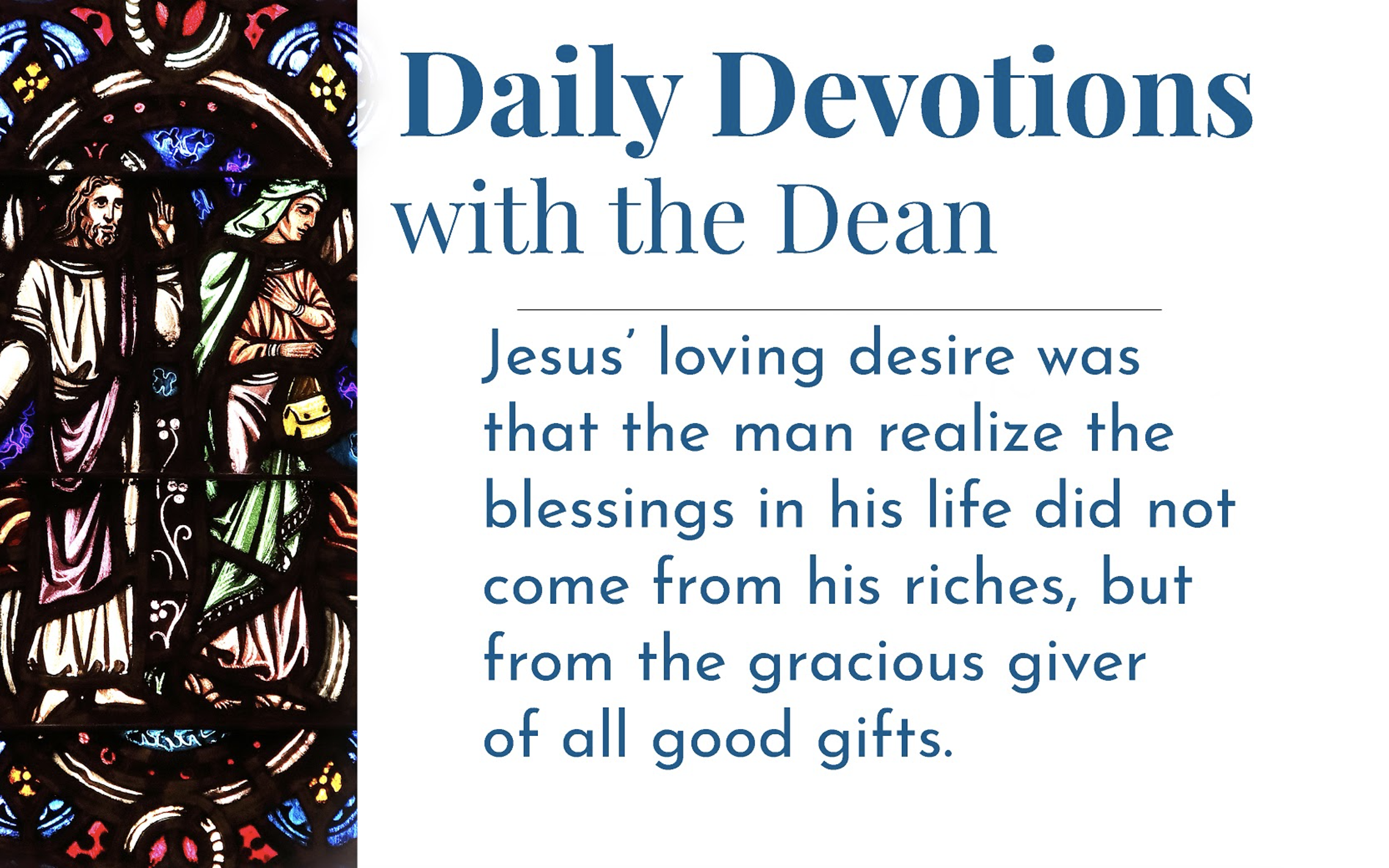
Image: The Rich Young Ruler, stained glass, Cathedral Church of St. Luke, Orlando, FL 

To mount a measured resistance against foolish teaching like this, Paul reminds Timothy of several things. 

First, it’s important not to get mired down in trivial arguments about meaningless words. Paul wants Timothy (and us too!) to prioritize, and to pick his (and our!) battles. Not everything is worth fighting over. The resurrection is, but many other things are not.  

Second, all ideas that seem to be progressive aren’t necessarily so. The opponents are claiming a kind of advancement over a seemingly boring and staid orthodoxy that calls for waiting for a future resurrection. Their heresy will cause something to grow, and it will be an advancement of something; but it is the growth of disease, not health, the advancement of decay, not well-being. Paul likens the effect of their teaching to gangrene, which is the progressive dying of body tissue due to lack of blood. The false teachers’ your-best-life-now mindset will promote greed, not generosity; selfishness, not servanthood; viciousness, not love. And so, Timothy must stay at his post, and be “an apt teacher, patient, correcting opponents with gentleness” (2 Timothy 2:24–25).   

Third, the reason that Timothy can be both resolute and gentle is that he can rest in the confidence that the Lord is sovereign and in control. “But God’s firm foundation stands, bearing this inscription: ‘The Lord knows those who are his’” (2 Timothy 2:19). Timothy stands in the line of Isaiah who had cried out to a people suffering in exile: “Arise, shine; for your light has come, and the glory of the Lord has risen upon you” (Isaiah 60:1). In that day, God was going to bring about a new exodus, a return from exile, that his people could never have engineered for themselves. Timothy’s God is that very same God, the One who builds “the City of the Lord, the Zion of the Holy One of Israel” (Isaiah 60:14).  

Timothy’s God is also the God in whom Jesus had invited the rich man in Mark to trust, the God of generous provision. Jesus invites the man to step into a whole new level of trust in God: “Jesus, looking at him, loved him and said, ‘You lack one thing; go, sell what you own, and give the money to the poor, and you will have treasure in heaven; then come, follow me.’” Jesus’s loving desire was that the man realize the blessings in his life did not come from his riches, but from the gracious giver of all good gifts. In addition to his love for the man, Jesus has confidence in the sovereign goodness of his God and Father. Even though he does so sadly, Jesus can step back and allow the man to walk away, because (I think) he knows the man’s story is not over, and is in the best hands it could possibly be in.  

Finally, the reason that Timothy can be straightforward in defending the truth but not be defensive in doing so, is that he will be giving God room to grant repentance. Here, I think, is the sense of the last portion of today’s epistle: “Correct opponents with gentleness. God may perhaps grant that they will repent and come to know the truth, and that they may escape from the snare of the devil, having been held captive by him [the devil] to do His will [i.e., ironically, God’s will]” (2 Timothy 2:25b–26). Timothy can lead with what Paul calls elsewhere “the meekness and gentleness of Christ” (2 Cor 10:1), and leave the convicting to God himself.  

A good lesson in “speaking the truth in love” (Ephesians 4:15) for all of us! 

Be blessed this day,  

Reggie Kidd+