

Daily Devotions with the Dean

This morning’s Scriptures are: Psalm 41; Psalm 52; Isaiah 8:16–9:1; 2 Peter 1:1–11; Luke 22:39–53
This morning’s Canticles are: following the OT reading, Canticle 9 (“The First Song of Isaiah,” Isaiah 12:2–6, BCP, p. 86); following the Epistle reading, Canticle 19 (“The Song of the Redeemed,” Revelation 15:3–4, BCP, p. 94)
Isaiah. This week we continue to read God’s pronouncements, through Isaiah, of condemnation and destruction for Israel and Judah. God’s people have been horribly faithless towards Yahweh. They have spurned his blessings and presumed his protection without honoring him as the source of these good things. They have cheated on him. They are flirting with, or are having full-fledged affairs with, other gods. The consequence: Israel will be decimated by the Assyrians in 732 B.C.
Judah, on the other hand, will be miraculously delivered from the godless Assyrians (2 Kings 19:32-36):
32 “Therefore thus says the Lord concerning the king of Assyria: He shall not come into this city, shoot an arrow there, come before it with a shield, or cast up a siege ramp against it. 33 By the way that he came, by the same he shall return; he shall not come into this city, says the Lord. 34 For I will defend this city to save it, for my own sake and for the sake of my servant David.”
35 That very night the angel of the Lord set out and struck down one hundred eighty-five thousand in the camp of the Assyrians; when morning dawned, they were all dead bodies. 36 Then King Sennacherib of Assyria left, went home, and lived at Nineveh.
Nevertheless, Judah, too, will break faith with Yahweh, and later be destroyed by the Babylonians, marking the end of Davidic rule.
Even in judgment, Yahweh leaves a remnant. Believing this truth, Isaiah says, “…I will hope in him. See, I and the children whom the Lord has given me are signs and portents in Israel from the Lord of hosts, who dwells on Mount Zion” (Isaiah 8:17b–18). As testimony, Isaiah names his own children Shear-jashub (“A remnant shall remain”) and Maher-shalal-hash-baz (“The spoil speeds, the prey hastens,” meaning Assyria will invade, but its victory will be short-lived—Isaiah 7:3; 8:3–4). Moreover, Isaiah promises that Yahweh will begin his greatest work of redemption in the north, in “Galilee of the nations (or Gentiles)” (Isaiah 9:1). Centuries later, Matthew will record:
12 Now when Jesus heard that John had been arrested, he withdrew to Galilee. 13 He left Nazareth and made his home in Capernaum by the sea, in the territory of Zebulun and Naphtali, so that what had been spoken through the prophet Isaiah might be fulfilled:
15 “Land of Zebulun, land of Naphtali,
on the road by the sea, across the Jordan, Galilee of the Gentiles (or nations)—
16 the people who sat in darkness
have seen a great light,
and for those who sat in the region and shadow of death
light has dawned.” (Matthew 4:12-16)

In the end, a faith like Isaiah’s prevails because Yahweh prevails.
2 Peter. It is a lovely work of providence, I think, that today we begin a reading of 2 Peter. The epistle of 2 Peter is eloquent testimony to God’s faithfulness to Isaiah’s promise. Peter is a supposedly ignorant fisherman. He comes from “Galilee of the nations.” His home is Bethsaida, on the eastern shore of the River Jordan in the Golan Heights, literally “beyond the Jordan.”
In this stunning first chapter of his second epistle, Peter writes in refined Greek to a literate Gentile Roman congregation about some of the richest benefits of the resurrected Christ’s work in our lives:
4 Thus he has given us, through these things, his precious and very great promises, so that through them you may escape from the corruption that is in the world because of lust, and may become participants of the divine nature.
5 For this very reason, you must make every effort to support your faith with goodness,
and goodness with knowledge,
6 and knowledge with self-control,
and self-control with endurance,
and endurance with godliness,
7 and godliness with mutual affection,
and mutual affection with love.
8 For if these things are yours and are increasing among you, they keep you from being ineffective and unfruitful in the knowledge of our Lord Jesus Christ. 9 For anyone who lacks these things is short-sighted and blind, and is forgetful of the cleansing of past sins. 10 Therefore, brothers and sisters, be all the more eager to confirm your call and election, for if you do this, you will never stumble.
The coming of Jesus Christ into the world, Peter maintains, has enabled us to become “participants (koinōnoi, or “sharers”) of the divine nature” (2 Peter 1:4). The pattern of growth into bearing God’s image that Peter lays out here has profoundly motivated believers, even if in different ways. Peter’s language has fired the imagination of churches of the Orthodox tradition in one way. They explain Peter’s meaning in terms of “theosis” or “divinization”—that is, of our bearing more and more the divine image. By contrast, Peter’s pattern of growth has inspired Catholic and Protestant churches more in terms of “sanctification” towards “glorification”—that is, of our bearing more and more the divine image. At the end of the day, I believe that we will find these to be different, but complementarily important, emphases.
God’s very being is being poured into our lives as we grow in faith, goodness, knowledge, self-control, endurance, godliness, mutual affection (philadelphia), and love (2 Peter 1:5–7). The Christ who once walked in “Galilee of the nations” now lives within us, reproducing God’s own life in us, giving us, as Peter says, everything needed for life and godliness. Praise be!
Be blessed this day,
Reggie Kidd+
An Advent of the Heart by Brian Stankich
An Advent of the Heart: Moving from Death to Life One Moment at a Time
By Brian Stankich

A recent midweek gathering of Cathedral worshipers embarked on the Advent theme of death. I know, who thinks of death in the context of Christmas? Apparently, Episcopalians. It's okay, because death has been conquered by the manger inhabiting Savior, even if we may all experience a personal death. Avoiding death doesn't seem to be an option for us, though we may try to avoid it by our obsession with avoiding pain, heartache, trial, disappointment and suffering. Avoiding these terrors comes naturally to us; embracing that savior who toiled for us does not.
As we talked about the coming of Christ and the event's place in the church calendar, we had a lively discussion concerning the imminent return of Jesus, and how the early church sought to live in the expectation that he could return at any day. Then we asked ourselves the dreadful question: What would our lives look like if we lived like Jesus' second Advent could happen at any moment? The spectre of death arises again, along with it's shadows: selfishness, pride, hate, wandering from God and so many others.
I've thought through this a bit more and arrived at one conclusion. If it's possible that Jesus' second return could happen before we celebrate the 2020 version of his first return, and it is, then I propose that living in the moment is an effective way to honor the moment of Jesus' return. Said another way, What will you be doing when Jesus returns?
I do not have an admirable history of focusing on the Advent season, but the last two years I've stepped up a bit because, you know, I'm worshiping at an Anglican church now. One of the intellectual themes I've been pondering for my life in recent years is what I call 'living in the moment.' Living in the moment means taking every moment of the day seriously. Not every second, or every minute, but certainly every event, every transition of hello or goodbye, every interaction, every decision, every attempt to obey and honor God, every misstep and every thing that could end up in a journal at the end of a day. Taking every moment seriously means honoring every breath that God gives us, treating it as precious, meaningful, purposeful and with potential to be life giving.
As I've been thinking about living in the moment this week in the context of Advent, I found that my Lord was interested in my moments. One morning after I woke up, I was greeting God and getting ready to start my morning return. I sensed that he wanted more time with me, and so I took it. I found that he had a word for me as I picked up a book I'm reading on Moses. Moses is described by the author as being a selfless man and God offered that I ought to pursue that same characteristic: selflessness.
A few days later while driving home from work, I intended to play a podcast, per my norm, and again sensed the Lord saying, 'wouldn't you rather talk with me?' I don't always like to pray when I'm driving as I'm not confident I'll stay focused on the road, but I obeyed. What did he want to talk about, I wondered. Oh, yeah, that nagging feeling I've had the last hour. What is that about? Oh, yeah, that wandering heart issue. God called me out on my heart wandering from him. I realized it bothered me too. The next ten minutes I confessed my wandering nature to him, and the lack of desire to deal with it. I felt so much better, in a better place, I now realize, to meet Jesus face to face if he shows up in the next few weeks before Christmas. It was an advent of my heart, choosing life over death. Let's call it being steadfast before God.
Living in the moment is taking each moment seriously, because God gives us moments. Jesus came as a baby and savior and he will come again as a conquering king. And he is available during the days in between, how ever many they will be, to come to me, to walk with me, to talk with me, to give me moments. So I want to live in those moments, and in so doing, celebrate life and the Lord who gives it, who came, who will come again and who shows up in my life every moment of every day.
Being steadfast and being selfless are the themes God is working in me these days. He continues coming to me to conform me into the image of the Son. That is Advent, one aspect of my life, one day, one moment at a time.

Sunday Worship
Noonday Prayer
Daily Devotions with the Dean
This morning’s Scriptures are: Psalm 31; Isaiah 7:10–25; 2 Thessalonians 2:13–3:5; Luke 22:14–30
This morning’s Canticles are: following the OT reading, Canticle 10 (“The Second Song of Isaiah,” Isaiah 55:6–11; BCP, p. 86); following the Epistle reading, Canticle 18 (“A Song to the Lamb,” Revelation 4:11; 5:9–10, 13, BCP, p. 93)
I am forgotten like a dead man, out of mind; I am as useless as a broken pot — Psalm 31:12. We all have fears. To wind up on the pile of life’s discards—that’s one of the biggest for me. To find this verse tucked away in the same psalm that gave my Savior such words of confident trust as, “Into your hands I commend my spirit” (Psalm 31:5), is beyond heartening. Hanging there on his cross, Jesus knew better than I what it is to feel forgotten and useless. Hanging there, he redeems every experience of being cast aside like a broken pot, and turns death to life.
Isaiah today describes one of the saddest, and anticipates one of the gladdest, moments of biblical history.
The sad. As we saw yesterday, Isaiah has been seeking to move the young king Ahaz to a posture of faith. Ahaz, a direct descendant of King David, is offered the power to preserve the Davidic dynasty. Yahweh says, “Ask a sign….” Ahaz waves the offer off with a statement of dramatic pseudo-piety: “I will not ask, and I will not put the Lord to the test.” In another context, this demurral might reflect genuine faith (e.g., Jesus in the wilderness with the Tempter). But in this case, it is the worst sort of unfaith. It is not the Devil who is being answered dismissively, but Yahweh himself! That is why verses 17 through 25 prophesy unmitigated disaster for the people and land. From this day forward, David’s dynasty becomes a puppet government—puppet to the Assyrians, then to the Babylonians, then to the Persians, then to the Romans. David’s true Son and heir will eventually be born in a small town in a country under Roman occupation.
The glad. Yet there is a lightning bolt of hope in Isaiah’s words of gloom: “Behold, the virgin shall conceive and bear a son, and shall call his name Immanuel” (Isaiah 7:14 English Standard Version). I know full well that a century or so of biblical scholarship has insisted Isaiah’s word ꜥalmâ means simply “young woman,” not that she is a virgin. That push is driven less by textual evidence than by a Western secular prejudice offended by the idea of a Virgin Birth. . In the Old Testament, the word ꜥalmâ normally refers to a female who is marriageable (i.e., virginal) and unmarried (see, for instance, the reference to the prayer of Abraham’s servant, asking for God’s help in his mission to find a suitable wife for Isaac in Genesis 24:43. I commend the illuminating discussion in J. Alec Motyer’s commentary on Isaiah).
Two hundred years before Christ’s birth, the translators of the Hebrew Scriptures into the Greek Septuagint understood the term this way. That is why these Jewish scholars chose the Greek word parthenos, which more clearly delineates the virginity of a female who is marriageable and unmarried.
In the context of King Ahaz’s day, Isaiah foresees that there is a specific but unnamed woman (“the virgin”) who will shortly marry, conceive, and, in great faith, name her baby “Immanuel” (meaning “God with us”). By the time this “Immanuel” is weaned, Yahweh will have dealt with the threat from Israel and Damascus. Beyond that, however, Ahaz’s refusal of trust has also locked in Judah’s eventual devastation and the disenfranchising of the line of David.
In the larger context, however—visible really only in hindsight—Isaiah provides one of the most elegant “Easter eggs” in all the Bible. One day, an angel would announce to a parthenos whose name we are given (Mary, and who herself is of the line of David) that she will, as the Virgin Mother, bear David’s heir: God’s own Son (Luke 1:26–38).
God has no discards. The matter that is easy to overlook in today’s passage in Isaiah is the faith of the woman who, in the face of the gloom and destruction that are coming upon God’s people, nonetheless will name her baby “God with us.” In a context of dire judgment, she nonetheless clings to the God who promises to dwell among his people. Hers is a faith worthy of Psalm 31’s, “Into your hands….”
Similarly, Paul piles extravagant language on people in Thessalonica who are outwardly altogether impressive. This band of recent converts to Christ appear to be largely working class people. “Anyone unwilling to work should not eat,” he tells them, urging them to “work quietly and to earn their own living” (2 Thessalonians 3:10b,12). Insignificant people they may be in the eyes of the world, but not to Paul, and not to God. Paul calls them “beloved,” and embraces them as adelphoi (rendered “brothers and sisters” in the NRSV). He says God has chosen them and will sanctify them and give them “the glory of our Lord Jesus Christ” (2 Thessalonians 3:13–14). I don’t even know where to begin to unpack the richness of that language. All I can do is accept it, and wonder in it.
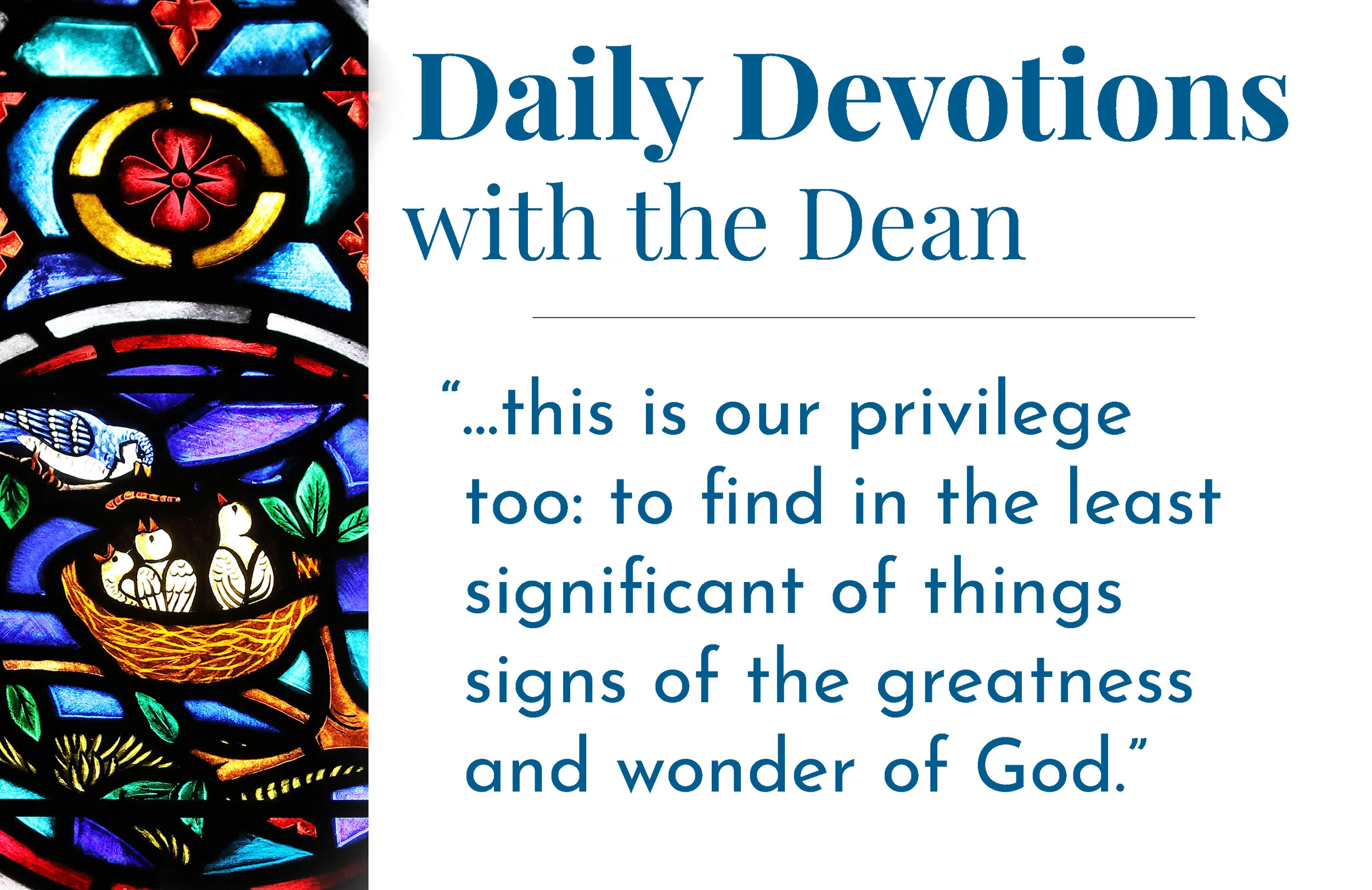
Likewise, on the night of his betrayal Jesus takes the most common of elements—bread and wine—and gives them to the most ordinary of people—his disciples. He and they, he says, are participating in an anticipation of a most extraordinary meal. They taste ahead of time the feast of the Kingdom of God. Week after week, this is our privilege too: to find in the least significant of things signs of the greatness and wonder of God. And to find in the least significant of people—one another—signs of the promise of glory. That is our Advent hope. May we all know it in any discouragements, rejections, failures, or attacks that may lie before us. We are not discards, but God’s beloved.
Be blessed this day,
Reggie Kidd+
Noonday Prayer
Daily Devotions with the Dean
This morning’s Scriptures are: Psalm 37:1–18; Isaiah 7:1–9; 2 Thessalonians 2:1-12; Luke 22:1–13
This morning’s Canticles are: following the OT reading, Canticle 8 (“The Song of Moses,” Exodus 15, BCP, p. 85); following the Epistle reading, Canticle 19 (“The Song of the Redeemed,” Revelation 15:3–4, BCP, p. 94)
Isaiah’s call to stand firm in faith. In his 5th chapter, the prophet Isaiah had chastised God’s people for failing to live up to their calling to be God’s life-giving vine. Yahweh had planted them among the nations so they could bring justice, temperance, and faithfulness into a desperately needy world. But they had responded with injustice, intemperance, and faithlessness.
In his 6th chapter, Isaiah recalls how he had been called into the overwhelming majesty of the heavenly courts. There he had been purged of his own sinfulness so he could be sent as messenger of Yahweh’s lordship, despite knowing that people would resist with unhearing ears and unseeing eyes.
Now, in his 7th chapter, Isaiah recounts how he began his ministry of announcing both judgment and hope. Judgment is coming—very soon for Israel to the north, and somewhat later for Judah in the south. As a result, Isaiah offers at least limited near term hope for Judah, and massive long term hope for both Judah and Israel (and the world as well, in a string of messianic passages, beginning with tomorrow’s promise of the birth of “Immanuel”).
In today’s passage, Isaiah offers words of near term hope to Ahaz, the young and beleaguered king of Judah, “the house of David.” Aram and Israel are trying to force Judah to join them in a military alliance to fend off an invasion by Assyria. To Yahweh, it is an unholy pact. Assyria will be his hand of judgment against faithless Israel. Isaiah’s mission is to bolster Ahaz in his resistance to the ill-fated coalition: “Take heed, be quiet, do not fear, and do not let your heart be faint because of these two smoldering stumps of firebrands…” (Isaiah 7:4).
Even more fundamentally, Isaiah is sent to challenge Judah’s king to a deeper faith in Yahweh: “If you do not stand firm in faith, you shall not stand at all” (Isaiah 7:9.—there is a powerful wordplay on the Hebrew word for “faith/faithfulness,” emet, translated here as “stand,” in both halves of this verse). Standing firm is a challenge that is as good for our day as it was for Ahaz’s.

Paul’s call to stand firm in faith. It is also a good challenge for Paul’s congregation in Thessalonica. They are rattled about judgment coming upon the world. Some have even stopped working (2 Thessalonians 3:6–15). In his first epistle to them, the apostle had assured the Thessalonians that they need not worry that they will be eternally lost should they die before the Lord’s return. He had insisted those in their graves when the Lord returns will have an advantage over those still living on the earth: the dead will be first to be taken up to be “with the Lord.” “Let us encourage one another with these words,” he had concluded (1 Thessalonians 4:18). Now he is writing a follow-up letter to them because they’ve somehow gotten the idea that they may have missed “the day of the Lord,” and along with it, the Parousia of Jesus and the great “gathering together to him” that was supposed to happen for those still on the earth when he came (2 Thessalonians 2:1–2).
His basic message to them is: “Chill! You’ll know it when it comes, and in the meantime be faithful.” Paul’s basic perspective on the “end times” is that Christ’s first coming has provoked an ultimately futile pushback from Satan. The Evil One received a mortal blow in the cross and resurrection of Jesus (see Colossians 2:15). But he has not stopped fighting. His response to the coming of the true Christ was to launch a program of evil that will eventuate in the emergence of a counter-Christ, whom Paul calls “the man of lawlessness” (2 Thessalonians 2:3,8), and whom John calls “the antichrist” (1 John 1:18,22).
And just as the victorious campaign of God’s gospel is enabled by the pouring out of the Holy Spirit, the Devil, in retreat, spews out “a mystery of lawlessness” (2 Thessalonians 2:7), strangely empowering “signs, lying wonders, and every kind of wicked deception” (2 Thessalonians 2:9b–10a). For now, God has placed a restraint on the Evil One (which, apparently, he explained somewhat to the Thessalonians, but not to us!—2 Thessalonians 2:5–6).
At some point in the future, in what biblical scholar Herman Ridderbos calls an “explosion of evil,” the Devil’s “man of lawlessness” will have his own mock “parousia” (2 Thessalonians 3:9). At his “coming out,” he will seat himself in God’s temple (whether it’s a physical [rebuilt] temple or the spiritual temple of the church, Paul doesn’t tell us), “declaring himself to be God” (2 Thessalonians 2:4). Point is: when it happens, we’ll know. We’ll know because the Lord’s response will be decisive: “…the Lord Jesus will destroy [him] with the breath of his mouth, annihilating him by the manifestation of his coming [parousia]” (2 Thessalonians 2:8).
In the meantime, Isaiah’s word to Ahaz is just as good for us: “Take heed, be quiet, do not fear, and do not let your heart be faint” (Isaiah 7:4). We know how the story ends. We know who wins!
Resting in the sure and certain hope of the victory of Christ, be blessed this day!
Reggie Kidd+
Midday Eucharist
Daily Devotions with the Dean
This morning’s Scriptures are: Psalm 38; Isaiah 6:1–13; 2 Thessalonians 1:1–12; John 7:53–8:11
This morning’s Canticles are: following the OT reading, Canticle 11 (“The Third Song of Isaiah,” Isaiah 60:1–3,11a,14c,18–19, BCP, p. 87); following the Epistle reading, Canticle 16 (“The Song of Zechariah,” Luke 1:68–79, BCP, p. 92)
Relicta sunt duo, miseria et misericorda (“Two remain, misery and mercy”). In six Latin words, the fifth century bishop of Carthage, St. Augustine, offers the most elegant commentary imaginable on today’s gospel passage about the Woman Caught in Adultery.

Despite the fact that this story just may embody Jesus’s ministry better than any other, it is the least well attested of any event of his life. Why? Well, this particular story, only told in John’s gospel, interrupts the narrative flow of the book. And it is not written in John’s Greek—in neither his writing style nor his vocabulary. As a result, some modern scholars reject the story’s authenticity altogether. But the story stubbornly and persistently commends itself. The likelihood, I think, is that the story is authentic, but that it was written by someone other than John. It earned a place in Scripture because it pressed itself upon early believers as being true to who Jesus is and as having come from reliable sources. Augustine simply treats it as an established part of Jesus’s ministry. I suggest we do the same.
One of the places the story occurs in the manuscript tradition is here, where the Daily Office places it: right after Luke tells us that during Holy Week, Jesus was spending his nights on the Mount of Olives and then teaching at the temple during the day (Luke 21:37–38). At the beginning of John 8, as Jesus returns from the Mount of Olives on one of these mornings to resume his teaching ministry in the temple, he is intercepted by a posse of righteous people. In their custody is a woman who has been caught “dead to rights” in the act of adultery. They want to know whether Jesus is going to comply with Jewish law that demands condemnation and execution; or whether instead, he is going to be true to his own teachings about love, compassion, and forgiveness.
Jesus does not straightforwardly confront these enforcers with their hypocrisy. Contrary to the Law of Moses, they’ve only brought one of the guilty parties—the woman. Curiously, he bends down and starts writing in the sand. What’s he doing? Gathering his thoughts? What’s he writing? Nobody knows. Maybe he’s writing out the Scripture, “If a man commits adultery with the wife of his neighbor, both the adulterer and the adulteress shall be put to death” (Leviticus 20:10). Or maybe he’s just writing something like: “Adultery is horrible. But, hey, where’s the guy?!”
Members of this coterie of morality sheriffs persist in their demands, and after a while Jesus stands up and simply says: “The sinless one among you, go first: Throw the stone” (John 8:7 The Message). He bends down again … and starts writing again. In The Gospel Road, the 1973 movie about Jesus’s life, Johnny Cash offers a wonderful suggestion: “Maybe he’s writing things like, ‘Liar’ … ‘Hypocrite’ … ‘Thief’ … ‘Rapist’ … ‘Murderer.’” Regardless, it’s enough to make the tattletales slink away, each of them, one by one. One of the reasons for thinking this story is true rather than fabricated is its understatement: somebody who is making up a fictitious Jesus might want to make him sound like their idea of the “real Jesus” by having him rail at the hypocrites. At the same time, the story’s pastoral sensibility sounds just like the Jesus we do know from the canonical gospels: Jesus, the discerner of hearts, gives each sinner—even these guys!—room to reflect, and space to repent.
The next words in the text are: “…and Jesus was left alone with the woman standing before him” (John 8:9). What a dramatic moment. And Augustine gets it just right: All that is left is the sinner’s need for mercy, and Mercy’s readiness to give it. Jesus asks the woman where her complainants are, and whether there is anyone left to accuse her. Her answer is simply, “Nobody, sir.” Then again, it’s not that simple. The word she uses for “sir” is kurie, which also means “Lord.”
Jesus’s answer also appears simple, but on reflection is not: “Neither do I condemn you. Go your way, and from now on do not sin again” (John 8:11). Jesus came neither to condemn sin nor to dismiss it—he came to absorb it and kill it. He has to tell some people to follow him so they can understand things better. However, our Lord trusts this one—delivered from the miseria of sin and condemnation—to work out how misericorda kills sin. So he can say to her very simply, “Go your way.”
Living in that same misericorda, may you be blessed this day,
Reggie Kidd+