
Daily Devotions

"Most Freaking Awesome!" - Daily Devotions with the Dean

Tuesday • 2/22/2022

We’re taking a detour from the Daily Office readings for a few days. Instead, we’ll be thinking through various facets of worship and how our Lord provides meaningful communion with him through our formal corporate worship as well as in individual worship in our daily devotions. The thoughts offered here are excerpts from articles I wrote for Worship Leader magazine a few years ago.  We’ll resume our reflections on the Daily Office Monday February 28.


Worship That Is “Most Freaking Awesome!”

One year, I had to miss Father’s Day because of an out of town speaking engagement. I got home so late that night, I dropped my bags in the front hallway and went to bed. The next morning I got up at my usual zero-dark-thirty, made coffee, and headed for my study.

When I walked bleary-eyed into my study, I caught a “presence” in my peripheral vision. I turned to look, and … Yikes! My coffee went everywhere. Freak out! Goosebumps! A tall person – thin, expressionless, motionless – Was.Standing.There.Staring.At.Me. 

After a few seconds, I realized that the “person” was a life-sized cardboard cutout of Sheldon Cooper from the TV series The Big Bang Theory. It turns out my wife thought this would be a fun welcome home surprise. BAZINGA! I laughed and laughed.  

Ultimate Awe

When heaven and earth converge – or perhaps better – when the thin veil between them gets drawn back, it’s the sort of thing that makes your hair stand on end. God covers Mt. Sinai with “a blazing fire, and darkness, and gloom, and a tempest, and the sound of a trumpet, and a voice whose words made the hearers beg that not another word be spoken to them” (Heb 12:18 NRSV). 

According to the writer to the Hebrews there is a “Presence” among us even more more goosebump-raising than Mt. Sinai’s “blazing fire … darkness  … gloom … tempest … trumpet … voice.” “In these last days,” he says, “God has spoken through his Son, the reflection of God’s glory and the exact imprint of God’s very being” (Heb 1:2-3 NRSV). 

Supremely Amazing

Not only that, but “through the eternal Spirit,” this Son has “offered himself without blemish to God” … to “purify our conscience from dead works to worship the living God!” (Heb 9:14 NRSV).  He could do so because he is the true Melchizedek, a priest and king whose ministry could not be cut short by death (Heb 7). As a result, he is now able to be in two places at once: physically in heaven at the Father’s right hand where he is – as the new Melchizedek – “Liturgist (or Worship Leader) in the sanctuary and the true tent” (Heb 8:2), and Spiritually (note the capital S) among us leading us in that worship. There and here at the same time, he pulls back the veil between heaven and earth and creates a reality that is truly goosebump-raising. That is what we taste in worship. 

The fourth century Greek-speaking church created a word for Christ’s goosebump-causing presence among us as our Liturgist and Worship Leader: phrikodestates (pronounced approximately “freak-oh-des-TAH-tays”). It’s an adjective in the superlative degree, based on a verb (phrisso) that means, literally: “shudder,” “get goose bumps,” or metaphorically, “be overcome with awe.” It wouldn’t be far off in modern vernacular to render phrikodestates as “most freaking awesome!”

Commune

For over 1,000 years the locus of awesomeness was the presence of the Lord at the Table. Thus, the 4th century’s Cyril of Jerusalem said that at the Eucharist we “Lift up our hearts to the Lord” because we have come to a “phrikodestates hour.” And rightly has the church celebrated that awesomeness, because our great Liturgist, the new Melchizedek, has brought us to an altar from which “those who serve the tent have no right to eat” (Heb 13:9) – but from which we do! 

Faith by Hearing

In the Reformation of the 16th century, the locus of awesomeness became the presence of the Lord in the proclamation of the Word and the rediscovery of the Bible in worship. And rightly has the Church celebrated that awesomeness, because Our Great Liturgist is among us declaring the Father’s name to us (Heb 2:12a). 

Intercessory Evangelism 

In the great “awakenings” and “revivals” of the 18th, 19th and 20th centuries, the locus of awesomeness became the presence of the Lord in the conversion of the soul – and by extension in the mission to the world. And rightly has the church celebrated that awesomeness because Our Great Liturgist is at the Father’s right hand, “ever interceding” that the lost will be found and the found will be cleansed, preserved, and gathered to the Father at the end (Heb 7:25). 

Inhabited Praise

In the wake of the Charismatic Renewal, the locus of awesomeness has become the Lord’s “habitation in the praises” (Psalm 22:3). And rightly has the church celebrated that awesomeness because the Risen Christ – Chief Musician in the new order of Melchizedek – “sings hymns” to the Father in the assembly (Heb 2:12b). 

Holy Convergence

Oh for the day when we all know Christ’s phrikodestates presence in all aspects of worship: at the Table, in the Word, in intercession, and in praise!

Be blessed this day, 

Reggie Kidd+
How Can I Keep from Singing? - Daily Devotions with the Dean

Monday • 2/21/2022

We’re taking a detour from the Daily Office readings for a few days. Instead, we’ll be thinking through various facets of worship and how our Lord provides meaningful communion with him through our formal corporate worship as well as in individual worship in our daily devotions. The thoughts offered here are excerpts from articles I wrote for Worship Leader magazine a few years ago.  We’ll resume our reflections on the Daily Office Monday February 28.


I Know Why the Prisoner Sings *
For two millennia, Christians have sung their theology—from catacombs to dorm rooms, and from cathedrals to football stadiums. Every distinctive shape the faith takes – each its own “Jesus Movement” – finds its own musical voice. Ambrose’s robust trinitarianism both created and was supported by the florid hymnody of the church of fourth-century Milan. Gregorian chant both bespoke a quest of a spiritual music for the church and announced the ascendancy of the medieval church. In the sixteenth century, Martin Luther trumpeted his newfound grace as much through broadsheets and hymns as through sermons and books. 

Along the way, preachers and songsters have paired off, and sometimes the songsters have shaped the message as much as the preachers: John Calvin and Louis Bourgeois, John and Charles Wesley, Dwight Moody and Ira Sankey, Billy Graham and George Beverly Shea, Louie Giglio and Chris Tomlin. The evangelical uprising that began right after World War II, gained new life in the Jesus Movement of the 1960s, and persists into the beginning of the third millennium is characterized as much by its “praise and worship” as by anything else. When groups think about starting new churches, they are as anxious to establish their “sound” as they are their message.

Hopeful Abandon

God is in the process of reclaiming our lost planet, so singing fits the way things are. As a result, Christians have been irrepressible singers from day one. What J. R. R. Tolkien said is true: every fairy tale echoes the biblical drama—we were lost, and then we were found. Praise and thanks come unbidden to the surface of our being—and in the unbiddenness of our singing lies its rightness.

A song will illustrate. One of my coworkers teases me: “I always know it’s you coming down the hall, because I hear the music first.” I am an incorrigible singer, hummer, and whistler. The one song that forces itself into my consciousness more than any other is this:

My life goes on in endless song, above earth’s lamentations.
I hear the real, though far-off hymn, that hails a new creation.
Above the tumult and the strife, I hear its music ringing.
It sounds an echo in my soul. How can I keep from singing?

When tyrants tremble, sick with fear, and hear their death-knell ringing,
When friends rejoice both far and near, how can I keep from singing?
In prison cell and dungeon vile our thoughts to them are winging.
When friends by shame are undefiled, how can I keep from singing?

What though my joys and comforts die, the Lord my Saviour liveth.
And though the darkness round me close, songs in the night he giveth.
No storm can shake my inmost calm while to that Rock I’m clinging.
Since Christ is Lord of heaven and earth, how can I keep from singing?

Anne Warner composed this folk hymn in the middle of a most uncivil Civil War, and Doris Plenn reshaped it during the Cold War and its attendant paranoia. It is a hymn of courage in the face of tempest and darkness and tyrants. 

Trembling Courage

My absolute favorite version of the song is Eva Cassidy’s kicking “gospel” rendering. She sang it while she was trying to fight off the malignant melanoma that would eventually take her life. Perhaps that’s why she sings with an urgency most who take up this song don’t have. I know that there are different kinds of “prison cells” and “dungeons vile,” and that melanoma—which I too contracted—is one of them. I know therefore that the gift of a song in the night does keep the darkness back, if barely—“Dear God, do not let my children grow up without a father.” And I know that a response of unbidden song rings true because, and only because, Christ is indeed “Lord of heaven and earth.” I hope this was Eva Cassidy’s hope—it is mine, for though my cancer was found at a much earlier stage than hers and appears to have been treated successfully, I know that the “far-off hymn” isn’t as far off as it was pre-cancer. I know in a way I didn’t before that Christ’s victory over the grave promises “new creation.” More importantly, I know that in the worst of my fears I can’t keep from singing; Christ has plundered death and hell.

This hymn is a parable of the entire history of song in the church. It explains why we are such a singing lot. From the very beginning, God has been orchestrating a grand drama, the reclamation of his lost creation—and in operatic fashion, he has used the singing to his Jesus Movements to carry the story line. 

Be blessed this day, 

Reggie Kidd+

Image: Pixabay

* Today’s post is adapted from Reggie M. Kidd, With One Voice: Discovering Christ’s Song in Our Worship (Grand Rapids, MI: BakerBooks, 2005), pp. 17–20. 

We Live in "The Between Times" - Daily Devotions with the Dean

Friday • 2/18/2022
Friday of 6 Epiphany, Year Two 

This morning’s Scriptures are: Psalm 102; Genesis 32:22–33:17; 1 John 3:1–10; John 10:31–42

This morning’s Canticles are: following the OT reading, Canticle 10 (“The Second Song of Isaiah,” Isaiah 55:6–11; BCP, p. 86); following the Epistle reading, Canticle 18 (“A Song to the Lamb,” Revelation 4:11; 5:9–10, 13, BCP, p. 93)


Genesis 32–33. There have been several mini-breakthrough moments in Jacob’s relationship with Yahweh: the prophecy of his destiny (Genesis 25); the dream of the stairway between heaven and earth (Genesis 28); the dream preceding the Mizpah covenant (Genesis 31). And ever since his stairway dream, Jacob’s life has taken a turn towards faith. The decisive breakthrough lies here, though, in his wrestling with the angel. To be finally subdued, Jacob must throw his body into one last self-assertive grapple with God. The result is a vision of the “the face of God,” a permanent limp, as well as a new name. Jacob/Israel is finally not just Abraham’s grandson and heir. Now it’s fair to say he’s God’s son. 

1 John 3. We, says 1 John, are children of God, which means our lives increasingly take on the characteristics of our Heavenly Father and his only Begotten Son, our brother. The conclusion that John draws in today’s passage in 1 John is that a life of sinfulness no longer defines us: “No one who abides in him sins; no one who sins has either seen him or known him” (1 John 3:6). At the same time, John has already told those who abide in Jesus that they are kidding themselves if they pretend they are beyond sin; but they always have access to forgiveness through confession, because Christ is their atoning sacrifice (1 John 1:9–2:2).

The reality is that our lives work themselves out somewhere between an Eeyore-ish fatalism (“Salvation is just moving from one failure to the next”) and Tigger-ish triumphalism (“Good morning, Jesus! I’m so glad I’m getting better and better every day, and growing closer and closer to you!”). We live in “the between times,” no longer slaves to sin, but also not yet able to say we don’t have to be ever vigilant. 

The resources that John offers us in today’s words are: 1) the surety of our Father’s love; 2) the promise that God has committed himself to transform us into “the spittin’ image” of the Father whose children we are; 3) our Christus Victor is destroying the power of the Evil One who would destroy us if left to his own devices; 4) there is an inner compass within us that keeps pointing us in the direction of “doing right” and “loving our brothers and sisters.”

John 10. That’s why it’s so intriguing to find Jesus countering his opponents’ charge of blasphemy by citing to them Psalm 62, which faults Israelite leaders for failing in their duties: “I said, ‘You are gods’” (i.e., I called you and equipped you to exercise God-like care for my people). If God calls mere humans “gods,” how can it be blasphemy for the “one who came into the world” (i.e., the eternal Word who was in the beginning “with God” and who from eternity always “was God” — see John 1:1) to call himself God’s Son? (John 10:36).

The direct point is that Jesus as God’s Son is fully divine. May his name be praised!

The indirect point is that God’s lesser sons and daughters (you and I) are so invested with God’s blessing, so infused with his communicable attributes, and so commissioned to exercise dominion over his creation that there is a way in which they (we) can be referred to as “gods” without violating the distinction between Creator and creature. Accordingly, Paul refers to our salvation as a complex of “justification, sanctification, and glorification” (Romans 5–8). Peter says God has made us “sharers (koinōnoi, partakers, participants) in the divine nature” (2 Peter 1:4). 

There’s a deep mystery here, one that challenges the imagination. And we, whose perspective tends to be earth-bound, need the challenge. C. S. Lewis probably put it best when, in an oft-quoted passage from his “Weight of Glory” sermon, he said that the destiny of the redeemed is to become “everlasting spendours.” If we could see each other as we will be when this whole “between times” process of mortifying the flesh and living into the reality God’s sanctifying work in our lives is over — if we could see the finished product now, we would be tempted to fall down and worship each other. (Of course, when God’s work is finished, we’ll be beyond that temptation!)

May we walk in God’s calling as children he cherishes, and yield to his hand as he enables us to “do right” and “love our brothers and sisters.” May we worship him in wonder, love, and praise. 

Be blessed this day,

Reggie Kidd+

Getting Us All the Way Home - Daily Devotions with the Dean

Thursday • 2/17/2022
Thursday of 6 Epiphany, Year Two

This morning’s Scriptures are: Psalm 105; Genesis 32:3–21; 1 John 2:18–29; John 10:19–30

This morning’s Canticles are: following the OT reading, Canticle 8 (“The Song of Moses,” Exodus 15, BCP, p. 85); following the Epistle reading, Canticle 19 (“The Song of the Redeemed,” Revelation 15:3–4, BCP, p. 94)


Some overall perspective on the first 21 verses of Genesis 32: Graciously, Yahweh has intersected Jacob in his waywardness, revealing to Jacob that he is indeed the chosen bearer of the promises made to his grandfather Abraham. For this mission, he was chosen from the womb despite being the second born son: “The older son will serve the younger” (Genesis 25:23).  Somehow, he has not disqualified himself because of his earlier willfulness, deceptions, and maneuverings. Yahweh has seen him through terrible treatment at the hand of his uncle Laban. During his sojourn under Laban, Yahweh has even blessed him with a multitude of sons, and has prospered him with immense flocks. And at Mizpah, Yahweh has shown his readiness to stand guard between him and the resentful and envious uncle who has become his enemy. 

Still, there is a walk of humiliation that Jacob knows he must walk. Geographically, Jacob could have made a more or less straight line from Laban’s tents in Haran to Isaac’s tents at Hebron in south Canaan. But on his journey southwards, he unexpectedly veers east and heads for Esau’s tents in Shechem. Jacob needs reconciliation with the older brother whom he has deceived, and at whose expense he carries the blessing of Abraham. For Jacob, benefiting from God’s blessing lies on the far side of a walk of humiliation. 

. Jacob sends messengers to Esau, and Esau’s only answer is to send 400 men to meet him. Are they coming in friendship? Or are they coming to exact revenge? It’s not difficult, I think, to identify with Jacob’s plight. As commentator Derek Kidner observes, “Nothing could be more ominous than Esau’s silence and his rapid approach in force. Jacob’s reaction is characteristically energetic: he plans, (verses) 7,8 — prays, 9–12 — plans, 13–21 — prays, 22–32 — plans, 33:1–3. It is over-facile to condemn his elaborate moves as faithless … Jacob’s prayers show where his confidence lay.” *

John 10: why Jesus is such a good shepherd. For those of us who, like Jacob, teeter between faith and unfaith (“God you promised … but my brother could just kill me!”), it’s hard to imagine Jesus uttering more comforting words than these: “My sheep hear my voice. I know them, and they follow me. I give them eternal life, and they will never perish. No one will snatch them out of my hand. What my Father has given me is greater than all else, and no one can snatch it out of the Father’s hand. The Father and I are one.” (John 10:27–30). 

If we recognize Jesus’s voice and find ourselves inclined to follow him, we can be confident that that inclination did not begin with us. We are not that clever, nor that brave, nor (most of us, at least) that humble. (I mean, really — willing to give control of our lives over to somebody else?!) If we recognize Jesus’s voice and find ourselves following him, it is because way back in the counsels of eternity the Father loved us, chose us for himself, and gave us personally to his Son. It is that deeper call to which we have responded. And the comfort of it is that there is nothing — nothing — that can keep the Good Shepherd from getting us all the way home. 

1 John: As under-shepherd, John warns against “antichrists.” In yesterday’s reading in John’s Gospel, Jesus warns us against bad shepherds, hirelings who pretend they care for the sheep but in fact care only for themselves. When John becomes a shepherd to a portion of God’s flock, he senses there are bad shepherds in his churches. In 1 John 2:18, he calls them “antichrists” because they substitute for the true Christ (truly God and truly human) a false Christ (if he is fully God, then he is not fully human; if he is fully human, then he cannot be fully God). John says there are “many antichrists” in his day, And, alas, there have been many since. 

John’s Gospel and his Epistles carry such power because of their finely balanced and pastorally perfect perception that Jesus is fully divine with the authority to save, and fully human with the capacity to absorb all our sins and griefs. Fully divine to bring us Truth (with a capital “T”), and fully human to model and lead us in Life (with a capital “L”). 

Bad shepherds adjust the message because they are “hirelings” who attend more to their market than to their Master. They do so either in the direction of making Jesus a purely divine figure who swoops down just long enough to rescue us for heaven; or they adjust the message in the direction of making Jesus a purely human figure who helps us fantasize about making earth into heaven. A not-quite-human Jesus who has nothing to say about, say, civic responsibility or creation care, or a less-than-divine Jesus who leaves us frustrated and angry and despairing because we never seem to be able to make the Kingdom come. That makes them antichrists, and fully deserving of our inattention. 

May God give us discernment to hear the voice of the Good Shepherd in the words of faith-keeping, hope-instilling, and love-inspiring under-shepherds. Under-shepherds who themselves are being shepherded by one Shepherd who is truly Good. More deeply, may we know that our heavenly Father has lovingly placed us in the strong and secure hands of our faithful Good Shepherd, the Lord Jesus Christ. 

Be blessed this day, 

Reggie Kidd+

* Derek Kidner, Genesis: An Introduction and Commentary, Tyndale Old Testament Commentaries (Downers Grove, IL: Inter-Varsity Press, 1967), p. 168. 

The Good Shepherd - Daily Devotions with the Dean

Wednesday • 2/16/2022
Wednesday of 6 Epiphany, Year Two

This morning’s Scriptures are: Psalm 101; Psalm 109; Genesis 31:25–50; 1 John 2:12–17; John 10:1–18

This morning’s Canticles are: following the OT reading, Canticle 11 (“The Third Song of Isaiah,” Isaiah 60:1-3,11a,14c,18-19, BCP, p. 87); following the Epistle reading, Canticle 16 (“The Song of Zechariah,” Luke 1:68-79, BCP, p. 92)


Today’s Old Testament and Gospel readings converge in an intriguing way. 

John 10: Jesus is the Good Shepherd who protects his sheep from predators. He shows an affection for his flock unlike that of hirelings, posers who merely pretend to care for them. 

Genesis 31: Jacob’s shepherd is the LORD. After twenty years of abuse under his uncle Laban’s tent, Jacob has tried to leave quietly. But Laban has chased him down, gaslighting him by charging with being an ingrate and a thief (Genesis 31:25–28). God alone, complains Laban, keeps him from punishing Jacob. 

In angry exasperation, Jacob draws on his twenty years of shepherding for Laban to explain how much abuse he has endured at his uncle’s hands, despite which he has conducted himself honorably and fairly. He has cared for Laban’s flocks without stealing any for himself; he has absorbed the loss when he had been unable to protect any of Laban’s sheep from predators or thieves (Genesis 31:38–41). He has been anything but the kind of “hireling” Jesus will later declaim. He has been a “good shepherd,” only to have Laban reward him with deception, lies, and inconstancy. 

However, Jacob has come to understand that there is someone who cares for him. He has Yahweh (as his descendent David will describe it several generations later) as his shepherd: “The LORD is my shepherd, I shall not want…” (Psalm 23:1). Jacob recognizes that “the God of my father, the God of Abraham and the Fear of Isaac” has taken his side, protected him, and prospered him. He has come to know the care of his own Good Shepherd. 

Jacob is on his way to seek out his brother Esau, whom he knows he has profoundly wronged. There he hopes to find reconciliation. Here with Laban, he is content with a non-aggression pact. The so-called Mizpah benediction (Genesis 31:49) calls upon Yahweh to serve as watchman between the two of them, each erecting a testimonial pillar. 


A huge takeaway here is that sometimes our Good Shepherd: 1) gives us courage to cut the tie of a relationship in which we’ve been exploited, 2) the wisdom to build good boundaries, and 3) the strength to move on. 

The Collect for the Fourth Sunday of Easter seems a good conclusion for today’s devotion: O God, whose Son Jesus is the good shepherd of your people: Grant that when we hear his voice we may know him who calls us each by name, and follow where he leads; who, with you and the Holy Spirit, lives and reigns, one God, for ever and ever. Amen.

Be blessed this day, 

Reggie Kidd+

Image: Stained Glass, Cathedral Church of St. Luke, Orlando, FL

Believing is Seeing - Daily Devotions with the Dean

Tuesday • 2/15/2022
Tuesday of 6 Epiphany, Year Two 

This morning’s Scriptures are: Psalm 97; Psalm 99; Genesis 31:1–24; 1 John 2:1–11; John 9:18–41

This morning’s Canticles are: following the OT reading, Canticle 13 (“A Song of Praise,” BCP, p. 90); following the Epistle reading, Canticle 18 (“A Song to the Lamb,” Revelation 4:11; 5:9–10, 13, BCP, p. 93)


The French artist Georges Rouault, himself a “sighted” person, recalls having escorted a blind mathematics professor on a walk. On the walk, the blind man recited poetry — a world to which Rouault was “blind” — all the while the blind man’s “eyes turned toward the sky.” Hearing the flow of the poetry, Rouault found himself ruminating over which of them was more limited in the perception of reality. 

Rouault would later render the scene in a most memorable panel of his Miserere, Plate 55. In that plate one man is guiding another. One is blind, the other is not. Normally, the “sighted” person would lead the blind person, as had been the case when Rouault led his blind friend. But in the  scene Rouault creates, the roles are reversed. In the lead is the blind man, his blank eyes lifted to the heavens, while the “sighted” person follows, his world-weary head bent down toward the ground. Rouault titles it, “Sometimes the blind have comforted those who see.”*

John 9: when believing is seeing. John’s narration of the story of Jesus’s healing of the man blind from birth makes the very same point. Over the course of this story, the man who “once was blind but now I see” comes to see more than just the world around him. The eyes of his heart become gradually open to the reality of who Jesus is, and increasingly open to what true life is. At first Jesus is just the guy who heals him. The man barely catches his name: “The man called Jesus made mud, … They said to him, ‘Where is he?’ He said, ‘I do not know’” (John 9:11b,12a). 

Later, when pressed by the Pharisees to account for why he thinks Jesus could feel the freedom to heal on the sabbath, the man surmises, “He is a prophet” (John 9:17). Pressed further, he says (I phrase), “Look, OK, you all call him a sinner. All I know is that I was blind, now I see. … Could it be that deep down you really want to become his followers? … If this man were not from God, he could do nothing” (John 9:25,27). He’s getting it, and he’s willing to be rejected by his questioners for telling the truth about what his experience of Jesus has taught him! 

Finally, Jesus meets with him one-on-one and poses the question: “Do you believe in the Son of Man?” (John 9:35). That’s a loaded question, calling up the image of the Messiah from heaven that Daniel had predicted (see Daniel 7:13–14). The man expresses his willingness to believe, if only he knew in whom he was to believe. Jesus forthrightly acknowledges his own identity: “You have seen (what a pregnant term!) him, and the one speaking with you is he.” The man’s response shows just how much his eyes have been opened: “‘Lord, I believe.’ And he worshiped him” (John 9:37–38). The one who used to be blind now sees both with his once dead physical eyes and with his once dead spiritual eyes. 

Meanwhile, sadly, the Pharisees, stewards of God’s Word and those trained to discern true teaching and identify false, are stuck in the dark. They are blind to the fact that the Light of the World has dawned among them. Claiming to see heavenly things, their heads are bent to the ground and their eyes, though open, are unseeing. “Jesus said, ‘I came into this world for judgment so that those who do not see may see, and those who do see may become blind.’ Some of the Pharisees near him heard this and said to him, ‘Surely we are not blind, are we?’ Jesus said to them, ‘If you were blind, you would not have sin. But now that you say, ‘We see,’ your sin remains’” (John 9:39–41). If only, like Rouault, they would admit that despite their physical sight there was a whole new world they could not “see” — and to which only the experience of this formerly blind person could open them! 

There’s much to ponder here for those of us who sense we’ve been awakened to a world beyond what a radically secularized world has defined as “reality.” God give us grace to offer with humility our arms and with good humor our insights to those whose world-weary heads are bent to the ground with blank eyes. 

Genesis 31: the light begins to shine for Jacob. Change has taken hold in Jacob. The light has begun to dawn for him. The lens through which he has begun to see life is no longer secular, but sacred: “But the God of my father has been with me. … but God did not permit Laban to harm me. … Thus God has taken away the livestock of your father, and given them to me … Then the angel of God said to me in the dream, ‘Jacob,’ and I said, ‘Here I am!’” (Genesis 31:6,7,9,11). 

1 John: walking in the light. When the eyes of our hearts have been enlightened, we see ourselves in a different light. We are able to be honest about our sins because we know they have been covered: “But if anyone sins, we have an advocate with the Father, Jesus Christ the righteous…the atoning sacrifice for our sins” (1 John 2:1b–2a). 

Knowing we have been loved from on high, we find we want to love back. And we find that love obeys the commandments: “…whoever obeys his word, truly in this person the love of God has reached perfection” (1 John 2:5). 

Old commandments become new, from not profaning the sabbath to not coveting our neighbors’ possessions. The holiness and rest of one day in seven become a means of lovingly sacralizing every day and of flourishing in the six days of living out our calling. Contented gratitude for God’s kind provision for us frees us to love neighbors whom we no longer envy, but whose well-being we seek. “Beloved, says John, I am writing you no new commandment, but an old commandment that you have had from the beginning; the old commandment is the word that you have heard. Yet I am writing you a new commandment that is true in him and in you, because the darkness is passing away and the true light is already shining.” (1 John 2:7–8). 

Be blessed this day, 

Reggie Kidd+

Image: from Postage Stamp, 1961. 

* “L’aveugle parfois a console le voyant.” 

God Will Win the Day - Daily Devotions with the Dean

Monday • 2/14/2022
Monday of 6 Epiphany, Year Two 

This morning’s Scriptures are: Psalm 89; Genesis 30:1–24; 1 John 1:1–10; John 9:1–17

This morning’s Canticles are: following the OT reading, Canticle 9 (“The First Song of Isaiah,” Isaiah 12:2–6, BCP, p. 86); following the Epistle reading, Canticle 19 (“The Song of the Redeemed,” Revelation 15:3–4, BCP, p. 94)


Genesis 30: children born of grace. The utter grace of it all! The Bible never lets us forget that. The twelve tribes of Israel, easily romanticized as the pillars of God’s people, came about through the bitter rivalry between Jacob’s wives, one wanted (Rachel) and one unwanted (Leah). Despite all the machinations and bruised relationships, it’s pure grace that causes unwanted Leah to become mother to Israel’s priestly and kingly lines (Levi and Judah — and ultimately, to Jesus). The same grace gives near-to-despairing Rachel a single child, the last to be fathered by Jacob. That son’s story will crown the Genesis account. The exile of this son, Joseph, to Egypt forecasts both the exodus under Moses and the figure of a future suffering and overcoming Savior. 

When we feel ourselves surrounded by bad actors who manipulate their way into favor and power, especially in the name of God, this portion of Genesis can be, ironically, a bracing and encouraging read. Somehow, God will win the day. He always does. His redemptive purposes stand. 

John 9: the light that enlightens. In John 9, the eternal Light of the World engages our blindness and confusion. Jesus comes upon a man who has been blind from birth. His disciples pose what must have seemed to them like a deep theological question: “Rabbi, who sinned, this man or his parents, that he was born blind?” (John 9:2). Jesus dismisses their question: “Neither this man nor his parents sinned; he was born blind so that God’s works might be revealed in him” (John 9:3). 

In a world conditioned by sin and colored by the Fall, there is no one-to-one correspondence between a person’s behavior or personal sinfulness and their physical health, or of their social status for that matter. Confusion over that fact is itself a part of the blindness of sin. Disability is not a sign of moral deficiency. Nor is health an index of spiritual well-being. Nor is privilege a sign of worthiness. As this story unfolds, we will see that the religious leaders are more blind than the man who can’t see with his physical eyes: the eyes of their hearts are blind to the Light of the World! 

Jesus presses past the speculative theological confusion about the origin of suffering. He spits on the ground and makes mud from his spittle and the dirt. Don’t read past that too quickly! Heaven’s Rescuer combines his spit with the dust of our origin (“from dust you came”) to heal this son of Adam. Jesus spreads the mud on the man’s eyes and sends him to a pool (the name of which means “Sent”). “Go wash,” he tells him. And in that washing the lights come on! Small wonder the early church called baptism an “enlightenment.”* John’s Gospel announces early on that “in him was life, and the life was the light of mankind” (John 1:4 NET). 

1 John: what we’ve seen with our eyes. Now, if the apostle John authored the gospel that bears his name (and I think he did) and if that same John penned the Johannine epistles (and I think he did), it’s easy to imagine him capturing his own reaction to just such a sign: “…what we have heard, what we have seen with our eyes, what we have looked at and touched with our hands, concerning the word of life—this life was revealed, and we have seen it and testify to it…” (1 John 1b–2a). To the healing of the man born blind add turning water into wine at Cana (John 2), healing the royal official’s son in Capernaum and the paralytic at Bethesda (John 4 & 5), the feeding of the 5,000 his walking on the water (John 6), and the raising of Lazarus (John 11). Crowning it all, of course, is Jesus’s resurrection from the dead, when he shows the disciples “his hands and his side” (John 20:20) and even invites Thomas, “Put your finger here and see my hands. Reach out your hand and put it in my side. Do not doubt but believe” (John 20:27). 

The grace that worked through the dysfunction of Jacob’s family was no abstraction. That Grace is capitalized. That Grace walked in sandaled feet. That Grace merged heaven and earth. That Grace spat and sent, healed and instructed — and died and rose again. Because he rose from the dead, that Grace comes still, and heals still. For now, we experience but partial healing, whether physical or emotional, psychological or relational. One day, we will experience full healing of body, soul, and spirit. One day, as John says later in 1 John,) “when [Jesus[ is revealed, we will be like him, for we will see him as he is” (1 John 3:2). Then it will be our turn to join our voice to John’s “what we have seen, with our eyes, what we have looked at and touched with our hands!” May that Grace give us courage and strength and hope, 

… so that we may be blessed this day. Amen!

Reggie Kidd+

Image: "Jesus Feet" by Ben Lowery is licensed under CC BY 2.0

* Gregory of Nazianzus, Festal Orations, translation with introduction and commentary by Nonna Verna Harrison (Crestwood, NY: SVS Press, 2008), Oration 40, “On Baptism,” ch. 3.

We Don't Need to be "Good Enough" - Daily Devotions with the Dean

Friday • 2/11/2022
Friday of 5 Epiphany, Year Two 

This morning’s Scriptures are: Psalm 88; Genesis 27:46-28:4,10-22; Romans 13:1-14; John 8:33-47

This morning’s Canticles are: following the OT reading, Canticle 10 (“The Second Song of Isaiah,” Isaiah 55:6–11; BCP, p. 86); following the Epistle reading, Canticle 18 (“A Song to the Lamb,” Revelation 4:11; 5:9–10, 13, BCP, p. 93)


Genesis: “Grace, grace, God's grace, Grace that is greater than all our sin!” The Bible’s story is one long proof of this line from Julia H. Johnston’s (b. 1910) hymn. Today’s account of “Jacob’s Ladder” is case in point. 

If anybody ever needed grace, it was Jacob, the “Supplanter.” This second son had been prophesied to be the inheritor of his father Isaac’s estate, and the one through whom God’s promises to his grandfather Abraham would be fulfilled. Nonetheless, rather than trusting God to fulfill the prophecy and secure his inheritance, Jacob had conspired once to swindle his brother, and a second time to dupe his father. 

As today’s narrative picks up, Jacob is fleeing from his vengeful brother. At his mother’s urging, he is on his way to his uncle Laban’s home to seek refuge and simultaneously a wife. “He came to a certain place and stayed there for the night, because the sun had set” (Genesis 28:11). In matter-of-fact fashion, Jacob takes a stone for a pillow, lies down, and goes to sleep. No Evening Prayer, no Compline, no “Now I lay me down to sleep.” He just lays down a weary head.

Unsolicited, Yahweh comes to him in a dream. A stairway to heaven opens and Jacob sees angels traveling back and forth between heaven and earth. It’s not a means by which merit and effort and pride climb up. Later, Jacob calls it “the gate of heaven.” It’s the gateway through which grace condescends to come down. “Grace, grace, God’s grace….” 

With not a single word of rebuke, Yahweh pronounces over this wayward sinner the same promises he had given faithful Abraham: “I am the LORD, the God of Abraham your father and the God of Isaac; the land on which you lie I will give to you and to your offspring; and your offspring shall be like the dust of the earth, and you shall spread abroad to the west and to the east and to the north and to the south; and all the families of the earth shall be blessed in you and in your offspring. Know that I am with you and will keep you wherever you go, and will bring you back to this land; for I will not leave you until I have done what I have promised you” (Genesis 28:13b–15). Magisterially, Yahweh promises land, offspring, expansiveness, and presence. 

The good news is that for God to come to us, he doesn’t necessarily need us to be looking for him. He emphatically doesn’t need us to be good enough! “…Grace that is greater than all my sins!” 

John: whose child will we be? At some point, grace’s approach demands a receptive response. Jacob’s response takes time, but it does come. Eventually Jacob embraces Yahweh’s overture of love, and welcomes his role in his family’s unfolding mission to bless the nations. Sadly, not everyone in Jacob’s line does the same. (Well, they think they do, but they don’t.) That goes for too many of Jesus’s contemporaries, especially those who have risen to positions of spiritual authority. Abraham was promised “a seed,” a singular child (Genesis 12:7), through whom all the promises of land, of offspring, of expansiveness, and of God’s presence would come to fruition. That “seed” proved to be Jesus of Nazareth, but “He came unto his own,” John says, “and his own received him not” (John 1:11 KJV). To those who would not receive him Jesus utters the most chilling thing he ever says to anyone: 

If you were Abraham’s children, you would be doing what Abraham did, but now you are trying to kill me, a man who has told you the truth that I heard from God. This is not what Abraham did. You are indeed doing what your father does” (John 8:39b–40).

The stakes are high. Recognize the grace that is offered in Jesus. When it comes to us, whether we’ve been seeking it or not, decide to receive or spurn it. Embrace it (that is, embrace Jesus) and know what it is to be welcomed into God’s family. Rebuff it (or, him), and wake up one day staring into the most dreadful of faces, and bearing the most damning of family resemblances. 

A Prayer of Self-Dedication. Almighty and eternal God, so draw our hearts to thee, so guide our minds, so fill our imaginations, so control our wills, that we may be wholly thine, utterly dedicated unto thee; and then use us, we pray thee, as thou wilt, and always to thy glory and the welfare of thy people; through our Lord and Savior Jesus Christ. Amen.

Be blessed this day, 

Reggie Kidd+

Image: Pixabay

Truth That Sets Free - Daily Devotions with the Dean

Thursday • 2/10/2022
Thursday of 5 Epiphany, Year Two

This morning’s Scriptures are: Psalm 146; Psalm 147; Genesis 27:30–45; Romans 12:9–21; John 8:21–32

For more extensive reflections on Romans 12:9–21 from 7/17/2020

This morning’s Canticles are: following the OT reading, Canticle 8 (“The Song of Moses,” Exodus 15, BCP, p. 85); following the Epistle reading, Canticle 19 (“The Song of the Redeemed,” Revelation 15:3–4, BCP, p. 94)


The truth that “will set you free.” Truth that sets free is the fact that Jesus is the great “I AM” come in the flesh. John’s Gospel is characterized by the stupendous claim that Yahweh himself has come in the person of the Word, the true and only begotten Son of the Father. “I AM” is the name by which God revealed himself to Moses at the burning bush of Exodus 3 & 4. Jesus has the audacity to claim the same name for himself (not the use of the pregnant, free-standing phrase “I AM” at 8:18,24,28, and especially 8:58, “Before Abraham was ‘I AM’”)! Truly, if Jesus isn’t lying or delusional, here is God in flesh! Christians believe, in fact, that the divine and eternal Word has come in the flesh to reverse the corruption that set in when the world came under the dominion of “the prince of the world” after the Fall. 

Truth that sets free, moreover, is the fact that Jesus is the Light of the World (John 8:12). To redeem the world, Yahweh had called Israel to be a light to the nations (Isaiah 49:6). Through Israel’s one true Son, Yahweh’s light indeed shines into the world, bringing enlightenment and truth where there once was only darkness and error.

And truth that sets free is the fact that Jesus’s being lifted up on the tree of Calvary is the way not to “die in your sins” (John 8:21,24).  

The chains from which “the truth will set you free.” Within this paragraph in John, the truly liberating truth is that those who trust him do not “die in our sin,” and therefore, we do not wind up in an eternity of separation from God (really, a separation that would have been an extension of the hell already begun in this life). 

Within today’s reading in Genesis about Jacob and Esau, the truly liberating truth is that we have been freed from living life as either manipulators (like Jacob or Rebekah) or manipulated (like Esau or Isaac). The great I AM has come to free us from feeling we have to lie and cheat our way into getting what we deserve (like Jacob). The great I AM has come to free us from feeling envy of  people, or enmity against a world that we feel has victimized us (like Esau). 

Within today’s reading in Romans 12 (Paul’s “Desiderata” — see an earlier DDD on this passage), the liberating truth is that we have been freed: 1) from a life of pretending to care about others when all we care about is ourselves (“let love be unhypocritical”); 2) from masking evil motives beneath a veneer of doing good things (“hate what is evil, and cling to what is good”); 3) from sloth, malaise of spirit, and a “who cares?” outlook on life itself (“do not lag in zeal, be enthusiastic in spirit, serve the Lord”); 4) from xenophobia and caring only about people who look/talk/think like us (“pursue hospitality”, literally, “love for the stranger”); 5) from quarrelsomeness (“live in harmony with one another”); 6) from arrogance (“do not be haughty … do not be conceited”); and 7) from vindictiveness (“do not repay anyone evil for evil … do not be overcome by evil, but overcome evil with good”). 

Oddly, looking over this list, I, for one, feel a great weight being lifted. I feel freedom from things that don’t have to define me, hold me down, bind me up, and set me against everybody around me. I hope it has the same effect on you. If so, that is Jesus providing truth that sets you free! 

Be blessed this day, 

Reggie Kidd+
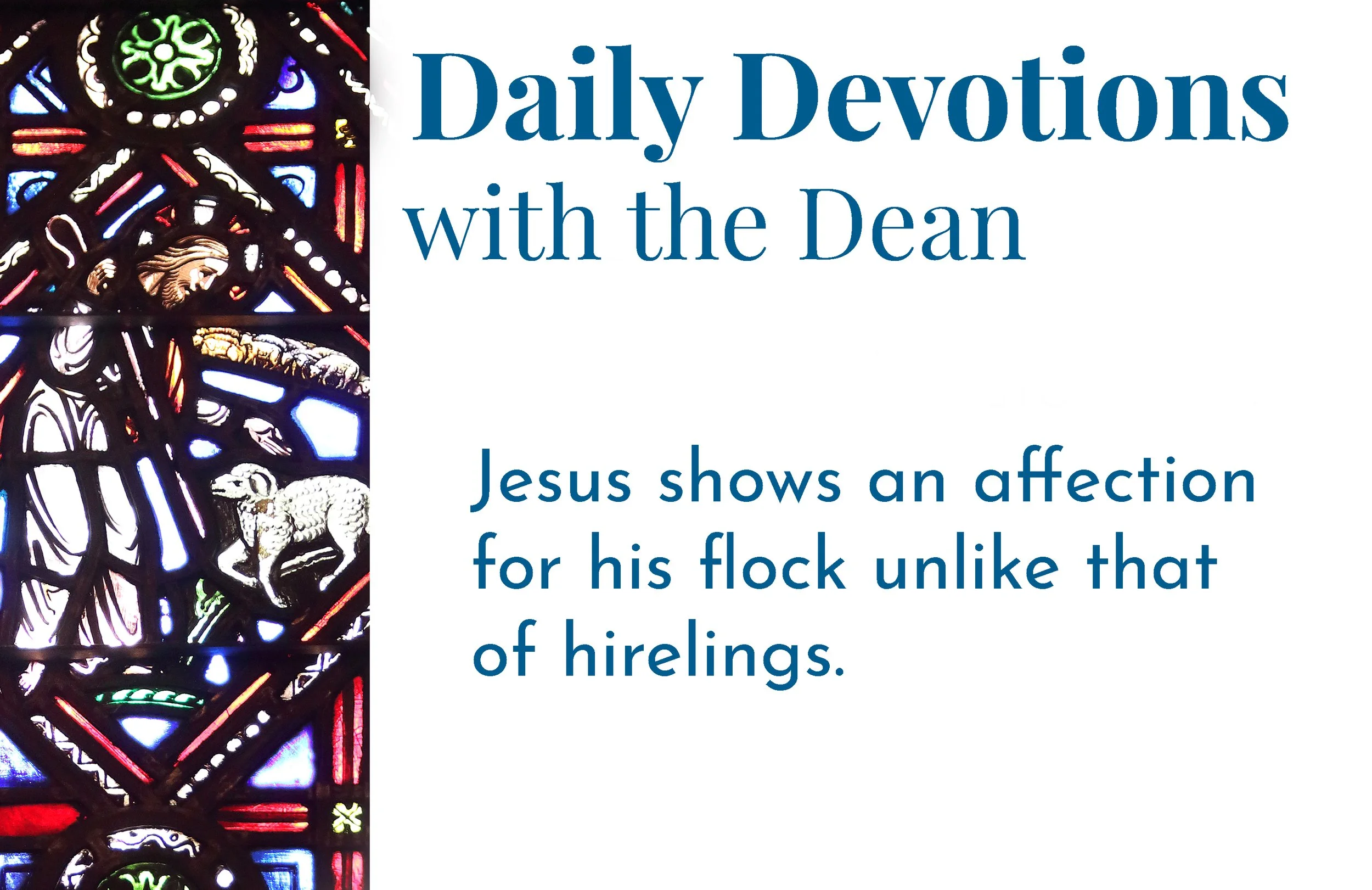
Image: Pixabay

God Continues to Work His Plan - Daily Devotions with the Dean

Wednesday • 2/9/2022
Wednesday of 5 Epiphany, Year Two

This morning’s Scriptures are: Psalm 119:97–120; Genesis 27:1–29; Romans 12:1–8; John 8:12–20 

For comments on Romans 12:1–8 from DDD 7/16/2020

This morning’s Canticles are: following the OT reading, Canticle 11 (“The Third Song of Isaiah,” Isaiah 60:1-3,11a,14c,18-19, BCP, p. 87); following the Epistle reading, Canticle 16 (“The Song of Zechariah,” Luke 1:68-79, BCP, p. 92)


Virtually every day gives me reason to thank God for this one truth: it is a mercy that the God of grace works his design to do us good despite our sometimes purposeful and sometimes unwitting penchant for fouling things up. I see this truth within myself. I see it in the people around me. I read it in the headlines. And I read it in the Bible. Every person in today’s account of Isaac’s blessing of Jacob acts in an unworthy, if not horrible, manner. Still, through all their questionable acts God advances his gracious plan to redeem the world.

Isaac and Rebekah both know that Yahweh has prophesied that their second son will receive the family inheritance, not their first-born: “And the LORD said to [Rebekah], ‘Two nations are in your womb, and two peoples born of you shall be divided; the one shall be stronger than the other, the elder shall serve the younger’” (Genesis 25:23). 

Moreover, Esau has sold his birthright to his younger brother: “Jacob said, ‘Swear to me first.’ So [Esau] swore to him, and sold his birthright to Jacob” (Genesis 25:33).

In defiance of what he knows, Isaac conspires with Esau to thwart God’s plans as well as the standing agreement between Esau and Jacob. Nor are Rebekah and Jacob innocents in the incident, as commentator Derek Kidner observes, “Rebekah and Jacob, with a just cause, made no approach to God or man, no gesture of faith or love, and reaped the appropriate fruit of hatred.”* 

Treachery and deceit win the day, as does, ironically, God’s sovereign will for the deliverance of the world through Abraham’s line. That God continues to work his saving plan through sinners desperately in need of salvation is, well, the point. Jacob’s very name testifies to God’s power to work through the mixed motives of his subjects. Jacob’s name can mean “May God be your rearguard” (that is, “…at your heels to protect you”). But instead of living up to his name, Jacob lives down to its other possible meaning: “You will grasp another by the heel.” He could be “Faith-filled.” Instead, he is “Supplanter” of his brother — and in today’s account, his mother is co-supplanter. 

Nonetheless, as Isaac himself eventually confesses, “Yes, and blessed [Jacob] shall be!” (Genesis 27:33b). And the writer to the Hebrews recognizes there is at least a kernel of faith in the blessing that has been coaxed out of Isaac under false pretense: “By faith Isaac invoked blessings for the future on Jacob and Esau” (Hebrews 11:20). 

John does a lovely thing when he juxtaposes Jesus’s teaching at the Festival of Booths that he is the source of living water (John 7) with his teaching that he is the Light of the World (John 8). Water and light happen to be main themes of the Festival of Booths. At the Festival of Booths, Israelites celebrated not only the future coming of the Spirit who would pour refreshing waters over the earth, but they celebrated Israel’s identity and destiny as bearers of God’s light to the nations. Moreover, Jesus claims that light to be himself, and that destiny to be his own, and therefore the destiny of all who belong to him and come to him. 

John begins his gospel by announcing that Jesus Christ has brought light into the world: “The light shines in the darkness, and the darkness did not overcome it,” says John (1:4,5). Thus, it is doubly lovely that the way John’s gospel came together,  the story of the woman caught in adultery is sandwiched between the themes of Living Water and the theme of the Light of the World. He is Living Water for souls in need of cleansing from sin — sin overt (like hers) and sin covert (like those of her accusers). He is Light of the World for image bearers stumbling in the dark of self-made rules for living and the harsh consequences thereof.  

I pray we live in the wonderful knowledge that our God graciously rules all things. He will not be thwarted in his design to reconcile heaven and earth through his Son. He is the God of whom Paul says, “He who began a good work in you will be faithful to complete it until the day of Christ Jesus” (Philippians 1:6 my translation). He will not fail to see through to the end the good work he has begun in each of his children. That includes you and me. It includes us when we are at our best and when, like Isaac and Rebekah and Isaac and even Esau, we are at our worst. God’s Son Jesus has come as the Light of the World, and “the darkness did not overcome” the Light. 

Collect for the 5th Sunday after Epiphany. Set us free, O God, from the bondage of our sins, and give us the liberty of that abundant life which you have made known to us in your Son our Savior Jesus Christ; who lives and reigns with you, in the unity of the Holy Spirit, one God, now and for ever. Amen. 

Be blessed this day, 

Reggie Kidd+

Image: Pixabay

* Derek Kidner, Genesis, p. 155. 

Our Great Shepherd - Daily Devotions with the Dean

Tuesday • 2/8/2022
Tuesday of 5 Epiphany, Year Two 

This morning’s Scriptures are: Psalm 78; Genesis 26:1-6,12-33; Hebrews 13:17-25; John 7:53-8:11

For comments on John 7:53–8:11 from 12/9/2020 

This morning’s Canticles are: following the OT reading, Canticle 13 (“A Song of Praise,” BCP, p. 90); following the Epistle reading, Canticle 18 (“A Song to the Lamb,” Revelation 4:11; 5:9–10, 13, BCP, p. 93)


Closing out Hebrews’ “brief word of exhortation”

We are learning precious truths about: our great God, our great Shepherd, ourselves, our great fellowship, the coherence of the New Testament’s message.

Our great God. May the God of peace…” Notice who he is: the God of peace — our Father God is himself the source in eternity of a covenant to reunite heaven and earth. He is not the wrathful, vindictive tyrant he is often caricatured to be. He is not an insecure, fickle Zeus who is torqued because Prometheus has brought us fire. Our God’s goal and intent from eternity is our flourishing, and our rising to the full stature of bearing his own divine character (2 Peter 1:4). 

Our great God and Father is the one who sent his Son as Apostle and High Priest to reclaim us for that high calling. Notice what he has done: he raised Jesus from the dead. And notice the careful phrasing of verses 20 and 21: “May the God of peace …make you complete … so that you may do his will, working in you that which is pleasing in his sight.” Our great God works to equip us to do what aligns with who he is, and then he does that very work within us. 

Ourselves. Every one of us feels, I’m certain, the drag of “the sin that clings so closely” (Hebrews 12:1). Some of us have even, perhaps, felt the temptation to adjust the requirements of faith in apostate ways (like the congregation of the Hebrews — see Hebrews 6). But as we’ve just seen, we have something powerful within us: God himself working (as Paul put the same thought) “both the willing and the working” (Philippians 2:13). We have the privilege of cooperating with a most amazing, transformative process: our own makeover. We are created and destined to reclaim our stature as lords and ladies of the universe! Recall the way Hebrews 2:6–8 cites and comments on Psalm 8: “Now God did not subject the coming world, about which we are speaking, to angels. But someone has testified somewhere, What are human beings that you are mindful of them …  you have crowned them with glory and honor, subjecting all things under their feet.’ … As it is, we do not yet see everything in subjection to them, but we do see Jesus….” We see him, in fact, as Lord in advance of our return to the lordship we lost at the Fall. And now we enjoy the Father’s work in us, by the Spirit of his Son, molding us in that direction—an onboard presence to steer and to guide, as the hymns puts it. Amazing, but true. 

Our great Shepherd. “…our Lord Jesus, the great shepherd of the sheep…” (Hebrews 13:20b). It is because Jesus has shed his blood for us that we can know we are forgiven. It is because he has been raised from the dead that he can now serve as our Shepherd, guiding us in our living and leading us in our worship. 

Our great fellowship. We have in front of us the example of Jesus. We have above us a great cloud of witnesses. We have the presence of one another around us “stimulating us to love and good works.” 

We have leaders so that we may “stimulate one another” well: “Obey your leaders and submit to them, for they are keeping watch over your souls and will give an account. Let them do this with joy and not with sighing—for that would be harmful to you” (Hebrews 13:17). The NRSV translation of the first sentence in this verse is perhaps a bit misleading (see discussion below). The thrust of the verse is that we trust that our spiritual leaders’ joy lies in helping us flourish. And the Lord will hold them to account for that. Our job is to receive  what serves to help us thrive in our relationship in Christ and with each other.  

Our great tradition. Nobody knows exactly who wrote this magnificent treatise on Jesus as our great High Priest and our need to stay true to him. Because the writer speaks of “exhortation/encouragement” (paraklēsis) in verse 22, because he is attentive to the contours of the priesthood, and because Joseph Barnabas was a Levite who came to be called “Son of Encouragement” (huios paraklēseōs — Acts 4:36), some people think Barnabas wrote the letter to the Hebrews. Some people notice how similar the Alexandrian manner of contrasting earthly things with heavenly things is, and they conclude the highly articulate Alexandrian Apollos wrote it (see Acts 18:24). Still others, sensing strong affinities with Paul’s thinking throughout Hebrews, and noticing that the writer references “our brother Timothy” and seems to be writing from Italy (the place of the last citing of Paul — see 2 Timothy), believe Paul may be the author. 

We just don’t know. What’s wonderful to me is that the overall coherence and congruence of the great teachers and leaders of the New Testament era is such that any of them could have given us this masterpiece from God. They were that much in sync. What a great tradition they have passed on to us!

I pray we can walk confidently in the great fellowship of those who know the God of peace, who has called us to life through his Son the Great Shepherd of the sheep, and who nurtures our life together in the Holy Spirit. Amen. 

Be blessed this day, 

Reggie Kidd+

Image: Pixabay

*The first verb in this sentence (which the NRSV renders “obey”) is peithesthe, a passive imperative from a verb that in the active voice means “persuade.” In the passive voice, it means “be persuaded by.” The second verb (which the NRSV renders “submit”) is hupakouete, and is normally translated “obey”; but its etymology is revealing. Its parts are hupo, which means “under,” and “akouein,” which means “to hear” — it’s not naked, unthinking submission or blind obedience that is called for, but rather a “coming under the hearing of.” In combination, peithesthe upakouete mean “listen to your leaders with a readiness to receive what they teach; listen attentively and discerningly.”