Daily Devotions

A Divine Sweetness - Daily Devotions with the Dean

Wednesday • 12/22/2021
Wednesday of the Fourth Week of Advent

This morning’s Scriptures are: Psalm 72; 2 Samuel 7:1–17; Titus 2:11–3:8a; Luke 1:39–56

This morning’s Canticles are: following the OT reading, Canticle 11 (“The Third Song of Isaiah,” Isaiah 60:1-3,11a,14c,18-19, BCP, p. 87); following the Epistle reading, Canticle 16 (“The Song of Zechariah,” Luke 1:68-79, BCP, p. 92)


I love Tootsie Roll Pops! I loved them as a kid! I love them now! I love slowly sucking the sweet hard candy shell nearly through, and lightly crunching through to the soft chocolate center, making sure not to bite all the way into it, so I can savor sucking the chocolate inside all the way to the stick. Oh my! I love the outer/inner duality of Tootsie Roll Pops! 

Israel’s outer core: hope for humanity. I love Israel’s story of a coming human king who will deliver humanity from lawlessness, false religion, poverty, depression, and despair. I love the sweet hard candy of humanity’s hopes for salvation through a son of David. I love today’s promise to David in 2 Samuel of a perpetual line of righteous human kings. I love the way Psalm 72 celebrates the embodiment of that kind of rule under David’s son Solomon. I love Mary’s paean of praise to the God who has graced her womb with the king that David and Solomon had prefigured. 

Israel’s inner core: a taste of divinity. And I love that all along there had been the hints of an inner core of a deeper, different kind of sweetness, the taste of divinity. It would take, for instance, the appearance of more than a man for David’s throne to “be established forever” (2 Samuel 7:16). A Solomon who will “live as long as the sun and moon endure” is more than a mere mortal (2 Samuel 7:16; Psalm 72:5). Mary’s song comes from a heart overwhelmed with the realization that she is mother of no less than her own Lord (Luke 1:43). 

Christmas Day’s inner core for Crete. Israel’s story always carried within it the promise of a Tootsie Roll Pop dual sweetness. More, it seems, than any group the New Testament addresses, the Cretans need a taste of the inner sweetness. Cretans’ predisposition to elevate humanity to deity prompts Paul to compose some of the most thrilling verses in the Bible, and they have to do with the wonder of Jesus’s divinity, the core and the center of the Bible’s promises to us. 

Titus 2:11-3:8 contains verses that have rightly asserted themselves as Christmas Day passages in the lectionary. Here Paul exults in the great “epiphany” of God that took place at the Incarnation. Jesus is not human ego projecting itself into the heavens, but divine humility pressing itself into the stuff of our lives. Jesus is the divine sweetness at the core of Israel’s and all of humanity’s story. 

But when the goodness and loving kindness (philanthrōpia) of God our Savior appeared…” (Titus 3:4). Jesus came to show the gracious, kind, and loving character of God. This is Paul’s way of saying what Jesus says in John’s Gospel: “If you have seen me, you have seen the Father” (John 14:9). 

To too many people, God looks sinister like J. K. Rowling’s Voldemort; predatory like Nightmare on Elm Street’s Freddy Kreuger; or unbendingly judgmental like Les Miserables’ Jabert. It’s not a new problem. Zeus punished Prometheus for having too much philanthrōpia, that is, for acting too much as though the gods had loving kindness towards humans (Aeschylus, Prometheus Bound 11,28). 

But when God himself appeared among us, says Paul, he showed us that God’s face turned towards us is a face of kindness and affection. “He it is who gave himself for us that he might redeem us from all iniquity and purify for himself a people of his own…” (Titus 2:14ab) and “so that, having been justified by his grace, we might become heirs according to the hope of eternal life…” (Titus 3:7).” Here Paul explains the significance of the cross on which the Son of God and our Savior died. “God so loved the world that he gave his only begotten Son,” John tells us (John 3:16). Here, Paul tells us that Jesus the only begotten Son loved us so much that he gave himself to purchase us from sin, and to make us part of his Father’s family and citizens of the kingdom of heaven. 

[H]e saved us, not because of any works of righteousness that we had done, but according to his mercy, through the water of rebirth and renewal by the Holy Spirit. This Spirit he poured out on us richly through Jesus Christ our Savior…” (Titus 3:5ac,6). Here Paul explains the significance of Christ’s  resurrection and ascension.  Jesus has made us new by the outpouring of the Holy Spirit on his church: humans’ ascent by divinity’s descent. We know the confidence of justifying grace and the security of our place in God’s family here and in eternity through the Spirit of Jesus within us. 

For the grace of God has appeared, bringing salvation to all, training us to renounce impiety and worldly passions, and in the present age to live lives that are self-controlled, upright, and godly…” (Titus 2:11–12) and “who are zealous for good deeds” (Titus 2:14c). Jesus came to teach the way of life: godliness rather than religious lies, justice rather than cruelty, and self-control rather than self-indulgence. With God alongside us and among us and in us, we are no longer servants of ourselves (subject to no authority but our own, hating one another, slaves to various passions and pleasures—see Titus 3:1–3). With Jesus’s teachings codified in the New Testament and with his personal presence in us via the Holy Spirit, he causes us to burn with a passion to make life beautiful for others.

May you, this Advent and Christmas season, taste the dual sweetness of your own very human life being graced with the very presence of God.

O holy Child of Bethlehem, descend to us, we pray; 
cast out our sin, and enter in, be born in us today. 

Be blessed this day, 

Reggie Kidd+

That They May Be an Ornament - Daily Devotions with the Dean

Tuesday • 12/21/2021
Tuesday of the Fourth Week of Advent, Year Two 

This morning’s Scriptures are: Psalm 66; Psalm 67; 1 Samuel 2:1b–10; Titus 2:1–10; Luke 1:26–38

This morning’s Canticles are: following the OT reading, Canticle 13 (“A Song of Praise,” BCP, p. 90); following the Epistle reading, Canticle 18 (“A Song to the Lamb,” Revelation 4:11; 5:9–10, 13, BCP, p. 93)


 Titus: living counter-culturally

The me-centered religious spirit of Crete (“Cretans always lie,” which, in context, translates: “I can be a god!”)* creates a culture of cruelty and self-indulgence (“vicious beasts and lazy gluttons”).  

Paul’s antidote is twofold: he wants Titus to counter with what we translate as “sound doctrine,” but which might better be rendered “healthy teaching” (Titus 2:1). The word translated as either “sound” or “healthy” is hugiēs. It’s a medical term, from which we get “hygiene.” Teachers in the Greek world of Paul’s day saw themselves more as physicians of the soul, and less as experts about ultimate reality. At the end of Titus 2 and the middle of Titus 3, Paul will describe the basic elements of “sound doctrine” or “healthy teaching”—theology that revivifies people who were dead to God, and that brings heart-health and soul-satisfaction.** 

Those truths will counter the lies of a culture that says: “We can make ourselves into gods!” Before getting to those truths, though, Paul addresses the lifestyle that accompanies and supports those health-producing truths. There is a way of “being” and “behaving” that corroborates “right believing.” 

Here’s the way Paul begins and ends today’s paragraph to Titus: “But as for you, teach what is consistent with sound doctrine” (Titus 2:1). “…show complete and perfect fidelity, so that in everything they may be an ornament to the doctrine of God our Savior” (Titus 2:10). In the face of the cruelty and self-indulgence rampant in their social world, Cretan Christians have the amazing opportunity to show “what is consistent with” and what is “an ornament to” the profound truths of the gospel. They become their own proofs of the truths they present. 

Paul instructs older men, for instance, to conduct their lives with (among other things) temperance and love (Titus 2:2), the opposite of being lazy gluttons and vicious beasts. He calls older women, younger women, and younger men to refuse to neglect others’ needs for the sake of their own: “…not to be slanderers or slaves to drink … love their children, to be self-controlled” (Titus 2:3,4). 

There’s something for us to think about even in Paul’s instruction for slaves, despite the chasm between the first century world and ours. It would have been interesting to see how Paul would address wicked “Christian” slaveholders like those Frederick Douglass describes in his autobiography who viciously beat their slaves when they try to learn to read so they can understand the Bible. We don’t know exactly how household slavery worked in the Crete of Paul’s day. Regardless, Paul saw an opportunity for slaves to show an extraordinary dignity by refusing to lower themselves to backtalk and pilfering, and instead to show themselves worthy of any trust accorded to them. In this way, in a world in which everybody is in it for themselves, these slaves “adorn the doctrine of God our Savior” (Titus 2:10 RSV). The Greek word “ornament” (NRSV) or “adorn” (RSV) is kosmein, from which we get “cosmetics” and “cosmetology.” These servants of Christ beautify God by their way of being. 

Twice Paul says “…so that the word of God may not be discredited” (Titus 2:5) and “…having nothing evil to say of us” (Titus 2:8). The French Catholic commentator Ceslas Spicq suggests these are elegant litotes (negative statements that make a positive point): they display the logic by which the gospel would eventually win the Roman Empire through the lives of the saints. Artfully, Paul crowns the paragraph by giving the greatest dignity to the least of Christ’s servants: their fidelity and truthfulness in a world of selfishness and dissembling make God’s truth beautiful. 

Wherever you are today, I pray God gives you wisdom to discern how to make the character of God our Savior both visible and believable—and gives you the grace to pull it off! 

Be blessed this day, 

Reggie Kidd+

*See yesterday’s DDD. 

**See tomorrow’s DDD.

A Renewal of Our Wonder - Daily Devotions with the Dean

Monday • 12/20/2021

Monday of the Fourth Week of Advent, Year Two 

This morning’s Scriptures are: Psalm 61; Psalm 62; Zephaniah 3:14–20; Titus 1:1–16; Luke 1:1–25

This morning’s Canticles are: following the OT reading, Canticle 9 (“The First Song of Isaiah,” Isaiah 12:2–6, BCP, p. 86); following the Epistle reading, Canticle 19 (“The Song of the Redeemed,” Revelation 15:3–4, BCP, p. 94)


Paul has given Titus, one of his most senior proteges, a daunting task: to make the wonder of the Incarnation make sense to a people who already have their own upside-down ideas about how God could be born among humans. In ancient times, the island of Crete claimed to be home to Zeus, a human who became divine. Cretans claimed to be able to show both where Zeus was born and where he was buried. They claimed the good deeds he had performed for others had won him his deity.*

Titus’s job is to persuade Cretans that, by contrast, the Jesus whom Paul had preached among them was not a mere man who ascended to deity, but is “our great God and Savior” who has come down to us. In Titus 2 and 3, Paul will describe Jesus as the very embodiment of God’s “grace” (Titus 2:11) and God’s “goodness and loving kindness” (Titus 3:4).

In Titus 1, however, as prelude to commending the incarnation, Paul exposes what’s wrong with the Cretan view. He enlists the aid of an ancient Cretan prophet, a self-critical voice from within Cretan culture. With no small irony, the Cretan prophet whom Paul quotes (usually identified by scholars as the 6th-century B.C. seer and poet Epimenides) says “Cretans are always liars!” (Setting up a famous logical problem: if a Cretan tells you Cretans always lie, is his statement true or false? Think about it.)

The full quote that Paul derives from the Cretan prophet is: “Cretans are always liars, vicious brutes, lazy gluttons” (Titus 1:2). The essence of the Cretan prophet’s self-critique is that bad religion (“Cretans are always liars”) has created among the Cretans a vicious social climate (“vicious brutes”) and a populace with a self-indulgent personal ethic (“lazy gluttons”). 

There is plenty for each of us to ponder right here: How do our bad ideas about God make us uncivil towards others and indulgent towards ourselves? Especially to the extent that we entertain the Cretan idea that we are born as gods-in-the-making, each of us the center of the universe. Narcissism is as narcissism does! 

For his part, Paul argues that his opponents in the church offer no help. Merely teaching morality from Jewish heroes of the past does not curb anti-social behavior. Nor does performing fleshly, external rites of passage, like circumcision, curb uncontrolled cravings, for, “To the pure all things are pure, but to the corrupt and unbelieving nothing is pure” (Titus 1:15a). No, something deeper needs to happen within us. And that takes place not because we make ourselves into little gods, but because God himself has truly come down to us. 

Each in their own way, Zephaniah and Luke wondrously point us in the right direction. 

Zephaniah is a fourth-generation prophet who ministers in Judah in the years before the Assyrian and Babylonian conquests. Deeply immersed in the logic of God’s covenant, in Zephaniah 1, he blasts God’s people with the bad news of the judgment that is coming: “The day of the LORD … will be a day of wrath, a day of distress and anguish, a day of ruin and devastation, a day of darkness and gloom” (Zephaniah 1:14–18). His words inspired the Dies Irae musical motif, one of the most easily recognized musical themes in the history of Western music, frequently showing up in movie scores—always a harbinger of judgment. 

What is so lovely about today’s passage from Zephaniah is how it is revealed to the prophet that God’s own mercy and love will at last win out. The people will not make themselves better. They will not merit their rescue. But God himself will come among them to reclaim them. He will champion them once again with his love, and he will sing over them a song not of judgment, not of Dies Irae, but a song of joy and gladness, and of love renewed and celebrated: “[Yahweh] will rejoice over you with gladness, he will renew you in his love; he will exult over you with loud singing as on a day of festival” (Zephaniah 3:17). Rightly did one of my seminary professors refer to Zephaniah 3:17 as the John 3:16 of the Old Testament!

And the opening verses of Luke’s gospel are a perfect start to the week leading up to Christmas Day. Here Luke announces his intention to provide a well-researched and orderly account of the events of Jesus’s life and work. He says that he does so in order that his readers, “most excellent Theophilus” (Greek = “Friend of God”)—and, by extension, you and I (also friends of God)—may have full assurance of the things in which we have already been instructed (Greek = katēchthēs, “in which you have been catechized”—Luke 1:4). This week’s readings in Luke include the Song of Zechariah and Mary’s Magnificat—answers to Zephaniah’s promise of God’s song among his people. May we find here renewal of our wonder at the goodness of God’s good news. 

May today’s rich texts prove for us what Anselm said, that faith seeks (and finds) understanding. 

Be blessed this day, 

Reggie Kidd+

*See Reggie M. Kidd, “Titus as Apologia: Grace for Liars, Beasts and Bellies,” Horizons in Biblical Theology, 21.2, Dec. 1999, pp. 185–209; and the excellent treatment of Titus overall in Philip Towner, The Letters to Timothy and Titus (New International Commentary on the New Testament), Eerdmans, 2006. 

Armor of Light - Daily Devotions with the Dean

Friday • 12/17/2021
Friday of the Third Week of Advent, Year Two 

This morning’s Scriptures are: Psalm 40; Psalm 54; Zechariah 7:8–8:17 (includes Saturday’s reading); Revelation 5:6–14; Matthew 25:14–30

This morning’s Canticles are: following the OT reading, Canticle 10 (“The Second Song of Isaiah,” Isaiah 55:6–11; BCP, p. 86); following the Epistle reading, Canticle 18 (“A Song to the Lamb,” Revelation 4:11; 5:9–10, 13, BCP, p. 93)


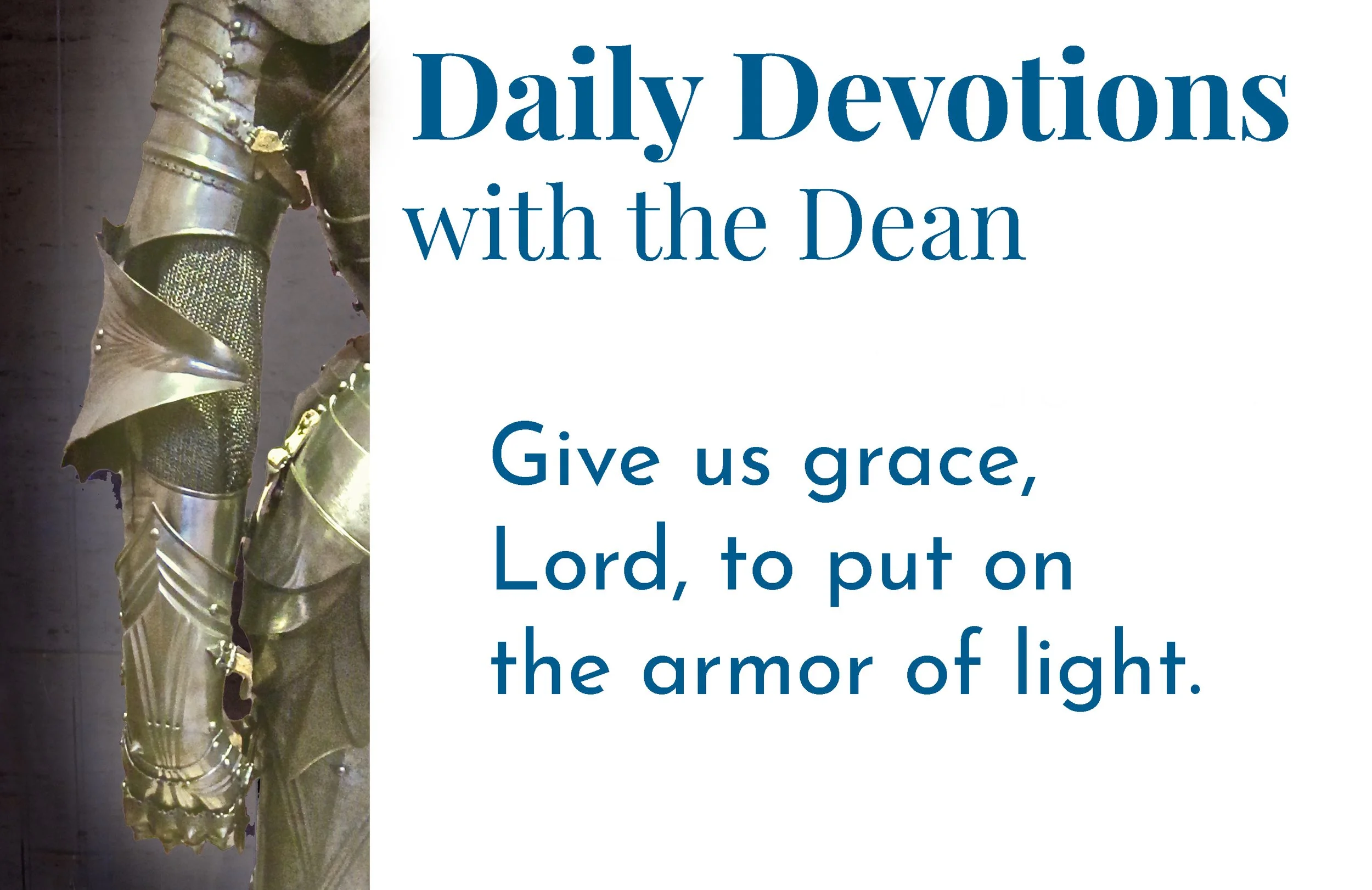
Advent’s keynote Collect keeps coming to mind, and I find myself praying it constantly this Advent season: Almighty God, give us grace to cast away the works of darkness, and put on the armor of light, now in the time of this mortal life in which your Son Jesus Christ came to visit us in great humility; that in the last day, when he shall come again in his glorious majesty to judge both the living and the dead, we may rise to the life immortal; through him who lives and reigns with you and the Holy Spirit, one God, now and for ever. Amen.

Today’s passages prompt meditation on casting away works of darkness and putting on armor of light. 

Zechariah. In Israel, the world was supposed to see what bearing God’s image looks like. Surrounding nations were supposed to see what God’s heart looks like in the way that Israelites lived their lives: committed to truthfulness, showing kindness and mercy especially to the lowly and the lost (Zechariah 7:9–10). God’s complaint, via Zechariah, is that he had placed Israel among the nations to be light amid darkness, but that they had contributed as much to the darkness as anybody. In place of justice, Yahweh found oppression; instead of kindness and mercy, hearts filled with evil intent; instead of ears attuned to God’s law and hearts ready to obey, ears purposefully stopped up and hearts adamantly set against God’s ways (Zechariah 7:11–12). Lord, have mercy!

But God’s redemptive purposes for Israel and the world can be held back only so long: “Just as you have been a cursing among the nations, O house of Judah and house of Israel, so I will save you and you shall be a blessing” (Zechariah 8:13). Yahweh brings his children home and promises peace and prosperity so they can return to their basic mission in this world as a kingdom of priests and as God’s “peculiar possession”: “Speak the truth to one another, render in your gates judgments that are true and make for peace” (Zechariah 8:16; and see Exodus 19:5,6). 

Judah’s and Israel’s return to the land is a call to cast away the works of darkness (deceit in the marketplace, in their courts, and in their worship; and oppression of the poor in their social life) and to put on the armor of light (truthfulness, peaceability kindness, and mercy). In doing so, Zechariah promises, they will receive his blessing: “For there shall be a sowing of peace; the vine shall yield its fruit, the ground shall give its produce, and the skies shall give their dew; and I will cause the remnant of this people to possess all these things” (Zechariah 8:12). 

Revelation. The generation of Zechariah, Zerubbabel, and Joshua experience in a promissory way the wonderful reality of God’s people being a light in the darkness of human experience, of modeling redemptive life amid fallen darkness. 

In the New Testament we find the fulfillment of Zechariah’s vision in the appearance of Jesus Christ. As the Lion of Judah who is slaughtered as a Lamb, Jesus removes forever the stench and the stain of sin. He ransoms for God people from “every tribe and language and people and nation” (Revelation 5:9b). Fittingly, then, the heavenly courts sing to Jesus “a new song”: “you have made them to be a kingdom and priests serving our God, and they will reign on earth” (Revelation 5:9,10). 

Matthew. On behalf of this same Jesus, Matthew addresses Jesus’s Parable of the Tenants to the church. As a result of his atoning death, the resurrected Jesus has received “all authority in heaven and on earth” (Matthew 28:18). If I may compress some of Jesus’s teachings in Matthew: with Emmanuel our King (“God with us”) living among and within us, we so manifest God’s life on this earth, whether by deed (“light of the world” … “salt of the earth” … “a city on a hill”) or by word (“making disciples … teaching … baptizing”), that at the end of time, people will have to acknowledge Jesus’s lordship (“… they will glorify your Father in heaven”—Matthew 5:13,14,16; 18:20; 28:20). 

The Parable of the Talents takes its place within the larger context of Jesus’s teaching in Matthew by showing us that each of us is given some place of authority and some empowerment within that great mission. How tragic it would be, according to the parable, if at the end of time we were to show ourselves contemptuous of the Lord who, like “a man going on a journey,” had so graciously entrusted us with a share of his estate. How magnificent it will be, by contrast, to find that our faithful use of what gifts and authority he has assigned us will doubly redound to his glory and to our own honor. 

It is a staggering prospect—enough to prompt the Advent prayer: help us, Lord, to “cast away the works of darkness, and put on the armor of light, now in the time of this mortal life…” Amen!

Be blessed this day,

Reggie Kidd+

Image: adaptation from "Armor by Helmschmied" by ellenm1 is licensed under CC BY-NC 2.0

Oli in Our Lamps - Daily Devotions with the Dean

Thursday • 12/16/2021
Thursday of the Third Week of Advent, Year Two

This morning’s Scriptures are: Psalm 50; Zechariah 4:1–14; Revelation 4:9–5:5; Matthew 25:1–13

This morning’s Canticles are: following the OT reading, Canticle 8 (“The Song of Moses,” Exodus 15, BCP, p. 85); following the Epistle reading, Canticle 19 (“The Song of the Redeemed,” Revelation 15:3–4, BCP, p. 94)


Many of us know what it is to look over the landscape of our lives and see devastation. Whether it’s being abandoned by parents or a spouse, being under-appreciated at work, seeing our body succumb to disease, or losing our willpower to resist an addiction or an obsession. Sometimes, surveying the wreckage of our lives can be debilitating. 

For such a time, Yahweh gives Zechariah a vision of hope. In 520 B.C., Jerusalemites inhabited a desolate city. Where Solomon’s temple had once stood, they could see only rubble. Under the leadership of Joshua the priest and Zerubbabel the governor, a foundation had recently been laid for a new temple. But, still, the overall scene was bleak, like a movie depiction of post-apocalyptic destruction. 

Through a fourth nighttime vision he gives to Zechariah, Yahweh invites his people to imagine the temple as though it had already been rebuilt and furnished. Yahweh highlights two furnishings: a golden lampstand and two olive trees (I’m not sure what olive trees are doing inside the temple—but dreams have their own logic!). Combining the symbolic elements of both furnishings, Yahweh urges them to understand that no matter how bad things look, there’s nothing he can’t accomplish by his Spirit.

Not by might, nor by power, but by my spirit, says the LORD of hosts” (Zechariah 4:6). The oil of the lampstand and the oil which the olive tree produces are symbols of God’s life-giving, light-bearing, power-releasing Spirit. God’s fuel will keep the lights on in the temple. God’s strength will keep the workers working and the enemies and detractors at bay. 

‘What are these two branches of the olive trees, which pour out the oil through the two golden pipes?’ He said to me, ‘Do you not know what these are?’ I said, ‘No, my lord. Then he said, ‘These are the two anointed ones who stand by the Lord of the whole earth’” (Zechariah 4:12–14). In Zechariah’s day, two offices received an empowering anointing: Joshua the priest, and Zerubbabel the governor, one to pray and the other to govern. The glory of the new order that Jesus would institute six centuries later is the combining of these roles into one: a Priest-King, after an older order, that of Genesis 14’s Melchizedek, who is both “king of righteousness” and “priest of the Most High” (see the Epistle to the Hebrews in toto).  

The hands of Zerubbabel have laid the foundation of this house; his hands shall also complete it. … [W]hoever has despised the day of small things shall rejoice…” (Zechariah 4:9–10). Who could have imagined what this “day of small things” would yield? Fast forward to the astounding vision in Revelation of the Lion of Judah stepping forward in answer to the question as to who has the moral right and the capacity to unfold the scroll of human history: “‘Who is worthy to open the scroll and break its seals?’ … ‘See, the Lion of the tribe of Judah, the Root of David, has conquered, so that he can open the scroll and its seven seals’” (Revelation 5:2b,5b). 

Refusing to wither in the face of adversity and of the enormity of the task set before them, Zechariah and Zerubbabel and Joshua gamely play their part in their “day of small things.” May God give us grace to do the same. 

Matthew: keeping oil in our lamps. Advent normalizes our waiting. Therein lies its poignance! Advent says that it’s OK to have a hard time holding onto hope when the horizon seems far off … and that it’s not OK to give up and quit hoping. That’s the entire point of Jesus’s parable about the bridesmaids. Through a long night watch, their one job is to be on the alert to welcome the groom. Half come prepared to do so and do stay on the alert. Half don’t come prepared, and finally must abandon their calling. As we’d put it colloquially, they run out of gas. Our job is to be among those who keep hoping and not run out of gas. 

Zechariah the prophet was given a glimpse of the great things that God was going to do to build his Kingdom; and his generation had no small part in keeping that hope alive. Joshua the priest and Zerubbabel the governor were called to envision a rebuilt temple and to work towards it, knowing all the while that it was “not by might, not by power,” but by God’s Spirit that the work would get done. But the true temple building awaited the appearing of Christ who united the work of Prophet, Priest and Prince; brought the whole system of sacrifice to its perfect end; and ushered in God’s righteous rule. 

God’s Kingdom has been inaugurated in all the events that flow out of Christ’s birth at Christmas. God’s Kingdom will be consummated at the end of time when Christ returns in triumph and power. In the meantime, God’s Kingdom continues among us in our Advent lives, as we learn to find hope in the ashes of our lives.* At Advent, we renew our commitment to count on the promise that God burns only to refine, that he wastes none of the tears of his loved ones, and that he makes every instance of suffering a “fellowship in the sufferings of Christ” himself (see Philippians 3:10). 

Richest Advent blessings to you this day, 

Reggie Kidd+ 

*Thanks to my friend Richard Pratt for his pithy way of putting the three-phase coming of God’s Kingdom: inauguration, continuation, and consummation. 

Image: Bíblia de Cervera, Menorá de Zacarias from National Library of Portugal , Public domain, via Wikimedia Commons

A Fourth Vision of Hope - Daily Devotions with the Dean

Wednesday • 12/15/2021
Wednesday of the Third Week of Advent

This morning’s Scriptures are: Psalm 119:49–72; Zechariah 3:1–10; Revelation 4:1–8; Matthew 24:45–51

This morning’s Canticles are: following the OT reading, Canticle 11 (“The Third Song of Isaiah,” Isaiah 60:1-3,11a,14c,18-19, BCP, p. 87); following the Epistle reading, Canticle 16 (“The Song of Zechariah,” Luke 1:68-79, BCP, p. 92)


Zechariah receives a fourth nighttime vision of hope.Then he showed me the high priest Joshua standing before the angel of the Lord, and Satan standing at his right hand to accuse him. And the Lord said to Satan, ‘The Lord rebuke you, O Satan!’” (Zechariah 3:1). Satan the accuser’s accusations mean nothing when the Lord steps in. Despite the complicity of the priesthood in Israel’s guilt, Yahweh intends to bring purity back into worship. 

Symbolic of the guilt of past priests, Joshua the high priest appears at first with filthy garments. The LORD removes them and replaces them: “See, I have taken your guilt away from you, and I will clothe you with festal apparel” (Zechariah 3:5). 

Yahweh knows that this can be but a partial measure, because every priest, including this Joshua, is a sinner, and can offer only tainted offerings. Thus, Yahweh promises a better Priest. He informs Joshua that he and his colleagues “are an omen of things to come; I am going to bring my servant the Branch” (Zechariah 3:8b). Through that branch, Yahweh promises to “remove the guilt of this land in a single day” (Zechariah 3:9b). 

In Jesus Christ, that Branch has come. In his obedient life and in his sacrifice on the cross, Jesus Christ has removed the guilt of the whole earth “in a single day.” Praise be!

Revelation 4 (again)! A few weeks ago, the Daily Office Lectionary took us up to the Sunday of Christ the King (the culmination of the Christian Year) by telling us the destiny of two women, the Harlot of Babylon and the Bride of Christ (Revelation 12–22). History concludes with the separate destinies of these two. As part of the preface for that narrative, the Lectionary took us back to Revelation 4 and its throne room scene. 

Here in Advent at the beginning of a new Christian Year, the Lectionary has taken us through Revelation’s letters to the seven churches (Revelation 2–3). These letters are portals into the various travails and victories of the church—the Bride in Waiting— through the ages. Appropriately, after inviting us to read those letters, the Lectionary revisits the throne room scene. We need to be reminded of the glory that stands above us in the midst of our struggles here below. 

Things said a month ago are worth saying again: 

Now, with Chapter 4, the Lord begins to pull back the curtain that, for now at least, separates earth and heaven. He shows John (and us) what’s going on behind the scenes: “…and there in heaven a door stood open!” (Revelation 4:11b). In his vision, John is taken, in the first place, to the throne room, where the Creator of heaven and earth still governs. Here, God the Father sits on a throne in a setting redolent with colors of the rainbow—his symbol that he is both creator and preserver of his good creation (Revelation 4:3). 

Worship ascends to the Father from all of creation: from wild animal life (the lion), from domesticated creatures (the ox), from the birds of the air (the eagle), and from humanity (the human face—Revelation 4:6b). Twenty-four elders (Israel’s twelve tribes and Jesus’s twelve disciples) represent the full sweep of the biblical story, humanity’s true history and destiny. Each of the twenty-four has his own throne and crown. In humble adoration, each lays his crown at the feet of God. 

Week after week, the struggling church here below accepts the liturgy’s invitation to join this heavenly chorus in their unending song, “Holy, holy, holy, the Lord God the Almighty, who was and is and is to come” (Revelation 4:8b). Their song is our song as well. For when we sing, with them, of the worth of our Lord and God, we re-center our lives around the fact that reality is thicker than what we can perceive with our senses.

Matthew: how shall we then live? I borrow this sub-heading from a book that Francis Schaeffer and C. Everett Koop co-wrote in the mid-1970s, surveying the challenge that believers face in advocating for life in a death culture. Jesus intends his sobering parable about an abusive household steward, I think, to make us draw back in horror, and say “May it never be!” 

We have been so loved that Christ gave his life as a sacrifice for our sins (Matthew 26:28—the ultimate fulfillment of God’s promise to remove Joshua the high priest’s filthy clothes!). Christ has promised us his very presence each and every day (Matthew 18:20; 28:20). Christ has promised us a place in the coming renewal of all things: “Truly I tell you, at the renewal of all things, when the Son of Man is seated on the throne of his glory, you who have followed me will also sit on twelve thrones, judging the twelve tribes of Israel” (Matthew 19:28). 

The very thought that we who are beneficiaries of such great gifts and have been entrusted with such a high calling should live abusive and self-indulgent lives — a horrific thought! How should we then live, indeed? Well, that’s largely what Matthew’s glorious gospel is all about, beginning with, “Blessed are the poor in spirit,” and running all the way through, “Teaching them all that I have commanded you” (Matthew 5:3; 28:20). That is who we are! 

And that is why our keynote prayer in Advent is: Almighty God, give us grace to cast away the works of darkness, and put on the armor of light, now in the time of this mortal life in which your Son Jesus Christ came to visit us in great humility; that in the last day, when he shall come again in his glorious majesty to judge both the living and the dead, we may rise to the life immortal; through him who lives and reigns with you and the Holy Spirit, one God, now and for ever. Amen.

Be blessed this day,

Reggie Kidd+ 

Image: "O Radix Iesse" by Lawrence OP is licensed under CC BY-NC-ND 2.0 

"Most Freaking Awesome!" - Daily Devotions with the Dean

Tuesday • 12/14/2021
Tuesday of the Third Week of Advent, Year Two 

This morning’s Scriptures are: Psalm 45; Zechariah 2:1–13; Revelation 3:14–22; Matthew 24:12–44

This morning’s Canticles are: following the OT reading, Canticle 13 (“A Song of Praise,” BCP, p. 90); following the Epistle reading, Canticle 18 (“A Song to the Lamb,” Revelation 4:11; 5:9–10, 13, BCP, p. 93)


Laodicea: a warning, a knock, a promise

A sobering warning. I am about to spit you out of my mouth” (Revelation 3:15). The Book of Revelation’s Laodicea was a thriving city in west central Asia Minor, noted for its banking, medical school, and clothing industry. Christians there fit right in, thinking of themselves as wealthy and healthy; and they dressed the part. The angel of the Lord would have them understand otherwise: “[Y]ou say, ‘I am rich, I have prospered, and I need nothing.’ You do not realize that you are wretched, pitiable, poor, blind, and naked” (Revelation 3:17). 

Laodicea happened to be situated in a valley within eyesight of two other cities: Hierapolis, up on a nearby bluff, and Colosse (really more a small town) down in the same valley as Laodicea. Hierapolis was home to medicinal hot springs, from which Laodicea’s water was piped in. Naturally, by the time that water got to Laodicea, it was tepid in temperature. It no longer had the medicinal value attributed to it at its source. Nor was it refreshingly cool like the spring that supplied water to nearby Colosse. Laodicea’s water either had to be reheated for some purposes, or allowed to cool for other purposes. As it was, it was good for nothing. “I know your works; you are neither cold nor hot. I wish that you were either cold or hot.  So, because you are lukewarm, and neither cold nor hot, I am about to spit you out of my mouth” (Revelation 3:15–16). Be healingly hot or appetizingly cold, writes the angel, but not uselessly neither/nor! 

A gracious and persistent knock on the door. Listen! I am standing at the door, knocking; if you hear my voice and open the door, I will come in to you and eat with you, and you with me” (Revelation 3:20). The sobering thing about this verse is that it is addressed to people already inside the church. Somehow, the Laodicean Christians, with all their wealth and sense of well-being, had managed to lock him out! Yikes!!

I recall the sense of moral superiority that my Reformed teachers had in pointing out that evangelists who used this passage to appeal to non-Christians were taking it out of context. John, they rightly pointed out, doesn’t have a vision of Christ almost pathetically pleading with the unbeliever to let him in. 

But, I repeat, Yikes! In context, the vision is even more ominous than that. It’s a picture of Christ having been shut out of his own house, and now trying to get back in! That concerns me week after week as I show up at church to lead worship. Dear Lord, don’t let us lock the door on you! May we never let ourselves slide into a smug sense of superiority, so that we cannot feel the warmth of your passion for the lost or lose the wonder of the freshness of your presence. May we never become so content with our possessions, our sense of well-being, our being so well put together, that you become a mere chaplain to our religion of self. 

Until today’s wrestling with this passage, I had never thought to keep reading. I guess I was so struck by the strong warnings that I failed to see the promise that follows. 

An astounding promise. To the one who conquers (Greek, nikān, from which comes the name of the company Nike) I will give a place with me on my throne, just as I myself conquered and sat down with my Father on his throne” (Revelation 3:21). Here’s the very One who, at the beginning of the letter to the Laodiceans, names himself “the Amen, the Faithful and True Witness, the very Origin of God’s creation.” Here he is saying to those of us who can stir our hearts out of lukewarmness, who will come to him for riches, who will humble ourselves to wear white robes of his gifting, and who will admit that our blindness must be healed by the oil of his anointing (Revelation 3:18)—he is saying that if we do these things, he will consider us overcomers, victors, and conquerors. We won’t be wearing the Nike swoosh on our tee shirts. We ourselves will be walking and talking Nike swooshes. 

Not only that, but to us who have overcome, he will say, “Here, sit next to me. Share my rule and reign!” Un-freaking-believable. In fact, the early church coined a word for something like this: phrikodestatēs, or, in the vernacular, “most freakin’g awesome!” 

So, this Advent season, I pray that you and I refuse to succumb to the laze of lukewarmness, and that we determine not to lock the door on the overtures of our Savior. But, rather, that we dare to believe that the extraordinary goal of his incarnation is to raise us up to royalty, and not just any royalty, but a share in his own! 

Be blessed this day,

Reggie Kidd+

Image: iStock photo

Words of Comfort, Visions of Hope - Daily Devotions with the Dean

Monday • 12/13/2021

Monday of the Third Week of Advent, Year Two 

This morning’s Scriptures are: Psalm 41; Psalm 52; Zechariah 1:7–17; Revelation 3:7–13; Matthew 24:15–31

This morning’s Canticles are: following the OT reading, Canticle 9 (“The First Song of Isaiah,” Isaiah 12:2–6, BCP, p. 86); following the Epistle reading, Canticle 19 (“The Song of the Redeemed,” Revelation 15:3–4, BCP, p. 94)


 Zechariah: words of comfort and visions of hope

A student discovers she is going to have to retake a course because, well, things didn’t go swimmingly the first time around. Her teacher says, “I’m proud of your resilience. I know you’ll get it this time.” A church worker is fired, and he is deep in a “slough of despond.” A friend shows up at his home and says, “I’m sorry nobody was there to speak up for you, but I’m here for you now. And, you know what? You’re going to be OK.” 

After a dark night of the soul, words of comfort and a vision of hope—they mean the world. 

The happy task of the prophet Zechariah (whose name means “Yah remembers”) is to speak words of comfort and to offer visions of hope to dejected, disheartened, and drained returnees from the 70 year long Babylonian Captivity. The task before them is monumental: to rebuild Jerusalem and its fallen temple, to restore vibrant and sacrificial worship, and to renew Israel’s calling to model for the world how justice, mercy, truth, and love can govern life. 

In the course of one night in 520 B.C. some five months after Jerusalemites have begun to rebuild their city wall, Zechariah receives eight visions of hope for his discouraged fellow countrymen. 

Today’s reading in Zechariah recounts the first of those visions. Angels on horseback appear to him, offering a message of hope from God: “Then the LORD replied with gracious and comforting words to the angel who talked with me” (Zechariah 1:13). Yahweh wants his people to know three things. 

Yahweh is still the God of mercy. Despite allowing his people to endure the consequences of their covenant-violations, Yahweh has never stopped being who he essentially is: the God of mercy and compassion. I’m reminded of the words of the Prayer of Humble Access: “But thou art the same Lord, whose property is always to have mercy….” Jerusalemites of Zechariah’s day could count on that fact, So can you and I! So can the student taking her course a second time. So can the dismissed church worker. 

Wrongs against God’s people have not gone unnoticed.I am extremely angry with the nations that are at ease; for while I was only a little angry, they made the disaster worse” (Zechariah 1:15). It is a curious twist in biblical historiography that God weaves nonbelievers into his redemptive designs. Abram and Melchizedek are interlaced in order to demonstrate God’s grace. Even Egypt is a refuge for Israelites from famine, until the imposition of slavery. The Persian king Cyrus is Judah’s “Savior,” because he proclaims release from captivity in Babylonian. 

But God had also employed the mighty, destructive, and terrifying armies of Assyria and Babylon to execute the curses of covenant-violation. However, the violence that Assyria and Babylon unleashed against God’s wayward people far exceeded what God’s justice called for. Yahweh wants his people to know that their innocent and undeserved tears have not gone unnoticed. In his own time and in his own way, Yahweh will balance things out. 

They don’t have to take matters into their own hands. They don’t have to wallow in self-doubt or surrender their souls to self-destructive bitterness. They can leave recompense in the hands of the Divine Enforcer. That truth is as good in our day as it was in the day of the prophet whose name means “Yah remembers.” He remembered then, and he remembers still. 

Prosperity lies in his people’s future.Thus says the Lord of hosts: My cities shall again overflow with prosperity; the Lord will again comfort Zion and again choose Jerusalem” (Zechariah 1:17). Looking beyond Zechariah, the season of Advent reminds us that we have read to the end of the story, and we know its happy outcome. 

To that end, John records the letter to the beleaguered church in Philadelphia (1st century Asia Minor): “Because you have kept my word of patient endurance, I will keep you from the hour of trial that is coming on the whole world to test the inhabitants of the earth. I am coming soon; hold fast to what you have, so that no one may seize your crown. If you conquer, I will make you a pillar in the temple of my God; you will never go out of it. I will write on you the name of my God, and the name of the city of my God, the new Jerusalem that comes down from my God out of heaven, and my own new name” (Revelation 3:10–12). 

What awaits the members of God’s city is a rich and wonderful future, one that more than offsets the trials, the failures, and the disappointments of this age. May you and I rest in the confidence of that great truth this Advent season, all the while living boldly and without regret, second-guessing, or bitterness. 

Be blessed this day, 

Reggie Kidd+

Image: sculpture: Moriz Schlachter (1852–1931); Photo: Andreas Praefcke, copyright released under GNU Free Documentation License, Public domain, via Wikimedia Commons

Ten Words - Daily Devotions with the Dean

Friday • 12/10/2021

We are taking a detour from the Daily Office readings for a few days. Instead, we are thinking through various facets of worship and how our Lord provides meaningful communion with him through our formal corporate worship as well as in individual worship in our daily devotions. The thoughts offered here are excerpts from articles I wrote for Worship Leader magazine a few years ago.  We’ll resume our reflections on the Daily Office Monday, December 13.


Ten Words 

The most remarkable worship leader I ever knew didn’t lead singing. He didn’t play an instrument. Robert Webber (1933–2007) was an evangelical theologian who happened to fall in love with ancient liturgy. He held the past in one outstretched arm and the future in the other and proclaimed: “What Christ has joined together, let not the church put asunder.”  

Worship practitioners are also worship theologians. We always implement a theology of worship when we lead. Our job description may put us more or less “in control” of that theology. But most of us have some say in its shaping. Here are “ten words” from Webber – six from his liturgical, and four from his evangelical sensibility – that may serve you in your vision of what worship can be.   

 Doxology. We gather for one thing: to honor God. Worship, of course, includes education and evangelism. It may even be entertaining. But worship is first and last doxological. Thus, it is theocentric, not narcissistic. Worship celebrates Christ as the central cosmic figure of the universe. Worship features God’s story, not our nation’s, not our favorite team’s, not our denominational tribe’s. 

Mystery. If God could be figured out or if he could be understood in his entirety, he wouldn’t be God. Sometimes he’s more real in his silence than in our answers. Some things get killed when they are over-explained. They just have to be allowed to be – to be experienced, not parsed. 

Incarnation. But God hasn’t left us in mystified befuddlement. He came in the very flesh of what we are. Jesus came as one of us, in order to redeem a creation God had made to be “good.” He reclaimed the world for God, so we tend it. He re-appropriated time, so we reshape it: B.C. and A.D. 

Sacraments. Christ meets us as material beings in material stuff. We’re not just dust. We’re not just spirit. We’re unified beings: dust that God has breathed into. We have ears to hear. Hands to raise. We have knees to kneel. Lips to drink, tongues to taste, noses to smell.

History. This is the “Be true to your school” principle (via the Beach Boys). No matter how our church got its name (e.g., such-and-such saint, such-and-such street, such-and-such one word), every church came from somewhere. And we can help it be the best St. Matthew’s or Delaney Street or Cornerstone or whatever. 

Catholicity. This is the complementary principle that comes from St. Vincent of Lérins: “What has been believed everywhere, always, and by all.” Before there was a Reformation with its Confessions, Revivals with their sawdust trails, the Jesus Movement with its “New Song,” or Emergence with its eclecticism, there was a Great Church that gave us the Creeds and a remarkably common pattern of worship. 

Orthodoxy. Life is at stake in our holding forth true theological truths. It matters that there is one God in three persons (one hope for humanity because of the eternal community of love). It matters that Jesus is truly God and truly man (he has the authority to forgive and the nearness to heal). It matters that his work saves from the guilt of sin, from the despair of death, from the lovelessness of loneliness. 

Scripture. Evangelicals embrace Scripture as a non-negotiable formal principle. Wisely, we refuse the serpent’s hiss: “Hath God really said?” At the same time, the classical liturgy is Scripture-saturated and Scripture-shaped in ways that evangelical worship often is not (even if too many in liturgical churches are reluctant to confess the Bible’s absolute authority). How powerful it is when evangelical and liturgical sensibilities merge. 

Conversion. Each person matters. The actual faith of individual worshipers matters. It doesn’t matter how “cool” the ad-libbed prayer. It doesn’t matter how profound the historical litany. Neither means anything apart from regenerate hearts and personal faith. Worship tells God’s story so new characters can take their place in the storyline. 

Mission. The Spirit who raised Jesus from the dead and indwells us impels us into the world in mission. The worshiping church is neither a museum of quaint antiquities nor a mall of religious exotica. It’s an Ark, says St. Augustine, a place that offers refuge to sojourners “in this wicked world as in a deluge.” Into its walls of safety the one Righteous Man draws those who otherwise would drown, and then makes them co-heralds of his victory over sin and death, his Father’s love for sinners still outside, and the Spirit’s power to rescue them as well. 

Be blessed this day, 

Reggie Kidd+

Image:  Cathedral Church of St. Luke, Orlando, Florida (adaptation of Theo Gordon photo)

Be Still - Daily Devotions with the Dean

Thursday • 12/9/2021

We are taking a detour from the Daily Office readings for a few days. Instead, we are thinking through various facets of worship and how our Lord provides meaningful communion with him through our formal corporate worship as well as in individual worship in our daily devotions. The thoughts offered here are excerpts from articles I wrote for Worship Leader magazine a few years ago.  We’ll resume our reflections on the Daily Office Monday, December 13.


.Be Still 

“Mr. Kidd, your mom’s heart is pumping blood as if she was 20 years old, not 91,” explains the ER doctor.

Flabbergasted, I reply, “OK, so why’s she in the ER?”

“She has congestive heart failure. (Pause, apparently taking in the blank look on my face.) Your heart has to have a constricting strength to pump blood out. She’s got plenty of that. But your heart also has to have an expanding strength to receive blood. Your mom’s heart is losing that ability. If the heart can’t relax and expand, blood can’t enter, and fluid gets backed up in the body. Eventually the congestion will take her out and cause her death. All we can do is manage things until that happens. I’m sorry.”

Several months later my mom’s congestive heart failure was indeed being managed … for the time being. She was doing well, even if, as she said, “Getting old will either make you tough or kill you!”

Heart Health

My mom’s particular heart ailment – power-to-pump-out-but-not-to-take-in – had given me pause, though. I think of my laundry-list prayer life, and of my affection for non-stop, high-octane, über-decibel worship. Of all the pressures I feel to be producing, conducting, crafting, designing, tweaking, critiquing, supervising, and leading worship. I wonder about my spiritual heart-health – and that of those I’m leading. 

Shortly after my mom’s hospital stay, the Robert. E. Webber Institute for Worship Studies, where I teach, was in session. I’m accustomed to Chaplain Darrell Harris leading our morning devotions with unusual spiritual perceptivity. But one morning I was caught unawares. 

I can’t go into detail – but let’s just say I was mired in some inner conflict. So, I’m pouring myself into the praise and prayer, looking to “worship” my way out of the funk. After his message Darrell says, “We go now to a period of silence. By silence, I mean silence. I don’t mean silent prayer. I don’t mean silent meditation on Scripture. I don’t mean rehearse your day’s schedule. I mean: be still. Be quiet, and just listen.” 

We knelt, and sang a lovely setting of “Be Still” (from Psalm 46:10a) that Darrell and Eric Wyse had written. 

Take in

Then the silence set in – glorious quiet, healing peace, grace-filled silence. I felt my heart relax and expand. I felt Spirit entering. I felt conflict flee. When, after a few minutes passed, we rose to sing “The Lord’s Prayer” (Eric Wyse’s version is sort of an IWS anthem) I rose a different person. 

In that moment I realized why the ancients revered silence, why many sought the desert, wanting to hear a voice the city drowned out. They knew the vision of God was a “Well, shut my mouth!” sort of affair: “The Lord is in his holy temple, let all the earth be silent before him” (Hab 2:20). They noticed that in Scripture some visions demand modesty of expression: “Do not write this down” (Rev 10:4). They observed that even in heaven itself when something big is about to happen, silence may be what the moment requires: “When the Lamb opened the seventh seal, there was silence in heaven for about a half an hour” (Rev 8:1). They perceived that, like Job, if you get the audience you wish for with God you just may have to say: “I lay my hand on my mouth” (Job 40:4-5). 

Worship needs the same sort of rhythm our hearts require. Pump out: “I lift my hands in praise, for you are majestic and mighty and worthy of honor.” Take in: “You are merciful and tender of heart, and yet unsearchable in your judgments and inscrutable in your ways – and so I bow and wait and listen in silence.”  

Be blessed this day, 

Reggie Kidd+ 

Image: Fra Angelico , Public domain, via Wikimedia Commons

We Tell Time by Christ - Daily Devotions with the Dean

Wednesday • 12/8/2021

We are taking a detour from the Daily Office readings for a few days. Instead, we are thinking through various facets of worship and how our Lord provides meaningful communion with him through our formal corporate worship as well as in individual worship in our daily devotions. The thoughts offered here are excerpts from articles I wrote for Worship Leader magazine a few years ago.  We’ll resume our reflections on the Daily Office Monday, December 13.


Telling Time by Jesus

Roger wears two watches. Because he travels a lot, he sets the watch on his left wrist to whatever time zone he happens to be in. He sets the watch on his right wrist to the time zone “back home” in Switzerland, where his heart always is and where his family lives. 

Stability on the right wrist gives him equilibrium for all the changes on his left. 

Lost in Time

A church is like a person whose left wrist is lined with watches that demand we keep up with different “time zones” all at the same time. There’s church programming for the fall. There’s Christmas ramp-up. There’s the first of the year blues. There’s Easter ramp-up. There’s the summer doldrums. There’s always some sports season time that affects people’s attendance and attention span (are we on NFL, NBA, or MLB time?). There’s “Hallmark” time (Mother’s Day, Father’s Day, Memorial Day, Independence Day). 

God gave Israel a pattern of life, from the beginning of the year at Rosh Hashanah. Thus he taught her to number her days according to his provision for spiritual and physical life. The church understood – and so Paul taught them – not to come under the calendar as law (see Gal. 4:10). Nonetheless, the church also understood – and so Paul also taught them – that Christ has brought “the fullness of time,” the time of “new creation” (Gal 4:7; 6:15). 

Christ Our Measure

Over time, the church sensed that we needed to “name” the time that God had “claimed.” And so over the first several centuries of the church a fairly wide consensus emerged that we would order our days according to the life of Jesus Christ. 

The Christian New Year begins with Advent, the four Sundays before Christmas when we anticipate the incarnation of our Lord. We rehearse the OT promises and the annunciation to Mary. We remember that Christ has come, and we celebrate the fact that Christ does come now in our lives and will come again at the end of the age. 

Celebrate

From December 25 and for the next 12 days (the original “12 Days of Christmas”) we rejoice in his birth. We exult at the fact that Christ’s incarnation is the beginning of the destruction of all that is evil. 

From January 6 up until Ash Wednesday, we celebrate Epiphany, the “Manifestation” of Christ in his mission to become Lord of the whole world. Here, worship focuses on Christ’s baptism, his turning water into wine, his teaching, healing, and preaching – and his transfiguration as he prepares to journey to Jerusalem. 

Reflection, Fasting and Prayer

Beginning on Ash Wednesday, in anticipation of Easter we spend 40 days considering the call of the cross, a season called Lent. Lent climaxes with Holy Week: Palm Sunday, Maundy Thursday, Good Friday, and Holy Saturday (concluding with the best kept secret of the Christian year, the Great Easter Vigil). 

Easter is more than a day – it’s a season, running from Easter Sunday to Pentecost Sunday, fifty days later: 6 weeks of Easter! While many modern churches put more of their energy into celebrating Christmas, the ancient church highlighted Easter. Christ lives, and so shall we! During the Easter season, worship emphasizes Christ’s post-resurrection appearances and teachings. 

The Great Mission

From fifty days after Easter to the first Sunday in Advent (almost half the calendar year!) we celebrate Pentecost and the pouring out of the Holy Spirit. At Pentecost in Jerusalem, the Holy Spirit reversed the curse of Babel and launched the church’s mission to the nations. The extended Pentecost season gives us ample opportunity to reflect on our place in that great mission. 

In the Christian calendar, the church offers a timepiece for the “right wrist” that anchors us in the “back home” of God and his story. We’re not just passing time according to the secular calendar or sports seasons or greeting cards. We are defined by our relationship with Christ, and he is the one by whom we tell time. 

Be blessed this day, 

Reggie Kidd+

Image: Image: from "My 2006 March Madness picks" by jakebouma is licensed under CC BY-NC-SA 2.0; "Happy 4th of July! The American Flag in Fireworks" by Beverly & Pack is marked with CC PDM 1.0; Arturo Pardavila III from Hoboken, NJ, USA, CC BY 2.0, via Wikimedia Commons; Super Bowl image – public domain