Daily Devotions

Singing the Faith Binds Us Together - Daily Devotions with the Dean

Tuesday • 12/7/2021

We are taking a detour from the Daily Office readings for a few days. Instead, we are thinking through various facets of worship and how our Lord provides meaningful communion with him through our formal corporate worship as well as in individual worship in our daily devotions. The thoughts offered here are excerpts from articles I wrote for Worship Leader magazine a few years ago.  We’ll resume our reflections on the Daily Office Monday, December 13.


Singing the “Symbol”

“So say we all!” began as a fortunate ad lib by actor Edward James Olmos in his role as Commander Adama during a rally-the-troops speech in Syfy’s series Battlestar Galactica. The line became a communal ceremonial affirmation of humans in their battle against the genocidal Cylons and in their galaxy-wide quest for a new homeland. Whenever I’d hear members of the Colonial Fleet raise the shout on their way to fight the Cylons, I’d recall from the book of Exodus the gathering on Mount Horeb. There, God’s people heard God’s Word and twice roared, “All that the Lord has said, we will do!” as they prepared for the covenantal sacrificial act and the meal by which God and his people bound their lives to one another (Exodus 24:1-11).  

Singing: Bridge and Invitation

I have come to love many features of worship with friends who emulate early Christian worship. No feature more so than the way we bridge from the ministry of the Word to the ministry of the Table. Having heard the Word read and proclaimed, we use the Nicene Creed to voice our “So say we all!” Then, and only then, are we ready to pray for the needs of the world and to break bread in the presence of our God and King. Placed right there, the Creed invites us to “re-enlist” in a cause that is more momentous than war against mere cybernetic enemies and in a quest that is also more assured than Adama’s for a New Earth. 

The Presbyterian church of my upbringing taught the baptismal creed: the Apostles’ Creed. But my Episcopal/Anglican friends use the church’s Eucharistic creed: the Nicene Creed. It spells out in greater detail the significance of Christ’s incarnation: that he who “for us and for our salvation came down from heaven and became incarnate” is “true God from true God.” 

The Nicene Creed came to be called “The Symbol of the Faith.” It stood as the best summary of the truths for which Christians had to contend during the first half-millennium of the church’s existence (issues which have only become more urgent in the 21st century): the Savior had the authority to save because he was divine, and the ability to do so because he had become one of us. 

Power of Song

What is not often appreciated is that for centuries (emerging as custom probably in the 4th century and becoming a matter of decree with Charlemagne in the 9th), it was normal for the Creed to be sung as part of the worship service. Because it was not merely recited, but sung, the Creed took on the features of a “national anthem” for citizens of the Kingdom of Heaven. These days, ordinarily when Protestants use the Nicene Creed, they simply recite it. Maybe that’s a loss (though on festival days at the Cathedral Church of St. Luke in Orlando, we chant the Creed in monotone, accompanied by improvisation on the organ). 

Intrigued by the idea of singing it, and also because it’s embarrassing for me to have to read the Creed while all the cradle-to-grave Episcopalians around me say it from memory, I came upon plainsong chant versions in the hymnal, one in a minor key that feels a little like “O the Deep, Deep Love of Jesus,” and one in a major key that feels a lot like “Of the Father’s Love Begotten.”* 

Three surprises: 1) how easy it has been to memorize the text as song; 2) how differently the two tunes nuance the text; 3) and most importantly, how having the chanted Creed in my being makes its truth sing in my soul. 

Many Songs, One Voice

There are many ways to declare the faith in worship, from Martin Luther’s “A Mighty Fortress,” to Graham Kendrick’s “We Believe,” to the simplest affirmations of God’s goodness, like Darrell Evans’ “Trading My Sorrow” (“Yes, Lord, yes, Lord, yes, yes, Lord, Amen!”). We all have different settings … and different souls. 

For all of us, though, there’s a power in how singing the faith anchors truth in us, augmenting what we know, re-focusing what we read, and shaping what we practice. There’s a Presence in how singing the faith binds us together, making us both His and one another’s. “So say we all!”

Be blessed this day, 

Reggie Kidd+

* Respectively, S 103 in the Episcopalian Hymnal 1982, and S 361 in the Hymnal 1982 Accompaniment Edition.
Not a "Drive-by" Salvation - Daily Devotions with the Dean

Monday • 12/6/2021

We are taking a detour from the Daily Office readings for a few days. Instead, we are thinking through various facets of worship and how our Lord provides meaningful communion with him through our formal corporate worship as well as in individual worship in our daily devotions. The thoughts offered here are excerpts from articles I wrote for Worship Leader magazine a few years ago.  We’ll resume our reflections on the Daily Office Monday, December 13.


Mystery Matters

Ahmed: Our religions are the same. You call him Elohim and I call him Allah. Both words mean the same thing: “God.” We both believe Jesus is God’s Son and was born of a virgin. We both believe he will come again at the end of time.

Me: But do you worship Jesus, Ahmed? 

Ahmed: Of course not, that would be blasphemy! The Son is not the same as Allah. 

Me: Then, no, friend, our religions are not the same. 

In my conversation with Ahmed, I realized how easy Christianity’s “sell” would be if we could just accept the logic that if there is one and only one God, then Father, Son, and Holy Spirit can’t each be God. 

The church of the first half-millennium bequeathed to us a fabulous gift: their stubborn refusal to surrender the lessons they had learned from Scripture and in worship to other voices.

One voice said: “Just put Jesus a little below the Father and as high above us as we wish. Make Jesus a fellow creature with us, one through whom we worship, but not one to whom we offer worship.” 

Its opposite said: “Elevate Jesus so far above us that he becomes just a ‘face’ that God condescends to use to communicate with us without dragging him down to a material existence.”Make Jesus less than fully divine or less than fully human. Either way, he becomes more plausible, more understandable … more, well, marketable. 

If early Christians had accepted either of these options – the one at the hands of Arians, the other at the hands of Gnostics – the church could have known early, easy success. 

As it is, though, Scripture told our spiritual forebears that “the Word became flesh.” Worship taught them both sides of the equation: THE WORD became flesh, and the Word BECAME FLESH. 

THE WORD: Only God Can Save

Scripture teaches truths that worship shapes into habits of the heart. One is that only God can save. Even Jesus’ enemies recognized that statements like “Rise, your sins are forgiven” were claims to deity. John the Baptist declared Jesus to be “the Lamb of God who takes away the sin of the world.” Instinctively, the church has translated that statement into prayer: “Lamb of God, you take away the sin of the world, have mercy on us.” 

Early Christians cultivated the habit of praying to Jesus: “You are seated at the right hand of the Father. Receive our prayer. You alone are the Holy One, you alone are the Lord, you alone are the Most High, Jesus Christ, with the Holy Spirit, in the glory of God the Father. Amen.” Thus, they insulated themselves from claims that the Word is less than fully divine. 

Most of us live in a cultural environment in which Jesus is considered a great man, perhaps larger than life, maybe even semi-divine. But not GOD. However, if he is not God, then he doesn’t really save. We’re left to try to save ourselves, however we define salvation. The greatest thing we can offer our secularist friends, our Muslim friends, our Jehovah’s Witness friends, is to worship not some generic “Lord,” but the distinctly Trinitarian God. This is the God who redeems – Father, Son, and Holy Spirit.  

BECAME FLESH: Not a “Drive by”

To some people, it seemed (and still seems) unworthy of God to think of him actually becoming human. So they sought (and seek) to protect the purity of God by having a fully divine Christ, but one who sort of passed through Mary rather than took substance from her. Jesus’ humanity disappears, or at least withers. Unfortunately then, so does ours. 

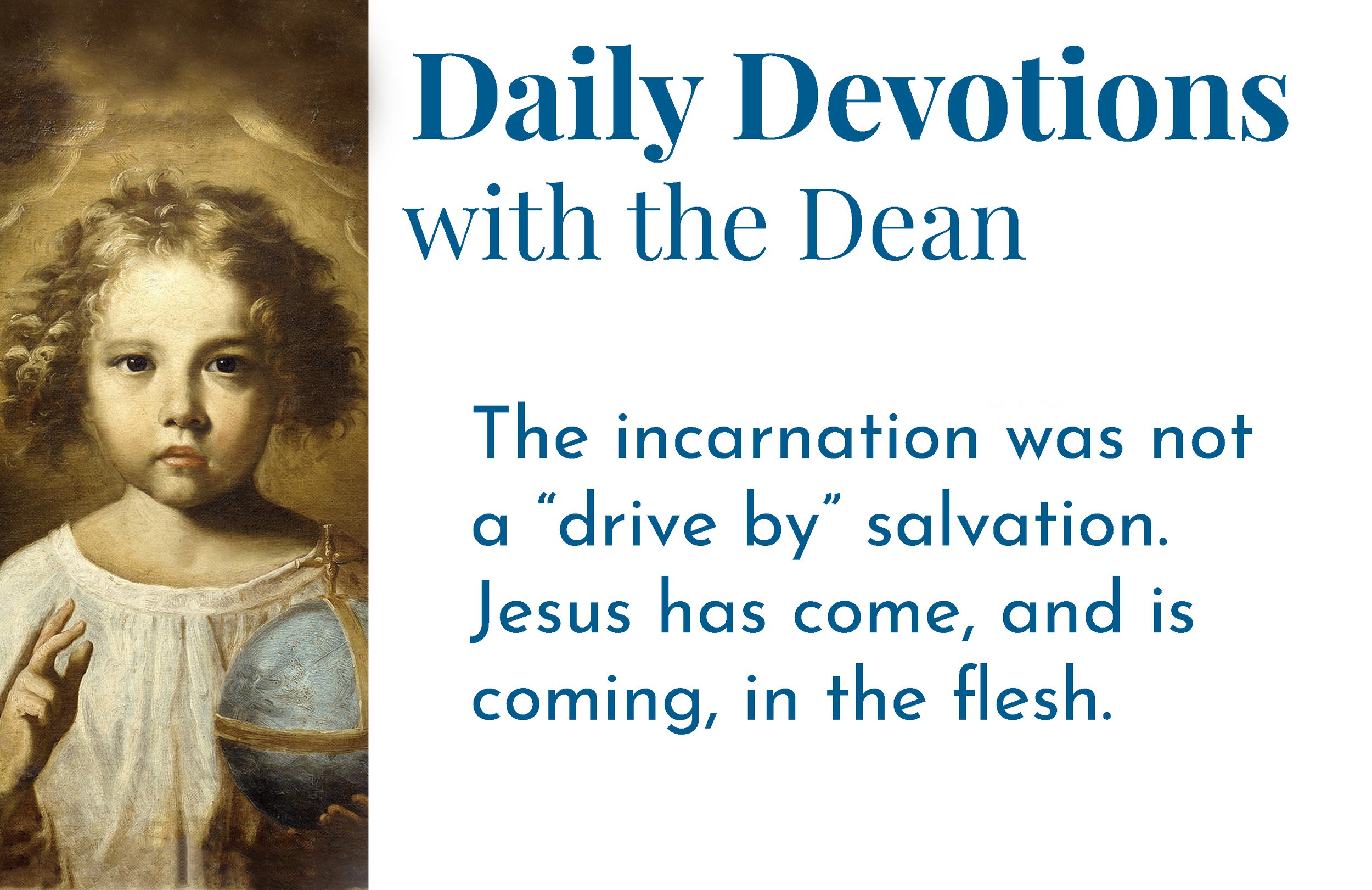
Most Christians, however, understand that since our problem – sin – includes body, mind, soul, and spirit, so does our solution. To heal us and rescue us, Jesus had to become one of us. The incarnation was not a “drive by” salvation. Jesus has come, and is coming, in the flesh (compare 1 John 2:26 & 2 John 7). Thus, we look for new bodies, not angels’ wings. 

That’s why “matter matters” in worship. Baptismal waters are simultaneously “our tomb” (the death of the “old man”) and “our mother” (the birth of the “new man”), as Cyril, Jerusalem’s 4th century bishop put it. Anointing with oil at baptism (Greek: chrisma) makes us little “Christs.” Just as Jesus turned water into wine then, he now turns wine into blood, so that in Communion “we become one body and blood with Christ. In this way we become Christ-bearers (a Greek word from which comes the name ‘Christopher’) as his body and blood are spread around our limbs.” Thus, the kiss of peace at Communion is not just any old greeting, but an expression of “a union of souls.”*

Here’s what I wish I had thought to say to Ahmed: The difference in our religions is a mystery you more experience in worship than figure out in your head. We worship Jesus because it’s the Son’s divinity that gives him the right to forgive. And we worship alongside Jesus because the Son has become our brother and made his Father ours. 

Be blessed this day,

Reggie Kidd+

* References in Cyril are to his Mystagogic Catecheses 2.4; 3.1; 4.3; 5.3, in Lester Ruth, et al., Walking Where Jesus Walked: Worship in Fourth-Century Jerusalem (Eerdmans, 2010). 

Image: The Infant Jesus, oil on canvas, attributed to “Old Master,” Italian,  17th century

Spiritual Soulmates - Daily Devotions with the Dean

Friday • 12/3/2021
Friday of the First Week of Advent 

This morning’s Scriptures are: Psalm 16; Psalm 17; Amos 5:1–17; Jude 1–25 (includes Saturday); Matthew 22:1–14

I plan to treat Matthew 22:1–14 in a DDD this coming January. 

This morning’s Canticles are: following the OT reading, Canticle 10 (“The Second Song of Isaiah,” Isaiah 55:6–11; BCP, p. 86); following the Epistle reading, Canticle 18 (“A Song to the Lamb,” Revelation 4:11; 5:9–10, 13, BCP, p. 93)


A meditation on Jude and 2 Peter

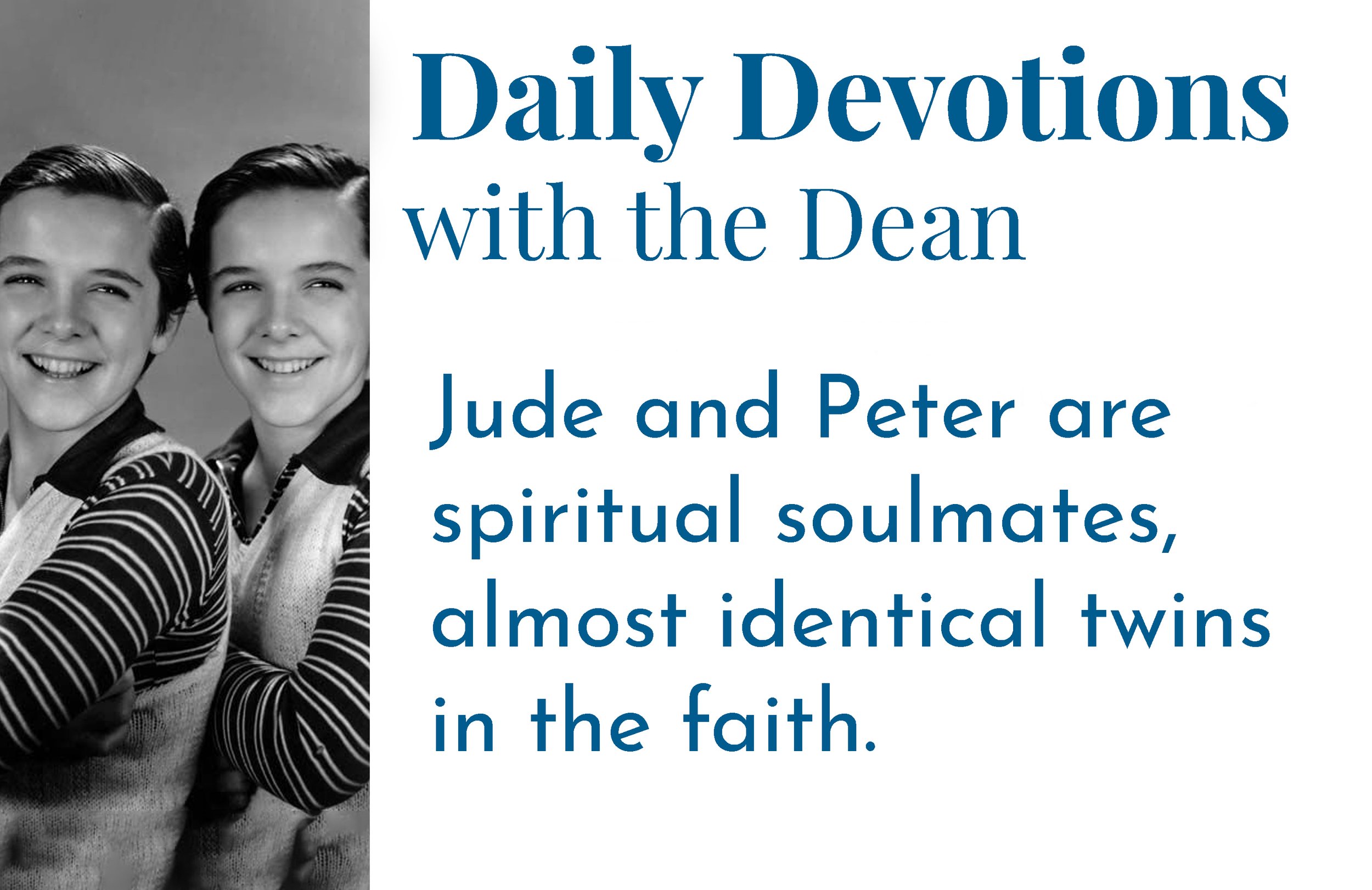
I grew up going to school with identical twins. We were 10 years old when we were in the same 4th grade class. At first John and Greg were indistinguishable to me. I had to take note each day of who was wearing what. By the time we were seniors in high school, I could never confuse John’s biting wit with Greg’s incisive analytics. And by then, even the subtle differences in their faces and the way they carried themselves were obvious to me. 

To me, Jude and Peter are like John and Greg. Jude and Peter are spiritual soulmates, almost identical twins in the faith. Jude’s letter and Peter’s 2nd letter bear so many resemblances that most scholars think there’s literary dependence between them (the consensus is that 2 Peter used Jude). I’m more inclined to think that the similarities have to do with their personal relationship with each other, their common relationship to their Master (who happens to be Jude’s half-brother), a common pastoral challenge, and a common theological wiring. 

Jude and 2 Peter deal with the same problem: people inside the church who bloviate meaninglessly to mask ethical mischief. In Jude’s words, “they indulge their own lusts; they are bombastic in speech” (Jude 16). And in Peter’s words “they speak bombastic nonsense, and with licentious lusts of the flesh they entice people…” (2 Peter 2:18—my adjustment of NRSV to show the parallels). Both apostles are dealing with people trapped in what later theologians would call libido dominandi, domination by desire. 

For Peter, the antidote is to let God’s life take root in us. God implants his own character within us and empowers us to nurture it: “His divine power has given us everything needed for life and godliness … so that … you may become participants of the divine nature” (2 Peter 1:3–4). God has imparted what western theologians call his “communicable attributes” to us. He does so to empower us from within, that we may recognize narcissistic, manipulative, high-sounding baloney, and show ourselves free from sin’s domination (compare 2 Peter 2:19). 

For Jude, the antidote is to stand on the truth of the Scriptures. God gives us in his Word a firm foundation for our lives: “I find it necessary to write and appeal to you to contend for the faith that was once for all entrusted to the saints” (Jude 4). Jude’s message to us is: stay true to that story, ponder its lessons, and you’ll be OK. 

In a cascade of events in Israel’s history, Jude illustrates the principle that to step away from the “faith once entrusted to the saints” is to reap a bitter harvest. He draws lessons from the exodus generation’s lack of faith, the fallen angels’ rejection of God’s authority, Sodom and Gomorrah’s immorality and lust, Cain’s jealousy, Balaam’s error, and Korah’s rebellion. 

Those who say otherwise, Jude contends, who insist that we are free to improvise, are like clouds that promise rain, but prove to be a tease (Jude 12). They turn grace into license (Jude 4), but cannot deliver the joy and the freedom their license promises. They can only lure us into illusory pleasure and make us over into the same sort of grumblers and malcontents that they are (Jude 16). They feed themselves at our feasts, Jude says, and they flatter us to their own advantage (Jude 12). I wish I could say that the kind of error—more moral than intellectual, though presenting itself as intellectually superior—died in the 1st century. But, alas, it did not. It pervades western churches and seminary classrooms today. 

By contrast, those who hold to “the faith once delivered” and stay “in” the story of God’s redeeming love will find God more than meeting their determined resistance to error and folly. Thus, the beautiful, powerful, and doxological conclusion to Jude’s letter: “Now to him who is able to keep you from falling, and to make you stand without blemish in the presence of his glory with rejoicing, to the only God our Savior, through Jesus Christ our Lord, be glory, majesty, power, and authority, before all time and now and forever. Amen” (Jude 24–25). That’s a thought worth contemplating and celebrating throughout this Advent season: “…to make you stand in the presence of his glory with rejoicing.” 

Peter directs our attention to the life-transforming process the Lord has set into motion within us. Jude offers us a point of reference outside ourselves: the solid foundation of truth that has been given us in the whole biblical story line. The bottom line of that story is that folly always gets its reward, and so does persevering faith. 

The perspectives of these identical twins in the faith, of course, are complementary. There’s an existential way in which God works within us, and there’s an authoritative way he calls us to hear and obey him. Praise be to him!

Be blessed this day,

Reggie Kidd+

Image: William A. Macis, Public domain, via Wikimedia Commons

Preparing to Feel "at home" in the New Heavens and New Earth - Daily Devotions with the Dean

Thursday • 12/2/2021
Thursday of the First Week of Advent

This morning’s Scriptures are: Psalm 18; Amos 4:6–13; 2 Peter 3:11–18; Matthew 21:33–46

This morning’s Canticles are: following the OT reading, Canticle 8 (“The Song of Moses,” Exodus 15, BCP, p. 85); following the Epistle reading, Canticle 19 (“The Song of the Redeemed,” Revelation 15:3–4, BCP, p. 94)


Amos: what sort of God? Who would have expected a lowly shepherd and farmer to offer up one of the most exalted and elegant descriptions of God in all the Bible? “For lo, the one who forms the mountains, creates the wind, reveals his thoughts to mortals, makes the morning darkness, and treads on the heights of the earth—the Lord, the God of hosts, is his name!” (Amos 4:13).

Transcendent thoughts!! Stop-you-in-your-tracks thoughts! And to think that at Advent we prepare to welcome this exalted God as one who lowers himself to be born in a manger to form a new people, to reveal his very person to mortals, to turn sin’s darkness to light, and to raise us to the heights of heaven! Amazing stuff!

2 Peter: What sort of people? In historic Christianity, believers have (unlike the “scoffers” of yesterday’s paragraph in 2 Peter) kept a vigilant eye on the distant horizon. We have done so all the better to give ourselves to living fully and well right here and right now. We do so in response to Peter’s probing questions: “Since all these things are to be dissolved in this way, what sort of persons ought you to be in leading lives of holiness and godliness?” (2 Peter 3:11). 

What sort of persons, indeed, are preparing themselves to fit into the garb of resurrection bodies, to be able to breathe the atmosphere of new heavens and new earth, and to feel at home rather than unhappy and out of place there? (Consider that sentence an invitation to read, or to reread, C. S. Lewis’s, The Great Divorce.) 

2 Peter: Hastening the coming… …waiting for and hastening (Gk: speudein) the coming of the day of God” (2 Peter 3:12). Now there’s an intriguing thought! Can I make the Lord come back faster by the way I live? Peter has just indicated that God’s desire that “all should be saved” is the reason for the “elongation” of history. It’s God’s patience that is holding back the Parousia (Christ’s return) and the consummation of all things. The Lord kindly and patiently waits, allowing the spread of the gospel to work repentance and faith within rebellious human hearts. Peter thinks a corollary is true as well. It would seem that Peter offers a Christian version of the 2nd century Jewish teacher Rabbi Eliezer’s teaching that Israel’s repentance would hasten the coming of redemption.* 

It’s not at all as though the Father’s sovereign will is diminished or that the mystery of the Son’s not knowing his day and hour is erased (Mark 13:32; Matthew 24:36). Rather, it’s a matter of perspective. I offer my own paraphrase of Peter’s thought: “If we are eager for the Lord’s return and for the establishment of final righteousness on a new earth under new heavens, then we should live as though we wanted it sooner rather than later! We should inhabit the peaceability of the Kingdom that is coming.” More amazing stuff!

2 Peter: As our dear brother Paul wrote… Peter’s brief comment about Paul is fraught with meaning. The reference is simple and affectionate, suggestive of how early 2 Peter is (since 2nd and 3rd century references to apostles by contrast are elaborate and over-the-top) and of how kindly Peter regarded Paul. 

After the row between them in Syrian Antioch that Paul recalls in Galatians 2  one might have expected tension between them. But such does not appear to have been the case. Peter supports Paul’s Gentile mission in Acts 15, and 1 Peter is replete with Pauline expressions and evidence of Paul’s influence on Peter’s theology.** 

Not incidentally, while acknowledging that Paul’s letters make for a challenging read, Peter elevates them (and he is the first to do so) to the same level of authority as “the other Scriptures” (2 Peter 3:16d)! In 2 Peter, the “fisher of men” has left us a gem of a letter. How impoverished we would be without it!

Be blessed this day, 

Reggie Kidd+

*In Richard Bauckham, Jude, 2 Peter, Word Biblical Commentary 50 (Word Books, 1983), p. 325). 

**Like Paul, Peter uses the phrase “in Christ” as virtually an adjective for “Christian” (1 Peter 3:16; see Romans 8:1; 2 Corinthians 5:17); like Paul, Peter uses the term “charismata” to refer to spiritual gifts (1 Peter 4:10–12; Romans 12:6; 1 Corinthians 12); like Paul, Peter refers to God building a house for his dwelling where we offer spiritual sacrifices (1 Peter 2:4–10; Romans 12:1–2; Ephesians 2:11–22); Peter’s affirmation of Christ’s substitutionary atonement looks like a crisp summary of Paul’s more extended treatment (1 Peter 3:18; Romans 3:21–26; 5:6–11). 

Image: "Distant Horizons" by Robert Hruzek is licensed under CC BY-NC-ND 2.0

God Has a Heart - Daily Devotions with the Dean

Wednesday • 12/1/2021
Wednesday of the First Week of Advent

This morning’s Scriptures are: Psalm 119:1–24; Amos 3:12–4:5; 2 Peter 3:1–10; Matthew 21:23–32

The Daily Lectionary reading of 2 Peter for this year (Year One), does not include chapter 2. For observations from 2 Peter 2 from Year Two, see https://tinyurl.com/8cxcddz4 for 2 Peter 2:1–10a, from 12/16/2020; https://tinyurl.com/5ukhhuzk for 2 Peter 2:10b–16, from 12/17/2020; and https://tinyurl.com/375377bm for 2 Peter 2:17–22, from 12/18/2020. 

This morning’s Canticles are: following the OT reading, Canticle 11 (“The Third Song of Isaiah,” Isaiah 60:1-3,11a,14c,18-19, BCP, p. 87); following the Epistle reading, Canticle 16 (“The Song of Zechariah,” Luke 1:68-79, BCP, p. 92)


2 Peter: of “scoffers with scoffing” 

Even though the New Testament is not beset with having to explain the so-called “failure of the Parousia (the return of Christ)” as some people think, it is wonderful to see Peter taking a good sidelong glance at early purveyors of that wrongheaded notion. At 2 Peter 3:3, he calls them “scoffers with scoffing.”

The “scoffers” have an ethical agenda.…[I]n the last days scoffers will come, scoffing and indulging their own lusts…” (2 Peter 3:3). The scoffers deliberately suppress truth, says Peter (2 Peter 3:5), because they don’t want certain things to be true. In the previous chapter, Peter writes about influencers in the church who “speak bombastic nonsense” that is a cover for “licentious desires.” Those influencers use their bombast, he argues, to “promise freedom,” when “they themselves are slaves of corruption” (2 Peter 2:19). We now find in 2 Peter 3 that in order to rationalize mischief-making they deny the accountability that the Lord’s return would bring. The more things change, the more they stay the same.

The “scoffers” assume that the elements are static, that what always has been must remain as it is in perpetuity, that, in a word, there can be no interruption in the space-time continuum: “For ever since our ancestors died,” they insist, “all things continue as they were from the beginning of creation!” (2 Peter 3:4). Peter counters by asserting that everything that is, is not eternal. To Peter (and to the entire outlook of the Bible), the creation of the space-time continuum was something that could not have been anticipated. And it came about in the first place simply by “God’s word.” The big bang theory only confirms the mystery of something suddenly coming to be from nothing; and science offers no more compelling an explanation for how and why that all happened than the Bible’s “God spoke.” There’s no reason to think creation’s consummation is as unthinkable as its dawn. 

The “scoffers” think their critical distance from accepted teachings makes them creative and innovative. Peter’s perspective is that they are proving the veracity of prophecies already made about them: “I am trying to arouse your sincere intention by reminding you that you should remember the words spoken in the past by the holy prophets, and the commandment of the Lord and Savior spoken through your apostles … that in the last days scoffers will come, scoffing…” (2 Peter 3:2–3). Unintentionally, the scoffers write themselves into their predetermined place in God’s story. Their error is no big surprise. It’s a part of the anticipated knee-jerk reaction of the power of darkness to the fatal assault that took place against it on the Cross (see Paul’s teaching on the man of lawlessness and John’s on the antichrist). 

The “scoffers” assume that time works the same for God as it does for us.The Lord is not slow about his promise, as some think of slowness…” (2 Peter 3:9a). Anglican priest and translator of the New Testament J. B. Phillips once titled a book Your God Is Too Small. One of the ways we mortals try to put God in a human sized box is by imagining him wearing a Timex that keeps his time in sync with ours. However, what seems like a long time to us is a nanosecond to God. By the same token, he can pack an eternity into, say, three days in a grave, where all the sins of all people of all time and all places are buried once and for all. If it takes millennia for God to gather his whole flock, when we look back from the far side of consummation, the whole process will appear as but a moment. Eternity keeps time differently than we do. 

In certain scholarly circles (I’m looking at you, Albert Schweitzer and Ernst Käsemann), the so-called “failure of the Parousia” takes the blame for the perceived flaws of later New Testament writers: the setting in of rigid doctrine, the establishment of a hierarchical church order, and the reconciling of Christian ethics with the values of this world. 

I’ve always been skeptical about every aspect of this thesis. To be sure, the apostle Paul, one of the earliest of the New Testament writers, finds he must tell the Thessalonians to settle down, because Christ’s return isn’t necessarily right around the corner. Not only is the Lord’s return not necessarily imminent, according to Paul, but, as Paul tells the Romans, the whole point of history now is about God bringing in a “fullness” of Jew and a “fullness” of Gentile (Romans 11:12,25). Paul doesn’t date those expectations, leaving open, instead, a wide vista on the prospect of a long-lasting mission to the world. As to rigid doctrine, Paul is already denouncing people who get their doctrine wrong (Galatians 1:8). As to church order, Paul refers to bishops and deacons in Philippi (Philippians 1:1). And as to ethics, he explicitly tells those same Philippians to affirm common ground with the values of their pagan neighbors (Philippians 4:8). 

The “scoffers” forget that God has a heart.The Lord is not slow about his promise, as some think of slowness, but is patient with you, not wanting any to perish, but all to come to repentance” (2 Peter 3:9). We look around our world, and we see suffering, pain, abuse, and hardship. God looks around, and sees the opportunity for many, many, many more lost image-bearers to respond to his loving overtures. He sees with merciful eyes, and so he elongates the offer of repentance. Peter invites us to see God’s temporary allowance of the continuation of evil as a heartfelt reluctance on his part to pull the trigger on final justice, and an unwillingness to shut the door into the ark of salvation until every elect soul is aboard. 

Be blessed this day, 

Reggie Kidd+

Image: "Trad watch" by Kent Wang is licensed under CC BY-SA 2.0

Advent Reminds Us that Light Broke In - Daily Devotions with the Dean

Tuesday • 11/30/2021
Tuesday of the First Week of Advent 

This morning’s Scriptures are: Psalm 5; Psalm 6; Amos 3:1–11; 2 Peter 1:12–21; Matthew 21:12–22

For observations on 2 Peter 1:12–21 from 12/15/2020, see https://tinyurl.com/4rvk9yxh

This morning’s Canticles are: following the OT reading, Canticle 13 (“A Song of Praise,” BCP, p. 90); following the Epistle reading, Canticle 18 (“A Song to the Lamb,” Revelation 4:11; 5:9–10, 13, BCP, p. 93)


Collect for the First Sunday of Advent. Almighty God, give us grace to cast away the works of darkness, and put on the armor of light, now in the time of this mortal life in which your Son Jesus Christ came to visit us in great humility; that in the last day, when he shall come again in his glorious majesty to judge both the living and the dead, we may rise to the life immortal; through him who lives and reigns with you and the Holy Spirit, one God, now and for ever. Amen.

Amos and Advent

Chronologically, Amos is the first of the great classical prophets (like Hosea, Isaiah, and Jeremiah). A poor shepherd and horticulturalist from the southern kingdom of Judah, Amos is called by Yahweh to travel to the northern kingdom of Israel. It’s the middle of the 8th century B.C., and Israel is enjoying a long period of prosperity and expansion under Jeroboam II. Nobody sees the devastation that awaits, for Assyria to the east has not yet arisen as a threatening world power. However, Yahweh anticipates the seeds of Israel’s destruction in its violation of the covenant, and he sends Amos north to call Israel to repentance. 

Israel tolerates exploitation of the poor. Fortunes are made by the usurious pressing of poor farmers to the brink of bankruptcy, then the seizing of their land (Amos 2:6–7). Shockingly, for a people to whom the Law teaches stringent sexual boundaries (Genesis 2:23–24; Leviticus 18:7–30), predation is rampant: “Father and son go in to the same girl, so that my holy name is profaned” (Amos 2:7b). People defile worship by laying at their altars money they have stolen and extorted (Amos 2:8). 

Despite the luster of life under Jeroboam II, what lies beneath is corrupt. Israel’s very existence is predicated upon their being a vanguard—a promise in advance—of the restoration of human worth and dignity in union with God. Instead, Israelites are showing themselves to be as worthy of judgment as anybody else. God’s chosen people simply get added to the other nations Yahweh will judge: Damascus, Philistia, Tyre, Edom, Ammon, Moab…and Judah and Israel (Amos 1:3–2:16). 

During the season of Advent, we examine our own lives for the same vestiges of corruption, asking God’s grace to “cast away the works of darkness and put on the armor of light.” 

Darkness will give way to light. Advent reminds us that the light broke in when God sent his Son in great humility. And Advent reminds us that the light will break in once again when the Son returns in glorious majesty. The sober, and indeed honoring, choice the Bible puts before us is whether to play a part ourselves in casting away those works of darkness, or (and this would be painful) waiting for the Lord do it all. 

You only have I known… (Amos 3:1). Yahweh will allow his love to be ignored only so long. Amos recalls the language of God’s covenant. “You only have I known” is not language of mere cognition. Yahweh is well acquainted with all the nations. But there is only one people with whom he has shared his heart, and that is the sense in which he says, “You only have I known.” As Adam “knew” Eve, and she bore a child (Genesis 4:1), so Yahweh has “known” Israel, and has looked for his life to be reproduced in her. With love, God has chosen this people from all the nations to be the place where he reinserts grace and justice and mercy into the human experience. And now, much like a parent who reluctantly allows a child to receive the consequences of disobedience, so Yahweh calls the nations to his service: “Proclaim to the strongholds in Ashdod, and to the strongholds in the land of Egypt, and say, “Assemble yourselves on Mount Samaria” (Amos 3:9a).

In advance of judgment, Amos calls God’s people to repent, to cast out the works of darkness, lest Yahweh do it for them. We know they choose badly. Advent reminds us that we can choose wisely. 

Be blessed this day,

Reggie Kidd+

A Faith as Precious as Peter's - Daily Devotions with the Dean

Monday • 11/29/2021

Monday of the First Week of Advent, Year Two 

This morning’s Scriptures are: Psalm 1; Psalm 2; Psalm 3; Amos 2:6–16; 2 Peter 1:1–11; Matthew 21:1–11

This morning’s Canticles are: following the OT reading, Canticle 9 (“The First Song of Isaiah,” Isaiah 12:2–6, BCP, p. 86); following the Epistle reading, Canticle 19 (“The Song of the Redeemed,” Revelation 15:3–4, BCP, p. 94)


2 Peter 1:3–7 is a masterfully constructed sentence in Greek, and it carries some of the most powerful truth in the entire New Testament. Who knew a Galilean fisherman could be so elegant? Then again, who wants to discount the power of Jesus to make us so much more than we are left to ourselves?!

Verses 3 and 5 are held together by an elegant, “Inasmuch as” (hōs — plus everything in verses 3–4), followed by a powerful “for this very reason” (kai auto touto de — plus everything in verses 5–7). 

Inasmuch as…” With his “inasmuch as,” Peter looks back at the gift of “faith” he had introduced in 2 Peter 1:1. Peter says that we have been granted a faith that is just as precious as his own: “To those who have received a faith as precious as ours…” (2 Peter 1:1). Extraordinary! A faith equal in value to that of the Peter who had been given the keys to the Kingdom, had stood on the Mount of Transfiguration, had had his feet washed in the Upper Room, and had had his failures met with the simple question, “Do you love me?” 

Our faith is no less a gift than his was (“Blessed are you, Simon son of Jonah! For flesh and blood has not revealed this to you, but my Father in heaven”—Matthew 16:17). Our faith gains us no less access to the presence of “our God and Savior, Jesus Christ” (2 Peter ), and is no less a resource for an abundance of “grace and peace” as we “grow in the rich knowledge of God and of Jesus Christ,” Peter’s Lord and ours. The gift of faith—a staggering and wonderful truth! 

And what a staggering thing it is we are asked and enabled to believe: that we “may become participants of the divine nature (theias koinōnoi phuseōs)” (2 Peter 1:4b). So enamored with this thought were ancient Christians from Irenaeus to Athanasias that they summed it up this way: “God became man, so man could become god.”*  What Peter and they mean is perhaps best expressed for modern western ears by C. S. Lewis (in a passage we have mentioned before), when he says, It is a serious thing to live in a society of possible gods and goddesses, to remember that the dullest and most uninteresting person you talk to may one day be a creature which, if you saw it now, you would be strongly tempted to worship.** According to Peter, Irenaeus, Athanasius, and Lewis, believers are destined to be everlasting, godlike splendors. 

“for this very reason…” The thing is that process begins now. So great a gift as sharing the divine nature calls forth from us a cooperation with the divine hand that has taken hold of our life. And that hand is in the business of making us over in the now into what we will be when Christ returns for us, when our Advent hope is fully realized. 

To faith add virtue. To such faith, maintains the rugged former fisherman, we should strive with all our might to add “virtue.” This word, aretē, expressed for Greek-speaking people the highest aspiration in character-formation. It is a “being” word, not a “doing” word. It recognizes that what comes out of us has its source in our core identity and set of values—often pre-reflective values. Peter says to let our faith do the deep work within us of making us people of character. 

To virtue add knowledge. Amazing insights come to hearts that are true and right and inclined toward the good. It simply works that way. 

To knowledge add self-control. Knowledge of what’s real gives one the ability to accept both challenges (that is, to summon our resources to accomplish great things) and boundaries (that is, to reel ourselves in when we are tempted to go spinning out of control). 

To self-control add endurance. It takes mastery of oneself to enable “a long obedience in the same direction” (it is sufficient to commend pastor-theologian Eugene Peterson’s marvelous book by that title). 

To endurance add godliness. Long-haul Christians come to value the disciplines that comprise what Peter’s term “godliness” literally means: “good religion” (eu+sebeia). “Good religion” is (at least) daily prayer, corporate worship, the giving of alms, taking our place in the Body of Christ (see also the baptismal vows in the Book of Common Prayer, pp. 304–205). The world rightly hates hypocritical “religious” people, those who have “the outward form of good religion but deny its power” (2 Timothy 3:5). What the world needs to see, and what the world will find persuasive, is people whose faith and hope and love have been sustained and strengthened by the disciplines of “good religion,” by godliness. 

To godliness add brotherly affection. The God who is a community of love (Father, Son, and Spirit) makes us irrepressibly fond of those who have been drawn into his human community of love. If we love the Triune God, we love those who belong to that fellowship—we are attracted to those in whom that life glows. We find that it goes with the grain of who we are as beloved of God to honor the first of our baptismal vows: to “continue in the apostles’ teaching and fellowship, to the breaking of the bread, and in the prayers.” 

To brotherly affection add self-giving love.  And that brotherly affection (to the extent that it is indeed Christ’s brotherly affection and not mere carnal mutual self-adoration) creates in us a love for those not yet in Christ’s fold. Our love for the Christian family propels us to love the entire human family. We find ourselves going with the grain of God’s reality by living into the last two baptismal vows: to “seek and serve Christ in all persons, loving your neighbor as yourself” … and “to strive for justice and peace among all people, and respect the dignity of every human being.” 

Praise be for the splendor that came in Jesus Christ, that will be revealed at his glorious return, and that works its way into our lives in the now. 

Be blessed this day, 

Reggie Kidd+

*Irenaeus, Against Heresies, 5, Preface; Athanasius, On the Incarnation 54.3; Against the Arians 1.39; 3.34; see also, for example, Clement of Alexandria, Exhortation to the Greeks 1. 

**From C.S. Lewis’s “Weight of Glory” sermon. 

Image: Guercino , Public domain, via Wikimedia Commons

United with Christ - Daily Devotions with the Dean

Friday • 11/26/2021
Friday of the Twenty-sixth Week After Pentecost (Proper 29)

This morning’s Scriptures are: Psalm 140; Psalm 142; Isaiah 24:14–23; 1 Peter 3:13–4:6; Matthew 20:17–28

This morning’s Canticles are: following the OT reading, Canticle 10 (“The Second Song of Isaiah,” Isaiah 55:6–11; BCP, p. 86); following the Epistle reading, Canticle 18 (“A Song to the Lamb,” Revelation 4:11; 5:9–10, 13, BCP, p. 93)


Our baptism

And baptism…now saves you…through the resurrection of Jesus Christ… — 1 Peter 3:21. Peter regales in the comprehensiveness of Christ’s work, and he sees Christ’s work being crystallized and brought into our lives at baptism. 

As believers in Christ, we live with liminality, that is, we live in the “betweenness” of darkness and light, of an old world that is fading and a new world that has only partially begun in Christ. We live simultaneously with the joy of knowing that we are “select” of God for salvation and sanctification, and with the challenge of being “strangers” in a world that requires of us submission and suffering (see the DDD for this past Monday). 

In our baptism, God provides a profound marker of our identity as “select strangers.” Peter explores that wonderful truth in today’s passage.

Comparing our situation to Noah’s, Peter sweeps us up into God’s great meta-narrative of his reclamation of the world. Our baptism plunges us symbolically into a death-by-drowning that we, along with the rest of the world, fully deserve, but from which we have been gloriously and graciously rescued. The symbolism is dense. 

United with Christ. Noah’s family floated above the drowning waters because the one righteous man (Genesis 6:9) brought them into the boat he had constructed. Similarly, Christ has gathered into the boat he is building (the church) those who by faith have become his own family members. United to him in his boat, we “are saved” amid the impending judgment that presently swirls around us and that will one day be executed with a worldwide conflagration (this time of fire rather than water—see 2 Peter 3:6–7,10). 

Dying and rising with Christ. Union with the living and righteous builder of the boat is one aspect of baptism’s symbolism. Another aspect of its symbolism is the way it pictures the death Christ has died in our place and the resurrection he has thereby won for us. 

Literal and Symbolic. Literally, Christ died. In fact, he even referred to his death ahead of time as “the baptism with which I am to be baptized” (Luke 12:50; Mark 10: 38). He died, Peter says, suffering for our sins, “the just for the unjust, in order to bring [us] to God” (1 Peter 3:18). Symbolically, we likewise die in baptism. We die when we are plunged into the waters of baptism, or have those waters poured over or sprinkled onto our heads. 

Literally, Christ rose, having accomplished all that was necessary for our consciences to be cleansed (1 Peter 3:21), for us to be released from the prison of death (1 Peter 3:19), and for us to be presented to God in the heavenly courts (1 Peter 1:7,9). Symbolically we rise when we come up out of the waters of baptism or emerge from the pouring or sprinkling of baptismal waters. 

Literally, Christ ascended to the right hand of the Father, receiving there the Holy Spirit as the Father’s gift to pour out upon the church. Symbolically, we are marked on our foreheads with oil that we may live in the power and the joy of the gift of that same Holy Spirit. 

Christ descends into death in ignobility, and with all the shame and cursedness of our sinfulness. He rises into resurrection life in glory, and takes his rightful place “at the right hand of God with angels and authorities and powers subject to him” (1 Peter 3:22). Our baptism unites us with Christ in such a way that our enduring of the (normally) little deaths of being counted strangers, submitters, and sufferers—it all becomes a matter of “sharing Christ’s sufferings” (1 Peter 4:13; and note the striking parallel of Paul’s language of “the sharing of his sufferings” at Philippians 3:10). And our baptism unites us with Christ in such a way that his resurrection becomes our life in the Spirit now, and a promise that one day our bodies will be raised from the dead like his was. 

For all these reasons (and more, though a brief devotional does not allow for a full discussion) our baptism becomes the place where heaven and earth touch. In baptism, Christ sweeps us up into this resurrected life, for “baptism…now saves you.” 

Be blessed this day, 

Reggie Kidd+

Image: Image: https://www.piqsels.com/en/public-domain-photo-svbzy

Live as Free People - Daily Devotions with the Dean

Thursday • 11/25/2021
Thursday of the Twenty-sixth Week After Pentecost (Proper 29)

This morning’s Scriptures are: Psalm 131; Psalm 132; Psalm 133; Zephaniah 3:1–13; 1 Peter 2:11–25; Matthew 20:1–16

On 1 Peter 2:11–25, see also https://tinyurl.com/2htusat8, from 4/23/2020

On Matthew 20:1–16, see also https://tinyurl.com/2dmdzrzh, from 6/24/2020

This morning’s Canticles are: following the OT reading, Canticle 8 (“The Song of Moses,” Exodus 15, BCP, p. 85); following the Epistle reading, Canticle 19 (“The Song of the Redeemed,” Revelation 15:3–4, BCP, p. 94)


 Beloved, I urge you as foreigners and exiles…

When Peter tells us in 1 Peter 2:11 that we are “foreigners” and “exiles” he means that we live by a completely different value system than the people around us. The two words in Greek (paroikoi and parepidēmoi) denote people who live “alongside” households and city populations, but do not fully belong to them. And for our outsider status, there will be a price to pay. 

It’s not easy to translate across the 2 millennia and the cultural differences that separate Peter’s world from ours. But there are some hints as to the challenges we share with our 1st century Christian counterparts in their Roman world.

Conduct yourselves honorably … though they malign you…” (1 Peter 2:12). There is a culture that stands outside us and makes us feel we are from another planet. We can capitulate and join the crowd. We can overreact and become jerks. Or we can strive to live wisely “in the world, but not of the world,” as some believers have summarized. The 2nd century Epistle to Diognetus elegantly sums our situation, calling us “this new race or way of life” (kainon touto genos ē epitēdeuma), neither Greek nor Jew (Epistle to Diognetus 1.1). Christians, as the Epistle explains very much in the spirit of 1 Peter, “live in their own countries, but only as nonresidents (paroikoi); they participate in everything as citizens, and endure everything as foreigners. Every foreign country is their fatherland, and every fatherland is foreign” (Epistle 5.5). 

…abstain from the desires of the flesh that wage war against the soul” (1 Peter 2:11). There are internal desires that wage war with our souls. Those desires would be tough enough to strive against if we were alone and living in a desert. The war becomes more desperate when we live in a world that glorifies materialism and appetite, and shouts “You can have it all!” 

…live as free people, yet do not use your freedom as a pretext for evil” (1 Peter 2:16). We can strive for “freedom,” and abuse that freedom to cover evil. The world around us thinks of “freedom” as giving us the right to unbounded self-expression. There may be no greater challenge for believers in our world (and I am thinking primarily of believers in first-world democracies) than living with the benefits of political, economic, and social liberty. “Nobody can tell me what to do!” is a slogan of our time. There’s nothing more anti-Christian, nothing more contrary to the life Peter is exhorting. The freedom we have in Christ, is a freedom to serve. 

…accept the authority of every human institution, whether of the emperor… or of governors…accept the authority of your masters with all deference…” (1 Peter 2:13). Lying politicians, abusive authority figures, and horrible bosses give us every reason to respond, “But, but…!” to Peter’s exhortation. And we (most of us who read these devotionals) live in a world, unlike Peter’s, in which we have a voice in who governs us and how they do so, and we are free to seek out better bosses. What Peter puts before us is the need to resist deep cynicism toward all authority, the obligation to reject an inclination to non-compliance whenever our convenience is infringed, and the imperative to say “No!” to a spirit of defiance that poisons every asymmetrical relationship. Like it or not, we all find ourselves in the “lesser” position of some asymmetrical relationships. Our job is to find Christ in those places. 

…Christ suffered for you, leaving you an example so that you should follow in his footsteps” (1 Peter 2:21). To this very end, Peter, alone among New Testament writers, finds in Isaiah 53’s Song of the Suffering Servant a model for the Christian life. We bear witness to Christ’s way of life by living that same life. For Peter, we win the doubters by following Christ into “the valley of the shadow.” When doubters see our willingness to accept mistreatment, they may at last ask about “the hope that is within us” (1 Peter 3:15).  

He himself bore our sins in his body on the cross, so that, free from sins, we might live for righteousness” (1 Peter 2:24). That’s when we have the chance to share the glorious good news about Christ’s atoning, forgiving, justifying, reconciling death for us, and his vivifying, sanctifying, transforming, righteousness-teaching presence among us by virtue of his resurrection and ascension. 

Be blessed this day, 

Reggie Kidd+

Image: Babyaimeesmom, CC BY-SA 4.0, via Wikimedia Commons

No Discards - Daily Devotions with the Dean

Wednesday • 11/24/2021
Wednesday of the Twenty-sixth Week After Pentecost (Proper 29)

This morning’s Scriptures are: Psalm 119:145–176; Obadiah 15–21; 1 Peter 2:1–10; Matthew 19:23–30

This morning’s Canticles are: following the OT reading, Canticle 11 (“The Third Song of Isaiah,” Isaiah 60:1-3,11a,14c,18-19, BCP, p. 87); following the Epistle reading, Canticle 16 (“The Song of Zechariah,” Luke 1:68-79, BCP, p. 92)


No “discards” 

Bob died not long ago. He was 92 years old, and he had been retired for many years from a long and productive calling as a pastor. Even though he led Bible studies up to the very end of his life, in his last few years he often wondered aloud to his daughter Donna if there was any more purpose to his life. Or whether he was a “discard.” She kept reminding him that he was precious to God, to her, and to the many people whom he had served and continued to serve in ministry. 

A couple of weeks before his death, Bob got a new roommate, Manny. Manny noticed that Bob read the Bible a lot, and he asked Bob about it. Bob shared his faith in Christ, and, to Bob’s surprise, Manny asked if he could pray to receive Christ. Two days later, Manny died.

Donna told Bob, “See, Dad, God has no discards. You were here for Manny, and now Manny will be part of the reception party for you when the time comes.” The time for that reception party came a mere two weeks later. Donna, of course, shed (and still does) many tears. But there’s no small joy mixed with the tears, knowing her dad knew his gracious God had given him that one last mission. 

The anchor of Bob’s soul was Jesus Christ, who himself knew what it was to be a “discard.” As Peter says, echoing Isaiah, Jesus was “rejected by men but chosen and precious in God’s sight” (1 Peter 2:4 NET; see Isaiah 28:6). Any of us who feel like life has passed us by, or that people have turned their back on us, can look to Jesus. That’s the way they treated him, and if we belong to him, we can count our dismissal as a sharing in his suffering of rejection. Whether it’s an employer who has said, “We are going in a different direction,” a spouse who says, “I don’t love you anymore,” a child who says, “I hate you and want you out of my life,” or a friend who says, “Because your politics are so distasteful to me, we can’t be friends any longer.” 

Jesus knew rejection. He also knew that to his Father in heaven, he was specially chosen, deeply known and deeply loved, in fact, before the foundation of the world. He knew that he was precious—the Greek at 1 Peter 2:4 is entimos, which means “highly valued.” He also knew that as “a living stone,” he was the anchoring stone (scholars puzzle over whether the term he uses makes him the foundation stone or the capstone) of an amazing new house his Father was building—a house in which God and we would reside together. Regardless of how others treated him, Jesus knew his mission was to anchor a building made up of other “living stones”—you and me, and Bob and Donna and Manny. 

Peter writes to people who are now outsiders to Roman life. Many of these, because of their new life in Christ, became castoffs in their homes, associated no longer in shady business deals, and no longer patronized brothels with their friends. Peter wants them to know they are treasured by their Heavenly Father, ransomed by their Brother and Friend, and essential to the house of which they themselves are a part.  

Peter augments the picture of their being “living stones” in God’s new building. He draws upon several vivid Old Testament images of the way God values and dignifies his people.

A holy and royal priesthood (1 Peter 2:5,9). While the world does not even know why it aches and feels cursed, Christ’s people stand between them and the God who loves them and they cry out, “How long, O Lord, until you end the aches and remove the curse?” 

A chosen race (1 Peter 2:9). While the world descends further and further into an ugly and destructive tribalism, Christ’s people resolutely invite anybody and everybody to become a part of a new peoplehood being built around the Second Adam, the Last Man (1 Corinthians 15:45,47).

A holy nation (1 Peter 2:9). In a field of competing loyalties, Christ’s people point to one leader, one king, one commonwealth that is worthy of ultimate loyalty: the Kingdom of God in Christ. 

A people for his possession (1 Peter 2:9). While the world grasps after and competes for more and more possessions (all the while becoming more and more possessed by those possessions) Christ’s people rejoice in the stunning wonder of counting themselves held, protected, and cherished by the God who has claimed them as his prized possession. 

No longer “Not a people” nor “Those who have not received mercy,” but now transformed into “God’s people” and “those who have received mercy” (1 Peter 2:10). In a world of people who secretly fear the worst about themselves—that they are and fully deserve to be “discards”—Christ’s people unrelentingly proclaim the excellencies of the God who claims precisely such people, forgives them, heals them, and beautifies them. 

I’m grateful Bob knew the full measure of these precious truths. I pray you and I know them too. 

Be blessed this day, 

Reggie Kidd+

Image: "ribbon, clasped hands, anchor, heart and cross" by Leo Reynolds is licensed under CC BY-NC-SA 2.0

Hard Thinking - Daily Devotions with the Dean

Tuesday • 11/23/2021
Tuesday of the Twenty-sixth Week After Pentecost (Proper 29)

This morning’s Scriptures are: Psalm 121; Psalm 122; Psalm 123; Nahum 1:1–13; 1 Peter 1:13–25; Matthew 19:13–22

This morning’s Canticles are: following the OT reading, Canticle 13 (“A Song of Praise,” BCP, p. 90); following the Epistle reading, Canticle 18 (“A Song to the Lamb,” Revelation 4:11; 5:9–10, 13, BCP, p. 93)


Today’s brilliant paragraph in 1 Peter leads with an intriguing metaphor: “[G]ird up the loins of your mind” (1 Peter 1:13a). As the editors of the New English Translation note, Peter employs “a figure of speech drawn from the Middle Eastern practice of gathering up long robes around the waist and tucking them under the belt to prepare for work of action.” 

I’m reminded of the way my samurai sword class prepares to clean the floors of our dojo at the end of class. We gather the divided skirts of our hakama and tuck them in our belt, so we move about on our knees and hands as we push moistened towels over the floorboards. “Girding your loins” means you are preparing to get to work. When its “the loins of our mind” that we are told to “gird,” that can only mean we are supposed to ready ourselves for some hard thinking.

There are too many thought-nuggets in this paragraph to track down in a short devotional. But here are a few. 

 “[S]et all your hope on the grace that Jesus Christ will bring you when he is revealed” (1 Peter 1:13b). Put hope in the grace that will come when Jesus comes again. It takes a lot of mental energy to sort out the things we can fix or attain in the present from the things that will have to wait for the Lord to fix or bring to us. Tooth decay I can address; my body’s eventual decay I can’t. Proximate justice we can hope for and work towards in society; perfect justice will have to wait. Here’s the Christian hope: all that is wrong now will one day yield to God’s kindness, his benevolence, his unmerited favor. That’s worth thinking hard about. 

[D]o not be conformed to the desires that you formerly had in ignorance” (1 Peter 1:14b). Reflecting on the strong desires that used to govern my life, I’m deluding myself if I think I haven’t been dragged around by them. For Peter, that is pretty much how our former lives were conducted. Ashley Null summarizes the guiding theological insight of Archbishop Cranmer, architect of the Book of Common Prayer (I approximate Null’s formulation), “What the heart desires, the will seizes, and the mind rationalizes.” We are desiring creatures before we are thinking agents. We all have things that are all too powerfully alluring to us. For example, potato chips, chocolate, and ice cream can defeat me. The only way I know how to eliminate those temptations when I come across them in the kitchen is to consume them! Peter challenges us to intervene with our brains. We do so by exposing as best we can the secret urges that would otherwise govern us all our days. That’s worth thinking hard about. 

You know that you were ransomed from the futile ways inherited from your ancestors” (1 Peter 2:18). In a similar vein, Peter invites us to reflect on the ways that our upbringing has shaped our sense of right and wrong, truth and falsity. Was our background one of privilege, or not? Were we taught that we were loved and valued, or that we were in the way and that other things matter more? Did we grow up with few friends or many, as an only child or one of many? Did we grow up relating to and valuing all sorts of people, or were we taught to divide the world into “us” versus “them”? Those are things worth thinking hard about.  

‘All flesh is like grass and all its glory like the flower of grass. The grass withers, and the flower falls, 25but the word of the Lord endures forever.’ That word is the good news that was announced to you” (1 Peter 1:24). My mind needs constantly to be reshaped by the truths that are in the Bible. There’s no way around that fact. My friend, the ever-vigilant Paul Kennedy recently discovered this introduction in his hotel room’s Gideon Bible: “Owned, it is riches; studied, it is wisdom; trusted, it is salvation; loved, it is character; and obeyed, it is power.” That’s worth thinking hard about. 

Be blessed this day, 

Reggie Kidd+