Daily Devotions

The Lord God Omnipotent Reigns! - Daily Devotions with the Dean

Monday • 11/15/2021

Monday of the Twenty-fifth Week After Pentecost (Proper 28)

This morning’s Scriptures are: Psalm 89; 1 Maccabees 3:1–24; Revelation 20:7–15; Matthew 17:1–13

More on Revelation 20:1–10 from 12/21/2020 at https://tinyurl.com/ykprytyz

More on Revelation 20:11–21:8 from 12/22/2020 at https://tinyurl.com/w98nee47

This morning’s Canticles are: following the OT reading, Canticle 9 (“The First Song of Isaiah,” Isaiah 12:2–6, BCP, p. 86); following the Epistle reading, Canticle 19 (“The Song of the Redeemed,” Revelation 15:3–4, BCP, p. 94)


Revelation. The first half of Revelation 20 (Saturday’s reading) is one of the most debated passages in the New Testament. I share my considered conclusions, and they are based largely on two observations. The first has to do with the image of “binding Satan,” the second is prompted by John’s explanation that the binding has the effect that Satan “would deceive the nations no more” for a thousand years. 

Binding. Over time as I’ve wrestled with the New Testament as a whole, I’ve come to see the “binding” (and the throwing of Satan into a pit, locking him in it, and sealing it over him) as a way of describing what Christ accomplished during his earthly ministry. Jesus, in fact, specifically says he has the power to exorcise demons because he has first “bound” the strong man: “But no one can enter a strong man's house and plunder his goods, unless he first binds the strong man. Then indeed he may plunder his house.” (Mark 3:27 ESV). That “binding” began when Jesus defeated the tempter in the wilderness (Matthew 4; Luke 4). Miracle after miracle following that wilderness encounter demonstrated the loosening of Satan’s grip on people’s lives. On the cross, Jesus broke the back of Satan’s power. No longer was the devil able to condemn; no longer was death a fear to those who trust Christ. 

What John calls “binding, throwing, locking, and sealing,” the apostle Paul calls “erasing, setting aside, nailing to the cross, disarming, making a public example, and triumphing over.” Paul describes the dynamic of Christ “erasing the record that stood against us with its legal demands. He set this aside, nailing it to the cross. 15 He disarmed the rulers and authorities and made a public example of them, triumphing over them in it” (Colossians 2:14–15). The writer to the Hebrews says that this breaking of Satan’s power over sinners is why Jesus became a man: “…so that through death he might destroy the one who has the power of death, that is, the devil, and free those who all their lives were held in slavery by the fear of death” (Hebrews 2:14b–15). 

1,000 years of gospel progress. The thousand years of that “binding,” I believe, symbolize the entire era in which the gospel goes to the nations. In John’s vision the binding has one purpose: to prevent Satan from keeping people from hearing that good news and bending the knee to King Jesus. This era is at one and the same time a “short” period of suffering and persecution for the church (the three and a half years of Revelation 11:2,3; 12:6,13:5), and it is also a “long” period of the church seeing countless numbers of people being, as Jesus put it to Paul, turned “from the power of Satan to God, so that they may receive forgiveness of sins and a place among those who are sanctified by faith in me” (Acts 26:18). It’s a season in which sinners enslaved by evil are “rescued…from the power of darkness and transferred…into the kingdom of his beloved Son, 14 in whom we have redemption, the forgiveness of sins” (Colossians 1:13b–14). 

Satan’s last power grab. The sobering thing is that before heaven and earth become one, and before all evil is vanquished for good, there lies ahead one last conflagration. Shortly before Christ returns, Satan will be let loose to do his worst: “When the thousand years are ended, Satan will be released from his prison and will come out to deceive the nations…” (Revelation 20:7–8a). The parallel passages in Revelation (especially 6:12–17; 11:5–18; 14:14–20; 16:14–21; 19:19–21) suggest the horrific nature of those events to come. Satan, the personification of evil, will mount one last battle against the Church (all these passages are referring to that battle: 16:14; 19:19; 20:8). Even leashed as he is now, Peter likens him to a roaring lion (1 Peter 5:8). We know he is mortally wounded; and when he is unleashed, his desperate raging promises to be terrible. 

The good news is that with one blast of his mouth, Jesus will end it at his glorious return: “From his mouth comes a sharp sword with which to strike down the nations … the rest were killed by the sword of the rider on the horse, the sword that came from his mouth” (Revelation 19:16,21). The unholy trinity of Beast, Antichrist, and false prophet go into “the lake of fire” (Revelation 20:10). From his “great white throne” God will bring justice to an earth that has been morally askew since the Garden of Eden. Resurrection, the settling of all accounts, and the making new of all things will follow directly. Hallelujah, for the Lord God Omnipotent reigns!

Be blessed this day, 

Reggie Kidd+

Image: Shutterstock, used with permission.

An Eternal Redemption - Daily Devotions with the Dean

Friday • 11/12/2021
Friday of the Twenty-fourth Week After Pentecost (Proper 27)

This morning’s Scriptures are: Psalm 88; 1 Maccabees 1:41–63; Revelation 19:11–16; Matthew 16:13–20

From Saturday’s readings: 1 Maccabees 2:1–28; and Sunday’s: 1 Maccabees 2:29–43,49–50

This morning’s Canticles are: following the OT reading, Canticle 10 (“The Second Song of Isaiah,” Isaiah 55:6–11; BCP, p. 86); following the Epistle reading, Canticle 18 (“A Song to the Lamb,” Revelation 4:11; 5:9–10, 13, BCP, p. 93)


1 Maccabees: Mattathias resists a faux unity. Then the king wrote to his whole kingdom that all should be one people, 42 and that all should give up their particular customs” (1 Maccabees 1:41). Antiochus IV Epiphanes manifests the Hellenistic aspiration for a united human race. However, it is unity on Hellenists’ terms: their language, their customs, their institutions, their philosophy, their worship, their hegemony. The forcible “civilization” of Jews required the destruction of Jewish culture: no offerings in the temple, no sabbath-keeping, no circumcision, no reading of the Torah. Instead, Antiochus imposed the sacrifice of swine on pagan altars in the land. He executed  families that practiced circumcision, forced the Jews to eat unclean foods, burned the Torah scrolls, and decreed a “desolating sacrilege on the altar of burnt offering” (likely an image of Olympian Zeus). 

The “enlightenment” being imposed—as is often the case—is brutal. Predictably, the reaction within the Jewish population is mixed. “Many even from Israel gladly adopted his religion; they sacrificed to idols and profaned the sabbath” (1 Maccabees 1:43). At the same time, “many in Israel stood firm and were resolved in their hearts not to eat unclean food. 63They chose to die rather than to be defiled by food or to profane the holy covenant; and they did die” (1 Maccabees 1:62–63). 

In protest of the ruinous paganization of the holy city, Mattathias ben Johanan, a priest, moves with his family of five sons to his hometown Modein, some 19 miles west of Jerusalem. When the king’s officers show up to impose the apostasy there in the hinterlands, Mattathias responds with the zeal of Phinehas (see Numbers 25:7–11). He slays both a Jew being forced to offer a pagan sacrifice and the king’s officer who is forcing the sacrifice (1 Maccabees 2:25–26). 

Mattathias and his family and followers then flee into the wilderness. There they refuse to defend themselves when troops from Jerusalem attack them on a sabbath. After a thousand of their company are massacred, the survivors vow to fight on the sabbath if necessary: “Let us fight against anyone who comes to attack us on the sabbath day; let us not all die as our kindred died in their hiding places” (1 Maccabees 2:41). An army of resistance gathers around Mattathias in the wilderness, and as the day of his death (apparently of natural causes) approaches, he urges his sons to continue the resistance: “Arrogance and scorn have now become strong; it is a time of ruin and furious anger. Now, my children, show zeal for the law, and give your lives for the covenant of our ancestors” (1 Maccabees 2:49–50). 

Revelation: John sees the rider on the white horse. At least in some way, Mattathias prefigures the great Christus Victor who fights a final battle to defeat his people’s enemies, freeing them from the pollution of idolatry and all that defiles and destroys life. 

Then I saw heaven opened, and there was a white horse! Its rider is called Faithful and True, and in righteousness he judges and makes war” (Revelation 19:11). In my (and others’) understanding of the structure of the Book of Revelation, this vision forms a wonderful inclusio with John’s first vision of a conquering rider on a white horse (Revelation 6:2). 

In Revelation 6:2, the rider on the white horse depicts Jesus in his earthly ministry, winning an eternal redemption for his people. Here in Revelation 19, Jesus reappears in his full glory to win ultimate victory. With finality, the one whose name is “Faithful” and “True” returns to fight one last battle (spoken of at Revelation 16:14; 19:19; 20:8). In this battle, he will put down the vast army of unregenerate humanity and the mock trinity of evil: Satan the Dragon (Revelation 20:7–15), the Antichrist Beast (Revelation 19:19–20a), and the lying spirit who animates the deceitful prophet and the rebellious kings of the earth (Revelation 16:12–21; 19:17–21). 

While many of the details of the Book of Revelation are elusive, and promise to remain so until Christ returns in power and glory, there is one matter that is not elusive at all. As is often said, the way to handle the Book of Revelation is to approach it with this philosophy: “We’ve read the end of the book, and we win!” And we win because, and only because, of the figure who stands at its center, the rider on the white horse who “is called Faithful and True, and in righteousness he judges and makes war” (Revelation 19:11).

Matthew: Peter recognizes the Messiah. For all his confusion about everything else, Simon Peter gets this one thing right in the singular most important conversation in all of Jesus’s earthly ministry. When Jesus asks the disciples, “But who do you say that I am,” Peter speaks up with the correct, the decisively correct, answer, “You are the Messiah, the Son of the living God” (Matthew 16:16). Peter has much to learn about  what that means, but he’s on the right track. Same for us. We have a lot to learn about how the details of history and our lives will play out. But there’s only one thing we really need to know to get there: Jesus is “the Messiah, the Son of the living God … Faithful and True, and in righteousness he judges and makes war.” He will set all to rights. 

Be blessed in the wonder of that knowledge this day, 

Reggie Kidd+

Image: Vasnetsov, Public domain, via Wikimedia Commons

"Hallelujah" and the Bride of Christ - Daily Devotions with the Dean

Thursday • 11/11/2021
Thursday of the Twenty-fourth Week After Pentecost (Proper 27)

This morning’s Scriptures are: Psalm 34; 1 Maccabees 1:1-28; Revelation 19:1–10; Matthew 16:1–12

This morning’s Canticles are: following the OT reading, Canticle 8 (“The Song of Moses,” Exodus 15, BCP, p. 85); following the Epistle reading, Canticle 19 (“The Song of the Redeemed,” Revelation 15:3–4, BCP, p. 94)


Revelation 19. Many people are surprised to discover that the word “Hallelujah!” (which means “Praise Yah!) does not occur in the New Testament until Revelation 19. All four incidences of the word in the New Testament lie here in this chapter—nowhere else. Neither the angels nor the shepherds use it at Jesus’s birth. The disciples don’t use it at Jesus’s resurrection or at Pentecost. Peter and Paul don’t use it at the Gentiles’ acceptance of the gospel. 

It’s as though the Holy Spirit were holding the term back to signal the events of this special moment: the downfall of the whore of Babylon at the end of time, and the simultaneous elevation of the Bride of Christ. 

Throughout the New Testament, “Hallelujah” awaits the demise of the “City of Man,” because “Hallelujah” depends upon the destruction of humanity’s seduction by sin. 

“Hallelujah!
Salvation and glory and power to our God,
    for his judgments are true and just;
he has judged the great whore
    who corrupted the earth with her fornication,
and he has avenged on her the blood of his servants”
(Revelation 19:1b–2).

Throughout the New Testament, “Hallelujah” awaits the bringing forth of the “City of God” like a radiant bride. “Hallelujah” depends upon Christ’s bride being freed from external persecution, purged of internal division and error, and forever united in marriage to Christ her Groom. 

“Hallelujah!
For the Lord our God
    the Almighty reigns.
Let us rejoice and exult
    and give him the glory,
for the marriage of the Lamb has come,
    and his bride has made herself ready;
to her it has been granted to be clothed
    with fine linen, bright and pure”—

for the fine linen is the righteous deeds of the saints (Revelation 19:6b–8). 

The only response I can think of to the glory of this picture is the words of the hymn writer: “And Lord, haste the day when my faith shall be sight, the clouds be rolled back as a scroll.…” 

1 Maccabees: introductory thoughts. In just over two weeks, we begin the season of Advent, a time of “leaning in” to hope. It is, first, hope realized, for Jesus has already come in humility. It is, second, hope yet-to-be-realized, for Jesus will come a second time in power and great glory.  

In preparation for that season, the daily lectionary takes us on a tour of the events that led to the Jewish celebration of Hanukkah, the rededication of Ezra and Nehemiah’s temple following its desecration by pagans in the middle of the 2nd century B.C. The inter-testamental Book of 1 Maccabees recounts how the successors of Alexander the Great sought to undermine Israel’s mission of being a people set apart to the service of the Lord. And it’s the story of how Jews faithful to God’s covenant successfully resisted. It’s impossible to understand the climate of the times of John the Baptist’s emergence to call for a new exodus and rescue from slavery without understanding how these Jews of a previous generation had also looked to God for deliverance. 

Jesus will eschew the violent sort of resistance to oppression that the heroes of 1 Maccabees mounted, but his zeal more than matches theirs. And it is not difficult to see in 1 Maccabees the kind of expectations that contemporaries of Jesus pinned on him. They hoped he would recreate against the Romans a military campaign similar to the one Judas Maccabeus had mounted against the Greek defilers of Jerusalem and the temple. 

Matthew: Jesus always offers a third way. Just like everybody else, Jesus’s disciples play the short game. They think Jesus feeds the multitudes because he’s interested in bread for the masses. Jesus had already settled that question in the wilderness with Satan: “Man does not live by bread alone….” Instead, Jesus offers a bread that feeds the soul and remakes lives. 

When his disciples panic because they’ve forgotten to bring food for a journey, he reminds them that they ought to know from his feeding of the 5,000 and the 4,000, that he’s perfectly able to take care of a lack of bread. But then, in what must have led to their even greater astonishment, he warns them of the “bread of the Pharisees” and the “bread of the Sadducees.” What he means, I think, is that the “bread” the Pharisees serve (similar to the Maccabean separatists) will not satisfy; nor will the “bread” the Sadducees offer (similar to the Maccabean assimilationists). 

Jesus is the third way between separation and accommodation. Jesus came to be the Temple, the place where God dwells with his people. He did not come to purify a building. He came to purify a people. He came in “tenting” fashion at first, a frail newborn, but later fully capable of dying for sinners. He will come again in his glorified state, to be “God-with-us” permanently. And the Bread he offers is his own life for the world. 

Be blessed this day, 

Reggie Kidd+

Image: Vector Illustration of City with Cathedral, public domain.

Interpreting the Word of God - Daily Devotions with the Dean

Wednesday • 11/10/2022
Wednesday of the Twenty-fourth Week After Pentecost (Proper 27)

This morning’s Scriptures are: Psalm 119:97–120; Nehemiah 7:73b-8:18; Revelation 18:21–24; Matthew 15:29-39

This morning’s Canticles are: following the OT reading, Canticle 11 (“The Third Song of Isaiah,” Isaiah 60:1-3,11a,14c,18-19, BCP, p. 87); following the Epistle reading, Canticle 16 (“The Song of Zechariah,” Luke 1:68-79, BCP, p. 92)


Dimensions of worship. The daily lectionary’s three-week-long exploration of reform under Nehemiah as governor and Ezra as priest and scribe closes today with a snapshot of people at worship. Though there are several important features of worship in this passage, I found myself making notes on the reading and interpreting of Scripture in worship (on another occasion, perhaps we can explore other dimensions of worship in this passage, like congregational participation, the nature of historically informed sacred actions, and provision for the needy). 

Reading the Word of God. [T[he priest Ezra brought the law before the assembly … He read from it facing the square before the Water Gate from early morning until midday … and the ears of all the people were attentive to the book of the law” (Nehemiah 8:3b). He may have read for what? four to six hours?! 

After Ezra and Nehemiah’s day, the practice of lengthy Scripture reading carried over into Jewish synagogue practice. I love the way the Christian church in second century Rome took their cue from this prioritizing of Scripture reading: “And on the day called Sunday, all who live in cities or in the country gather together to one place, and the memoirs of the apostles or the writings of the prophets are read, as long as time permits…” (Justin Martry, First Apology 67). There are many ways in which countless churches around the world honor this principle today—they gather to take in the story. However, sadly, many churches, even churches that vigorously defend the authority of the Bible, seldom actually read much of the Bible in worship. I wish churches in the latter camp would reconsider. I love the fact that the Sunday readings in the church I now serve consist of (often quite generous) portions of the Old Testament, the Psalms, the Epistles, and the Gospels … and that we stand for the Gospel. 

Interpreting the Word of God. As we are all acutely aware, everything in the Bible is subject to interpretation. It’s never really been as simple as, “The Bible said it, I believe it, that settles it.” Godly and competent and wise interpretation has been necessary from Day One. As Ezra reads, he is flanked by thirteen priests who along with thirteen Levites “helped the people to understand the law, while the people remained in their places. So they read from the book, from the law of God, with interpretation. They gave the sense, so that the people understood the reading” (Nehemiah 8:7b–8). 

Again, the early church learned from Jewish practice that preaching and teaching were necessary to explain the text and to help us figure out its meaning for our lives. Here’s Justin Martyr’s explanation of what kind of preaching would follow the reading of the memoirs of the apostles and the prophets in the second century Roman church: “…then, when the reader has ceased, the president verbally instructs, and exhorts to the imitation of these good things” (First Apology 67). The church didn’t gather to take their marching orders from a self-proclaimed policy wonk with a divinity degree, nor from a community organizer with a collar. They didn’t come from far and wide to find secrets to narcissistic self-actualization from a self-help sage with a stole. The ancient church knew, as Ezra and Nehemiah knew, that what people longed for was help to inhabit and orient their lives around the story being told, around the vision being painted, around the song being sung … in the Scripture being read.

Takeaways: read and interpret. 

Our new drama troupe at the Cathedral Church of St Luke recently presented Christopher Marlowe’s The Tragical History of Doctor Faustus. Those familiar with Marlowe’s rendering of the classical Faust story know that in the end Marlowe’s Dr. Faustus’s belief  is that God is all power and no love, all justice and no mercy. And so, while Faustus can imagine how “one drop” of Jesus’s blood, even “a half a drop” of his blood could save him, he just.can’t.bring.himself.to.ask! As one character chastises him: “… miserable man, That from thy soul exclud’st the grace of heaven.” 

Early in the play, Marlowe offers two factors that contribute to Faustus’s self-damnation. 

“Read, read the Scriptures…” Faustus finds enchantment in magic, but he can’t find the enchantment of the story that Scripture tells. A “Good Angel” exhorts him, to no avail, to put away the blasphemous books that enthrall him, and give the Bible a chance to re-engage his imagination. “Read, read the Scriptures … that [book of magic] is blasphemy!” But Faustus has decided he knows everything the Bible could possibly teach him, and is ready to move “beyond” it to magic and necromancy. But as we shall see, he’s only read the Scriptures partially, and badly at that. 

Interpret well, or things won’t go well. As he contemplates making a deal with the devil for his soul, Faustus recalls what he’s learned from the Bible. He remembers the first half of Romans 6:23, “The reward of sin is death….” The best he can conclude from this verselet is: “That is hard.” He can’t bring himself to recall the second half of the verse: “…but the free gift of God is eternal life in Christ Jesus our Lord.” 

Faustus then recalls 1 John 1:8, “If we say we have no sin, we deceive ourselves, and there’s no truth in us,” from which he infers that the Bible’s message is death and condemnation: “Que serà, serà. What will be shall be? Divinity, adieu!” Once again, Faustus reads only partially, and badly. He forgets that 1 John 1: 8 is the setup to 1 John 1:9, “If we confess our sins, he who is faithful and just will forgive us our sins and cleanse us from all unrighteousness.” 

I pray that unlike “accursed Faustus, miserable man,” and instead like the joyfully redeemed children of the generation of Ezra and Nehemiah, like the second century Christians of Rome, and like countless believers around the world today, we read the Scripture and read it well. May we find in God’s Word not confused ideas about God, a disenchanted picture of reality, and condemnation of our souls, but rather a robust view of God, a re-enchanted world, and abundant mercy for our souls through Jesus Christ our Lord. 

Be blessed this day,

Reggie Kidd+

Image: scanned by NobbiP, Public domain, via Wikimedia Commons

Even the Dogs Get to Eat the Crumbs that Fall Off the Table - Daily Devotions with the Dean

Tuesday • 11/9/2021
Tuesday of the Twenty-fourth Week After Pentecost (Proper 27)

This morning’s Scriptures are: Psalm 78:1–39; Nehemiah 9:26–38; Revelation 18:9–20; Matthew 15:21–28

This morning’s Canticles are: following the OT reading, Canticle 13 (“A Song of Praise,” BCP, p. 90); following the Epistle reading, Canticle 18 (“A Song to the Lamb,” Revelation 4:11; 5:9–10, 13, BCP, p. 93)


Nehemiah: back in the land but still in Egypt. At Advent, we hear again John the Baptist quoting Isaiah in the wilderness: “In the wilderness prepare the way of the Lord, make straight in the desert a highway for our God” (Isaiah 40:3). We take these words for granted, I think. Instead, we should be bowled over by them! When Isaiah forecasts God’s people’s exile for their sin, he characterizes that exile as a slavery just like that from Egypt under Moses, perhaps a millennium before his time. The Babylonian exile, says Isaiah, will require a second exodus. With his “Prepare the way of the Lord,” Isaiah offers hope for that second deliverance from slavery. 

John the Baptist’s premise is that his listeners are in the same position: in slavery in exile in a “Babylon” or an “Egypt,” and in need of rescue. Physically, they are in the Promised Land; and despite Roman occupation, there is no small level of prosperity and ease (at least for some) thanks to the expansive architectural ambitions and political finesse of the Herod dynasty. And yet, John the Baptist knows that his listeners understand they are still in an exile, still in need of a desert highway to home. His message strikes such a chord with people that they flock to him in the wilderness to receive his baptism of repentance in preparation for a new exodus. 

What is extraordinary about today’s reading in Nehemiah is the confession that the generation of Ezra and Nehemiah make: “Here we are, slaves to this day—slaves in the land that you gave to our ancestors to enjoy its fruit and its good gifts” (Nehemiah 9:36). Newly returned from the Babylonian exile Isaiah had predicted, newly “second exodusized” just as Isaiah had promised, they nonetheless confess themselves still to be in exile, in slavery, in need of the kind of exodus that four centuries later John the Baptist will announce. 

The response that Ezra and Nehemiah lead is worthy of note: there is deep confession, and a covenanting together of the people to renew their love for the God of forgiveness and redemption: “[W]e make a firm agreement in writing, and on that sealed document are inscribed the names of our officials, our Levites, and our priests” (Nehemiah 9:38).

Matthew: a moment of pregnant silence. As we saw in the first half of Matthew 15, Jesus maintains that the things that make us “unclean” do not come from outside us, but from inside us. What defiles us is not external dirt, but internal sin. The implication is that once the inside of a person has been made clean, that is, once a sinner has been made right, they are clean indeed. 

Now, in the second half of Matthew 15, Jesus launches a mission into territories inhabited by “unclean” people, Gentile “dogs.” First, he brings his disciples west to the land of classical Phoenicia. Following this leg of the journey, he will take them east across the River Jordan into the Decapolis, the land of classical Syria. 

What’s he doing? Jesus is showing how God plans to work among Gentiles to make sinners into saints. Jesus is demonstrating how faith in the gospel will transform the “unclean” into “clean.” He’s preparing his disciples for the day when he will send them to make disciples of all nations, a mission that has already been foreshadowed in the coming of “wise men from the East” to worship him in infancy (Matthew 2 and 28). 

I think that the reading of today’s account of the Canaanite woman (Matthew 15:21–28), requires attention to two things: 1) the fact that Jesus has brought his disciples into pagan territory right after teaching that “uncleanness” lies within the human heart; and 2) a pregnant silence. Let’s keep reading.

The only person we meet here on the coast of the Mediterranean is a woman of “the district of Tyre and Sidon” (Matthew 15:21). King Solomon had made a matrimonial alliance with the Sidonians, bringing idolatry into Israel (1Kings 11:1,33). King Ahab’s wife Jezebel, devotee of Baal and persecutor of the prophets, was a Sidonian princess (1 Kings 16:31). At the same time, the prophet Elijah had sojourned with a Sidonian widow and raised her son from the dead (1 Kings 17:9–24). In today’s reading, this pagan woman calls out to Jesus, “Lord, Son of David” (Matthew 15:22). Regardless of whatever influences are in her past, somehow she recognizes Jesus as Israel’s Messiah; and, not only that, but as the only hope that her daughter might be rid of a demon that has possessed her. This pagan woman asks Israel’s Messiah for mercy. Hers is a remarkable confession, a lightning bolt out of the blue. 

Jesus’s response is astounding. He says nothing: “But he did not answer her at all” (Matthew 15:23a). What’s he doing? He’s going to let his disciples make the next move. Do they understand? Do they “get it” that he has brought them over here to show them that any and every person can be made “clean” by faith in Messiah. 

What do they do? They say, “Send her away, for she keeps shouting after us” (Matthew 15:23b). To them, she’s an inconvenience and irritation. And so, Jesus, in full sarcastic mode, says (if I may paraphrase), “Well, gentlemen, you’re right. I have no idea what we’re doing over here. I only came for the lost tribes of Israel. Forget the fact that I brought you out of Israel over here into pagan territory” (Matthew 15:24). What’s going on in this conversation? She gets it, and presses in: “Lord, help me!” You can almost see the two of them make eye contact and smile. He says, “Surely you don’t expect me to take the children’s bread and give it to the dogs.” (In my head, I see, the “air quotes” he puts around “dogs,” a horrible term of disparagement that “clean” Jews used for “unclean” Gentiles.) She presses further in: “Well, look, even the dogs get to eat of the crumbs that fall off the table.” It’s as though she can see the smile in his eyes and hear the playfulness in his voice. He sees the smile in her eyes, and he lauds her faith. “Then Jesus said to her, ‘Woman, you have great faith! Your request is granted.’ And her daughter was healed at that moment (Matthew 15:28).

Takeaways. When we are trapped in prisons of sin, addiction, bad habits, and patterns of hurtful relationships, may we have the courage and honesty of the generation of Ezra and Nehemiah (as well as of those who came to John the Baptist). May we confess our imprisonment and ask for a new exodus. 

No matter your background, no matter your “Babylon” or “Egypt,” no matter what demon oppresses you or what temptation tempts you, I pray you know that Jesus the Son of David has the power to heal and to make you “clean” … and the mercy to will it so. 

Be blessed this day,

Reggie Kidd+

Image: Ilyas Basim Khuri Bazzi Rahib , Public domain, via Wikimedia Commons; 

This folio from Walters manuscript W.592 contains an illustration of Jesus and the Canaanite woman. Date: 1684.
1931: bequeathed to Walters Art Museum by Henry Walters

Living Wisely - Daily Devotions with the Dean

Monday • 11/8/2021

Monday of the Twenty-fourth Week After Pentecost (Proper 27)

This morning’s Scriptures are: Psalm 80; Nehemiah 9:1–25; Revelation 18:1–8; Matthew 15:1–20

This morning’s Canticles are: following the OT reading, Canticle 9 (“The First Song of Isaiah,” Isaiah 12:2–6, BCP, p. 86); following the Epistle reading, Canticle 19 (“The Song of the Redeemed,” Revelation 15:3–4, BCP, p. 94)


Matthew: “God commanded,” versus “But you said.” Commandments of God  override traditions of men. Here is an important point in principle: we can’t improve on God’s requirements. Whenever we do, we do so either to dismiss or exaggerate. Either way, there’s diminishment. When we dismiss, we substitute our own desires. When we exaggerate, we hide God’s heart behind a wall of legalism.

Jesus warns against drawing near with our lips while drawing farther and farther away with our hearts. Jesus offers, as an example, dedicating to the Lord resources that are necessary for the care of elderly parents. There are lines you’d think pastors promoting stewardship would not cross; but I was once a part of a church where the senior pastor told people to give to the church even if it meant holding back their mortgage payment. If that’s not vain worship “teaching human precepts as doctrines”… (Matthew 15:9). 

Then there’s the issue of blind spiritual guides. Jesus says God didn’t appoint them, and we should leave it to him to remove them: “Every plant that my heavenly Father has not planted will be uprooted. Let them alone; they are blind guides of the blind. And if one blind person guides another, both will fall into a pit” (Matthew 15:13–14). How prescient of Jesus to anticipate clueless church leaders who are blind to spiritual reality and who teach, for instance, that resurrection is incompatible with science, that only the gullible believe in miracles, and that activism substitutes for prayer. If we’re not responsible to call out and remove blind guides, we sure can spend every effort not to allow ourselves to be dragged into their pit of religious error, ethical confusion, and intellectual dissembling. 

Clean versus unclean. People today tend to think that the categories of “clean” and “unclean” don’t count anymore. That is unless you express an out-of-favor opinion about abortion, sexual ethics, or the Second Amendment. You find out quickly that some things are “clean” and others are “unclean.” Even people who have declared war on the sacred in the name of “desacralization” have boundary markers. Is nothing sacred, indeed? Well, some things clearly are. 

Jesus has hard words for those who place the boundary marker between “clean” and “unclean” in the wrong place: “For out of the heart come evil intentions, murder, adultery, fornication, theft, false witness, slander” (Matthew 15:19). We, it seems, are the problem. 

Nehemiah: Israel’s call to priesthood. The people of Israel had, in fact, been set aside to a holy end, that is, to be themselves a boundary marker between “clean” and “unclean.” “For I am the Lord your God; sanctify yourselves therefore, and be holy, for I am holy” (Leviticus 11:44). As God’s holy people, they were to be the incubator of God’s plan to bring redemption into the world, to reestablish holiness, to make clean again a world polluted by sin. 

That’s why Israelites were called to separate themselves from the nations during that incubation period—that is, during the era of the Old Covenant. That is why people in the era of Ezra and Nehemiah, as today’s passage says, “separated themselves from all foreigners, and stood and confessed their sins and the iniquities of their ancestors. 3They stood up in their place and read from the book of the law of the Lord their God for a fourth part of the day, and for another fourth they made confession and worshiped the Lord their God” (Nehemiah 9:2–3). As a kingdom of priests, the returning Israelite exiles acknowledged their failings and submitted themselves to God’s Word. In doing so, they reasserted God’s original call on them as his people. 

Revelation: the church versus Babylon. Revelation 17 (Saturday’s reading) had described the unholy alliance between the beast (the antichrist) and unredeemed humanity (“Babylon the great, mother of whores and of earth’s abominations”). The “the mystery of the woman” is that she is at once temptress with abominations and impurities, and also persecutor of the church. She is a symbol of world rulers who unite their power with the beast to “make war on the Lamb” (Revelation 17:4). 

Revelation 18 (today’s reading), promises her demise: “Fallen, fallen is Babylon the great! … [H]er plagues will come in a single day—pestilence and mourning and famine—and she will be burned with fire; for mighty is the Lord God who judges her” (Revelation 18:2b,8). 

At the same time, God’s people, like everybody else, are susceptible to her charms (we’ve just read Jesus teaching that the problem is inside us, not outside us). For this reason, John records: “Then I heard another voice from heaven saying, ‘Come out of her, my people, so that you do not take part in her sins, and so that you do not share in her plagues’” (Revelation 18:4). Until the City of God descends from above, we will necessarily live in the City of Man. But we do not need to allow, indeed we dare not allow, the City of Man to live in us. 

I pray God’s grace for each of us to do the sober self-reflection (which only grace can truly enable) for what is “unclean” within and needs to be brought to the Lord for cleansing. I pray God’s grace for each of us to give ourselves to reading, marking, digesting, and obeying God’s Word. I pray God’s grace for each of us to live wisely as citizens of the “city above” during our sojourn “here below.” 

Be blessed this day, 

Reggie Kidd+

Image: "Prophet with a Scroll" by Lawrence OP is licensed under CC BY-NC-ND 2.0 

Joy in Victory, Joy in Wrath - Daily Devotions with the Dean

Friday • 11/5/2021
Friday of the Twenty-third Week After Pentecost (Proper 26)

This morning’s Scriptures are: Psalm 69; Ezra 7:27-28, 8:21-36; Revelation 15:1–8; Matthew 14:13–21

This morning’s Canticles are: following the OT reading, Canticle 10 (“The Second Song of Isaiah,” Isaiah 55:6–11; BCP, p. 86); following the Epistle reading, Canticle 18 (“A Song to the Lamb,” Revelation 4:11; 5:9–10, 13, BCP, p. 93)


Heavyweight boxing champion Sonny Liston is supposed to have said, “A boxing match is like a cowboy movie. There’s got to be ‘good guys’ and there’s got to be ‘bad guys.’ And that’s what people pay for—to see the ‘bad guys’ get beat.” 

There’s something primordial and true here. Even if movies and sporting events only give us constructs of “good” and “bad,” they can do so because they are answering to something deep within us. Part of what it is to bear the imago dei is to long for good to prevail and evil to be repulsed.

Revelation: joy in victory… That said, it can be challenging to get our heads around the dual fact that redemption of the earth has a bright side and a dark side. Heaven cannot hold back its joyful song celebrating the combining and the consummating of Old Covenant promise (“the song of Moses”) and of New Covenant promise (“the song of the Lamb”). 

And I saw what appeared to be a sea of glass mixed with fire, and those who had conquered the beast and its image and the number of its name, standing beside the sea of glass with harps of God in their hands. And they sing the song of Moses, the servant of God, and the song of the Lamb:

Great and amazing are your deeds,
    Lord God the Almighty!
Just and true are your ways,
    King of the nations!
Lord, who will not fear
    and glorify your name?
For you alone are holy.
    All nations will come
    and worship before you,
for your judgments have been revealed
” (Revelation 15:2–4).


…and joy in wrath. The concluding note of the exuberantly joyful song of Moses and of the Lamb is that “your judgments have been revealed.” God is setting right what had become twisted and broken. The obverse side of redemption is the consummation and completion of God’s wrath against the wickedness that has infected his creation: “Then I saw another portent in heaven, great and amazing: seven angels with seven plagues, which are the last, for with them the wrath of God is ended … Then one of the four living creatures gave the seven angels seven golden bowls full of the wrath of God, who lives forever and ever; and the temple was filled with smoke from the glory of God and from his power, and no one could enter the temple until the seven plagues of the seven angels were ended” (Revelation 15:7–8). 

God is not an “it.” We dare not emotionally neuter him or robotize him. Nor is he a mere Big Buddy in the sky, a patsy who winks at evil. The God of the Bible loathes the dissolution and corruption that have taken hold in his creation. Therefore, part of what it is to be redeemed is to share God’s own repugnance at all that is evil and unjust and godless—beginning, of course, with that which is evil and unjust and ungodly within ourselves. But then, all that has corrupted everything around us in the political realm, in economics, in church life, in international relations, in misuse of communications technology—in whatever destroys human lives or the creation over which he made us stewards. We dare not be emotionally neutral about any of that, because our God is not!

Part of what it is to share the heart of Jesus is to “hunger and thirst for righteousness” (Matthew 5:6). Part of doing so is hungering and thirsting for the day when God’s wrath does away with all that have defiled his creation. In addition, part of doing so is putting ourselves on the side of all that is right in the here and now, for, as Micah said, 

He has told you, O mortal, what is good;
    and what does the Lord require of you
but to do justice, and to love kindness,
    and to walk humbly with your God?
” (Micah 6:8). 

Be blessed this day, 

Reggie Kidd+

Image: Medieval, Public domain, via Wikimedia Commons

Choose Wisely - Daily Devotions with the Dean

Thursday • 11/4/2021
Thursday of the Twenty-third Week After Pentecost (Proper 26)

This morning’s Scriptures are: Psalm 71; Ezra 7:1–26; Revelation 14:1–13; Matthew 14:1–12

This morning’s Canticles are: following the OT reading, Canticle 8 (“The Song of Moses,” Exodus 15, BCP, p. 85); following the Epistle reading, Canticle 19 (“The Song of the Redeemed,” Revelation 15:3–4, BCP, p. 94)


Unholy trinity. In Revelation 13 (delicately skipped over by the Daily Lectionary), an “unholy trinity” has risen up against God, the Lamb, and his people. Empowered by the dragon Satan, a beast comes up out of the sea (the sea is often a symbol of chaos in the Bible). The beast is a parody of Christ: he appears to have been killed but was healed. He leads the world in worship of the dragon, and then himself receives worship along with the dragon. This beast’s words (in perfect mockery of the true Christ—see Matthew 11:25–30), are proud and blasphemous (Revelation 13:5). The beast that emerges from the sea appears to be the figure John refers to in his epistles as “Antichrist” (1 John 2:18,22, 4:3

While most interpreters focus on what this horrible imagery means for the future of the church and the world, it is important to notice, I think, that the season of the rule of this first beast is forty-two months (the symbolic length of time for the persecuted church). As John says in his epistles, “antichrist” and many embodiments of “antichrist” are already among us (1 John 4:3; 2 John 7).

Meanwhile, a second beast emerges that has the power to give life to the image of the first beast, and to work miracles—deluding, deceiving miracles. There arises full throttled rebellion by the anti-trinity of dragon, first beast, and second beast. This rebellion will at some future date launch a concentrated attack, but it’s a rebellion with which the church must contend throughout this age of “already and not yet.” 

In view of the campaign of the dragon and the two beasts, what’s called for from us, says Revelation 13:10, is endurance and faith. Today’s reading in Revelation 14 underscores, and indeed, heightens this point. 

A church united in suffering and praise. In Revelation 14, John reprises the joint picture he had painted in Revelation 7 of a church comprised of the full number of faithful Israelites and of the myriad from all the nations to whom the eternal gospel is proclaimed. Even while soberly recounting the tribulations they undergo, John finds them joining the song of victory that resounds in heaven. 

The great choice in life is whether or not to receive the name of the Lamb and his Father on one’s forehead: “Then I looked, and there was the Lamb, standing on Mount Zion! And with him were one hundred forty-four thousand who had his name and his Father’s name written on their foreheads” (Revelation 14:1). 

 It is not inconsequential, I think, that in the ancient church, anointing oil would be applied to the forehead at baptism, when a person is sealed in Christ, declared “child of God,” and given their “new name.” As first fruits of God’s new creation, the baptized bear God’s name and announce his “eternal gospel” to the world. 

Choose wisely. By contrast, those who do not receive that sacrament will find themselves receiving an ugly parody of chrismation: “Those who worship the beast and its image, and receive a mark on their foreheads or on their hands…” (Revelation 14:9b). In addition, they will find that because they refused Jesus’s offer of the Bread from Heaven and the Cup of Salvation, “they will also drink the wine of God’s wrath, poured unmixed into the cup of his anger…” (Revelation 14:10a). 

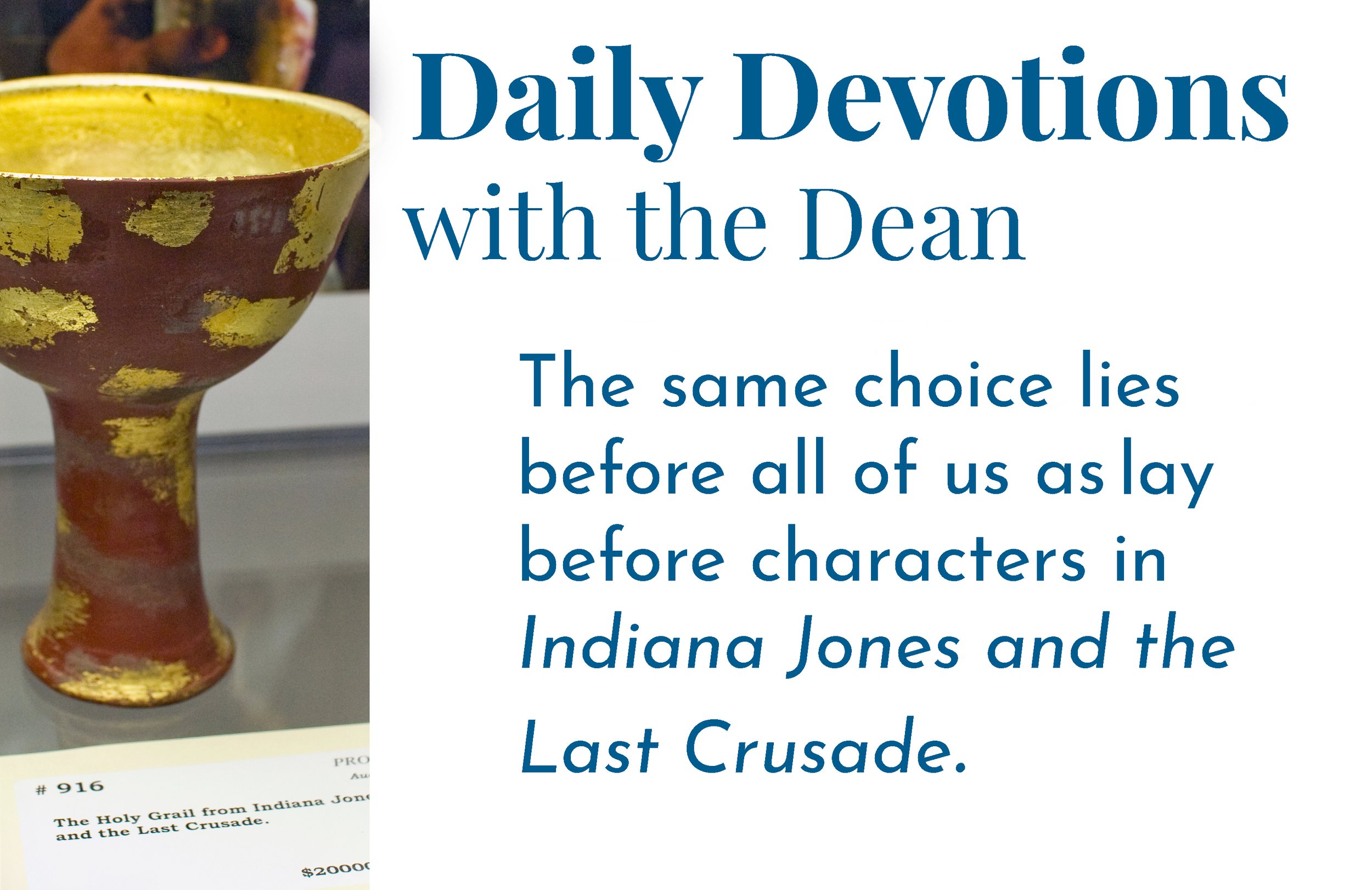
The same choice lies before all of us as lay before characters in Indiana Jones and the Last Crusade: “Choose wisely.” A cup of death, or a cup of life. 

John is shown that Babylon (a symbol of the human quest to overthrow God) will fall, if not immediately, then nonetheless inevitably. In the meantime, believers of every time and place (from the 7 churches of Revelation to the churches of our own day, and beyond) are given a threefold challenge: 

Here is a call for the endurance of the saints, those who keep the commandments of God and hold fast to the faith of Jesus” (Revelation 14:12). Our challenge is to endure with grace and courage all that comes our way, to obey God’s Word rather than our own predilections, and to believe in the finished work of Jesus on the cross and his ongoing work in our lives and in our world. 

And we are given a singular promise: our deaths are neither wasted nor to be lamented: “And I heard a voice from heaven saying, ‘Write this: Blessed are the dead who from now on die in the Lord.’ ‘Yes,’ says the Spirit, ‘they will rest from their labors, for their deeds follow them’” (Revelation 14:13). 

Be blessed this day, 

Reggie Kidd+

Image: https://www.flickr.com/photos/hartsell/2766008839/ Creative Commons Attribution-NonCommercial-ShareAlike 2.0 Generic License.

A Dramatic Redemption - Daily Devotions with the Dean

Wednesday • 11/3/2022
Wednesday of the Twenty-third Week After Pentecost (Proper 26)

This morning’s Scriptures are: Psalm 72; Nehemiah 13:4–22; Revelation 12:1-12; Matthew 13:53–58

This morning’s Canticles are: following the OT reading, Canticle 11 (“The Third Song of Isaiah,” Isaiah 60:1-3,11a,14c,18-19, BCP, p. 87); following the Epistle reading, Canticle 16 (“The Song of Zechariah,” Luke 1:68-79, BCP, p. 92)


Nehemiah: a balanced life. Ezra and Nehemiah belong to a beautiful season in redemptive history. What is compelling and attractive is the comprehensiveness of their vision of life for bearers of the image of God. It’s a vision of basking in God’s Word: Ezra reads the Law (Nehemiah 8:1–8). It’s a vision of gathering for worship: the people resume the sacred festivals (Nehemiah 8:9–18). And it’s a vision of lives being offered as living sacrifices, of people doing justice, loving mercy, and walking humbly before God. Ezra and Nehemiah reestablish the moral center of people’s lives. 

The last of these concerns is the theme of today’s reading in Nehemiah. After having been away from Persia for twelve years, Nehemiah had been required to return to Artaxerxes’s service. “After some time,” he explains, “I asked leave of the king and returned to Jerusalem” (Nehemiah 13:6b–7a). Upon his return, he finds that in his absence things have not gone well. Instead of feeding the sheep, spiritual shepherds are fleecing the sheep. The temple’s stewards have converted Yahweh’s temple into a marketplace for selling religious “benefits” for personal profit. People have stopped supporting the Levites, and so he asks, “Why is the house of God forsaken?” (Nehemiah 13:11). Meanwhile, merchants are making a mockery of sacred time. The malls are open on the sabbath (Nehemiah 13:15–19).

Nehemiah responds by booting those who had misappropriated temple grounds, cleanses the temple of stuff that doesn’t belong there (“I threw all the household furniture of Tobiah out of the room” — Nehemiah 13:8), returns sacred objects to their rightful place, reinstitutes tithes, brings the Levites back onto the temple staff, shuts down the sabbath markets, and informs the merchants not to come on the sabbath: If you do so again, I will lay hands on you” (Nehemiah 13:21). 

Nehemiah provides a glimpse ahead of time into the passion that drove Jesus to take a stand against the unjust and irreligious use of the temple in his own day (Matthew 21:10–17; Mark 11:15–17; Luke 19:45–46; John 2:13–17). It’s not enough to believe the right things and go through the motions of worship. There’s a non-negotiable life that aligns with those beliefs and with that worship. Without this life, the beliefs and the worship are worthless. 

In combination, though, orthopistia (right belief), orthodoxia (right worship), and orthopraxis (right behavior) embody God’s life powerfully, and make the most compelling statement to the world about who he is. One of the great gifts of the Ezra-Nehemiah chapter of the biblical story is to communicate this great truth to us. 

Revelation: a dramatic redemption. Today’s reading in Revelation portrays our redemption in a dramatic and unique way. It’s a breathtaking perspective: A great sign appeared in heaven: a woman clothed with the sun, with the moon under her feet and a crown of twelve stars on her head. This regal woman is about to give birth to “a son, a male child, who is to rule all the nations with a rod of iron” (Revelation 12:1,2,5). The Book of Revelation demands nuance and humility of interpretation. But I’m certain that this woman is Mary from God’s perspective: an embodiment of all that Israel was called to be. With her twelve-starred crown and birth pangs, she is both kingdom of priests and bride of God, bearing God’s life into the world. 

A dragon, i.e., Satan, would kill the child at birth (as well he attempted to do through Herod the Great — Matthew 2). And even Satan’s apparent success on the Cross is a failure, “because it was impossible for him to be held in [death’s] power” (Acts 2:24). Victorious over death, the “Child” is taken up to heaven at his ascension (Acts 1:1–11). 

Now, the woman who has represented Mary-as-Israel becomes the Church, the future Bride of Christ (see Revelation 19). For now, she is whisked into “the wilderness, where she has a place prepared by God, so that there she can be nourished for one thousand two hundred sixty days”—i.e., the same three and a half years by which Revelation describes the church-age in terms of a “short” season of tribulation. 

In the wilderness of her sojourn, the woman—i.e., the Church—will need nourishment and protection because a battle has broken out in heaven (Revelation 12:7). Michael the archangel defeats the dragon Satan, who is cast out of heaven and hurled to earth where he will do what damage he can to the creation and the creatures whom God loves—especially to God’s beloved Bride-to-be, the Church (Revelation 12:8–9). 

Even as she experiences the travails of her persecution (as recorded in the rest of the verses in Revelation 12, which the daily lectionary, alas, leaves out!), heaven’s song rings through: 

Now have come the salvation and the power
    and the kingdom of our God
    and the authority of his Messiah,
for the accuser of our comrades has been thrown down,
    who accuses them day and night before our God.
11 But they have conquered him by the blood of the Lamb
    and by the word of their testimony,
for they did not cling to life even in the face of death.
12 Rejoice then, you heavens
    and those who dwell in them!
But woe to the earth and the sea,
    for the devil has come down to you
with great wrath,
    because he knows that his time is short!
” (Revelation 12:10–12). 

I pray we know what it is to believe accurately, to worship rightly, to live obediently, and to rejoice in the wonder of God’s defeat of evil even amid our daily struggle against it. 

Be blessed this day,

Reggie Kidd+

Image: Zion72, CC BY-SA 4.0, via Wikimedia Commons

The Church Protected and Prevailing - Daily Devotions with the Dean

Tuesday • 11/2/2021
Tuesday of the Twenty-third Week After Pentecost (Proper 26)

This morning’s Scriptures are: Psalm 61; Psalm 62; Nehemiah 12:27–31a,42b–47; Revelation 11:1–19; Matthew 13:44–52

This morning’s Canticles are: following the OT reading, Canticle 13 (“A Song of Praise,” BCP, p. 90); following the Epistle reading, Canticle 18 (“A Song to the Lamb,” Revelation 4:11; 5:9–10, 13, BCP, p. 93)


Revelation 11: the church protected and prevailing

Looking back and looking ahead. In Revelation 10, John was instructed to eat a little scroll. It is sweet and bitter, because its message is both good news and bad news, both blessing and curse. Accordingly, from Revelation 12 to the end of the book, Revelation will forecast the destiny of two symbolic women: the “bride of Christ” for whom a wedding banquet is being prepared in a new heaven and new earth (Revelation 19–22), and “the great whore [of Babylon] who is seated on many waters, with whom the kings of the earth have committed fornication, and with the wine of whose fornication the inhabitants of the earth have become drunk” (Revelation 17:1b–2). Two women, representing humanities with two destinies. The book’s message to us is: choose carefully which future is yours.

Measuring time. Here in Revelation 11, in preparation for the unfolding of the drama contrasting the destinies of the bride of Christ and the whore of Babylon, John is given perspective on God’s provision and protection during “three-and-a-half years” of intense tribulation (Revelation 11:3). 

In their juxtaposition in the book of Revelation, two important numbers represent the duration of the church’s existence between Christ’s two comings: three-and-a-half years, and a thousand years. These numbers are, I believe (and it is a matter of interpretation), symbolic rather than literal. The church age is at one and the same time a short period in which Christians testify despite strong resistance (Revelation 11:3; 12:6,14; 13:5), and also a long period in which they share in Christ’s reign as a kingdom of priests (Revelation 20:2). 

Measuring the temple. Some interpreters believe the measuring of the temple in Revelation 11 has in view either the physical temple that no longer stands in Jerusalem or a temple that will one day be rebuilt there. I do not believe either is in view. I believe God is assuring John and readers like you and me that God protects and preserves the faithful who dwell in the new temple that has been under construction since Christ rose from the dead (John 2:19–20; 1 Corinthians 3:9; 6:19; Ephesians 2:19–22; Hebrews 3:6; 1 Peter 2:4–5). Right now, God dwells among his people, and despite the storm of tribulation through which they live, he neither abandons them nor forsakes them. Thus, Revelation 11:4–10 promises “oil” to keep the “lamps” of the temple lit, and power and authority to the words of the witnesses. 

What lies ahead: martyrdom and vindication. The New Testament consistently pictures a day that lies ahead of us when, by God’s permission, there will be something that NT theologian Herman Ridderbos calls “an explosion of evil.” In his epistles, John refers to “the Antichrist” and “the spirit of Antichrist” (1 John 2:18,22; 4:3; 2 John 7). In Revelation, John describes “the war against the Lamb and his people,” empowered by the unleashed dragon Satan (Revelation 12:9; 20:7–9a), effected through the great beast that emerges from the sea (Revelation 13), and inflaming all those in thrall to the whore of Babylon. 

In Revelation 11, John gets a preview of how challenging those days will be for God’s people: “When they have finished their testimony, the beast that comes up from the bottomless pit will make war on them and conquer them and kill them” (Revelation 11:7). With the unleashing of Satan, the rise of the beast, and the attack of the armies of the whore of Babylon, an intense season of martyrdom lies ahead. But that season of intense suffering will be limited to a symbolic “three and a half days,” and will be followed by Christ’s return and our resurrection. Vindication will come with the sounding of the seventh trumpet, the opening of God’s temple in heaven, a raining down of a storm of judgment against all lawlessness (Revelation 11:15–19), the return of Christ in glory (Revelation 19:11–21), and the establishment of God’s final reign (especially Revelation 20:9b–22:21). On that day, the church below will join the song of the church above: “The kingdom of the world has become the kingdom of our Lord and of his Messiah, and he will reign forever and ever” (Revelation 11:15). 

Meanwhile, while John is told not to write down everything he sees (Revelation 10:4), he is told to write this down for us: “The one who overcomes I will make a pillar in the temple of my God … The one who overcomes I will grant to sit with me on my throne … The one who overcomes will inherit these things, and I will be their God and they will be my son” (Revelation 3:12,21, 21:7, my translation). 

Be blessed this day, 

Reggie Kidd+

Image: "Heaven" by Boston Public Library is licensed under CC BY-NC-ND 2.0

The Master of the Field - Daily Devotions with the Dean

Monday • 11/1/2021
Monday of the Twenty-third Week After Pentecost (Proper 26)

This morning’s Scriptures are: Psalm 56; Psalm 57; Nehemiah 6:1–19; Revelation 10:1–11; Matthew 13:36–43

This morning’s Canticles are: following the OT reading, Canticle 9 (“The First Song of Isaiah,” Isaiah 12:2–6, BCP, p. 86); following the Epistle reading, Canticle 19 (“The Song of the Redeemed,” Revelation 15:3–4, BCP, p. 94)


Wheat and Tares

Anger is the prevailing mood of our day—cleansing, purging, “righteous” anger. One might have thought that a worldwide pandemic would bring us all together in a united campaign against a common enemy. Instead, it’s pushed us further into our separate corners, pitting “my rights” folks who won’t mask and who don’t vax against “our common good” folks who will mask and who do vax. In a range of matters political, racial, and economic, rage runs deep. Terms like “block,” “unfriend,” “cancel” have taken on new meaning. They are weapons of moral indignation, as people cleanse their worlds of those they view as unjust, ill-informed, and unholy. 

With his parable of “The Wheat and the Tares” (told in last Friday’s gospel reading and explained in today’s), Jesus urges us to hit the pause button. In brief, as I put it in another writing, “The master of the field is perfectly willing to allow weeds to get as much care as the wheat until the appointed time for making all things right. When the time for final judgment comes, the angels, not the workers, will do the final sorting.”

In God’s providence, “the children of promise” and “the children of the flesh,” or, to use another biblical image, “the sons of light” and “the sons of darkness,” live side by side until Christ returns to bring final judgment. It’s been that way since God protected Cain following Abel’s death (Genesis 4:1–16). God bestowed culture-building gifts to the line of Cain, while giving the gift of worship to children of the line of Seth (Genesis 4:17–21,25–26). As strange as it may seem to us, Cain’s descendants and Seth’s descendants live in interdependence to one another. Christ, and Christ alone, will separate “wheat” from “tares” and “sheep” from “goats” (Matthew 13 and 25), and that, at a time not chosen by him, but appointed by his Father (Mark 13:32; Matthew 24:36). 

As I was pondering this puzzling parable, I stumbled upon reflections written by Augustine, the North African 5th century bishop. He too lived in a time when people’s fuses were short. The redemptive hopes for a Christianized Roman Empire were falling short: pagans were asking why barbarians were still invading 100 years after Constantine’s conversion, and why riotous living had not been put in check. Here, Augustine writes the first Christian philosophy of history. In it, he calls for patience. The human story, he argues, is one of the simultaneous emergence of, and the divergence between, the “City of God” and the “City of Man.” Each “city” becomes more itself. 

In the previous parable about the Sower and the Seed, Augustine reminds his readers, Jesus warns us not to be “stony ground,” “shallow ground,” or “thorny places” (Matthew 13:1–9,18–23). Rather, we should, says Augustine, “plough the hard ground, cast the stones out of the field, pluck up the thorns out of it.” Guard, in other words, against a hard heart that will reject God’s Word. Avoid a shallowness of soul where God’s love will find no root. Remove things like lust and the cares of this world that would choke the life out of us. Instead, our lives should be “good ground,” where God’s Word gets planted deep, and produces much fruit. 

In this next parable about Wheat and Tares, Jesus changes the image (Matthew 13:24–30,36–43). We now are what comes up out of the ground. We are either wheat that nourishes, or tares (likely, darnel) that poison. The scary thing is that the wheat and the darnel plant look alike. Both will sit side by side in church, says Augustine, and be indistinguishable from the outside. Jesus warns us, of course, not to let ourselves be tares: life-giving in appearance, but death-dealing in actuality. Comments Augustine: 

I am addressing the tares; but the sheep themselves are the tares. O evil Christians, O you, who in filling only press the Church by your evil lives; amend yourselves before the harvest come … He is requiring repentance of you … and may it be so that they who today are tares, may tomorrow be wheat.

That’s something we might very well expect Jesus to say. What’s a bit surprising is what he says to the good wheat: Don’t think it’s your job to get rid of the tares. You’ll destroy yourselves if you do. As Augustine puts it:  

Why are you so hasty, [Jesus] says, you servants full of zeal? You see evil Christians among the good; and you wish to root up the evil ones; be quiet, it is not the time of harvest. That time will come, may it only find you wheat! … O you Christians, whose lives are good, you sigh and groan as being few among many, few among very many. The winter will pass away, the summer will come; lo! The harvest will soon be here. … 

Let the good tolerate the bad; let the bad change themselves, and imitate the good. Let us all, if it may be so, attain to God.

Almost as if to summarize this parable, and certainly to address people who live in a day like Augustine’s and ours, James the brother of Jesus puts it this way: “the wrath of man worketh not the righteousness of God” (James 1:20).  

Be blessed this day, 

Reggie Kidd+

Image: "icon of the wheat and tares" by bobosh_t is licensed under CC BY-SA 2.0

*Augustine, Sermon 23 on the New Testament, accessed at http://newadvent.org/fathers/160323.htm