
Daily Devotions

A Few Facts - Daily Devotions with the Dean

Friday • 10/15/2021
Friday of the Twentieth Week After Pentecost (Proper 23)

This morning’s Scriptures are: Psalm 16; Psalm 17; Jeremiah 38:14–28; 1 Corinthians 15:1–11; Matthew 11:1–6

This morning’s Canticles are: following the OT reading, Canticle 10 (“The Second Song of Isaiah,” Isaiah 55:6–11; BCP, p. 86); following the Epistle reading, Canticle 18 (“A Song to the Lamb,” Revelation 4:11; 5:9–10, 13, BCP, p. 93)


…I handed on to you as of first importance…” (1 Corinthians 15:3). Paul felt it was important to remind the Corinthians of a few facts. Perhaps it’s worthwhile for us to recall them. 

…Christ died for our sins…” (1 Corinthians 15:3). Jesus of Nazareth was the only human who ever lived who did not, by God’s standards, deserve to die. He died for one purpose. It was not, as some think, to give us an example of heroic resignation in the face of life’s inevitable end. He died to receive in his own person the consequences of his people’s sin. Unjustly killed, he won for us forgiveness at the bar of justice.

DDD Oct 15.jpg

…he was raised on the third day…” (1 Corinthians 15:4). As his death was “for” us, so was his resurrection. By his rising from the dead, he takes us by the hand and lifts us with him, as the Book of Common Prayer says, “out of error into truth, out of sin into righteousness, out of death into life” (BCP, p. 368). Because he lives, we live too: no longer subject to sin, to guilt, to shame, to endless death and separation from God. 

…in accordance with the scriptures…in accordance with the scriptures” (1 Corinthians 15:3,4). Paul repeats this phrase to underscore the point that Scripture provided forecast after forecast both of Christ’s death and of his resurrection. As Jesus had explained on the road to Emmaus on the day of his resurrection: “‘Was it not necessary that the Messiah should suffer these things and then enter into his glory?’ Then beginning with Moses and all the prophets, he interpreted to them the things about himself in all the scriptures” (Luke 24:26–27). 

The foreshadowing of Jesus’ death appeared when Joseph was lowered into a pit by his brothers and sent to prison by Pharaoh, when Moses was set afloat in the bullrushes, when Jeremiah was lowered into the cistern, when Jonah was swallowed by a fish, when David was persecuted by his enemies, when Hezekiah lay on his sickbed. 

The foreshadowing of Jesus’s being raised appeared when Joseph was lifted from his pit by nomads and brought from prison to rule on Pharaoh’s behalf, when Moses was rescued from the bullrushes by his mother, when Jeremiah was pulled up out of the cistern, when Jonah was vomited from the fish, when David was delivered from his enemies, when Hezekiah was raised up from his sickbed.

Now I would remind you, brothers and sisters, of the good news that I proclaimed to you, which you in turn received, in which also you stand, through which also you are being saved…” (1 Corinthians 15:1). Paul reminds us that we are not free to invent our own story. We belong to a story that has been given to us, and we are called upon to pass it on unvarnished, unembellished, and unchanged. We are not free to substitute a theology that sneers at Christ’s substitutionary death for sin or dismisses the hope of a resurrection like his. 

…as to one untimely born, he appeared also to me. For I am the least of the apostles…” (1 Corinthians 15:8–9a). When the staggering truth of Jesus’s death and resurrection hits home, it prompts a reassessment of oneself. For Paul, that truth meant realizing he wasn’t as special as he had thought—from which posture, of course, he was able to receive as a gift a new status and a new calling. For us, I pray that the staggering truth of Jesus’s death and resurrection “according to the scriptures” calls forth from us a similar combination of sober self-reflection and joy-filled reliance on “the grace of God that is with me” (1 Corinthians 15:10). 

Be blessed this day, 

Reggie Kidd+

Image: Detail, stained glass, Cathedral Church of St. Luke, Orlando, Florida
To Read and Ponder Jeremiah's Life and Times - Daily Devotions with the Dean

Wednesday • 10/13/2021
Wednesday of the Twentieth Week After Pentecost (Proper 23)

This morning’s Scriptures are: Psalm 119:1–24; Jeremiah 37:3–21; 1 Corinthians 14:13–25; Matthew 10:24–33 

This morning’s Canticles are: following the OT reading, Canticle 11 (“The Third Song of Isaiah,” Isaiah 60:1-3,11a,14c,18-19, BCP, p. 87); following the Epistle reading, Canticle 16 (“The Song of Zechariah,” Luke 1:68-79, BCP, p. 92)


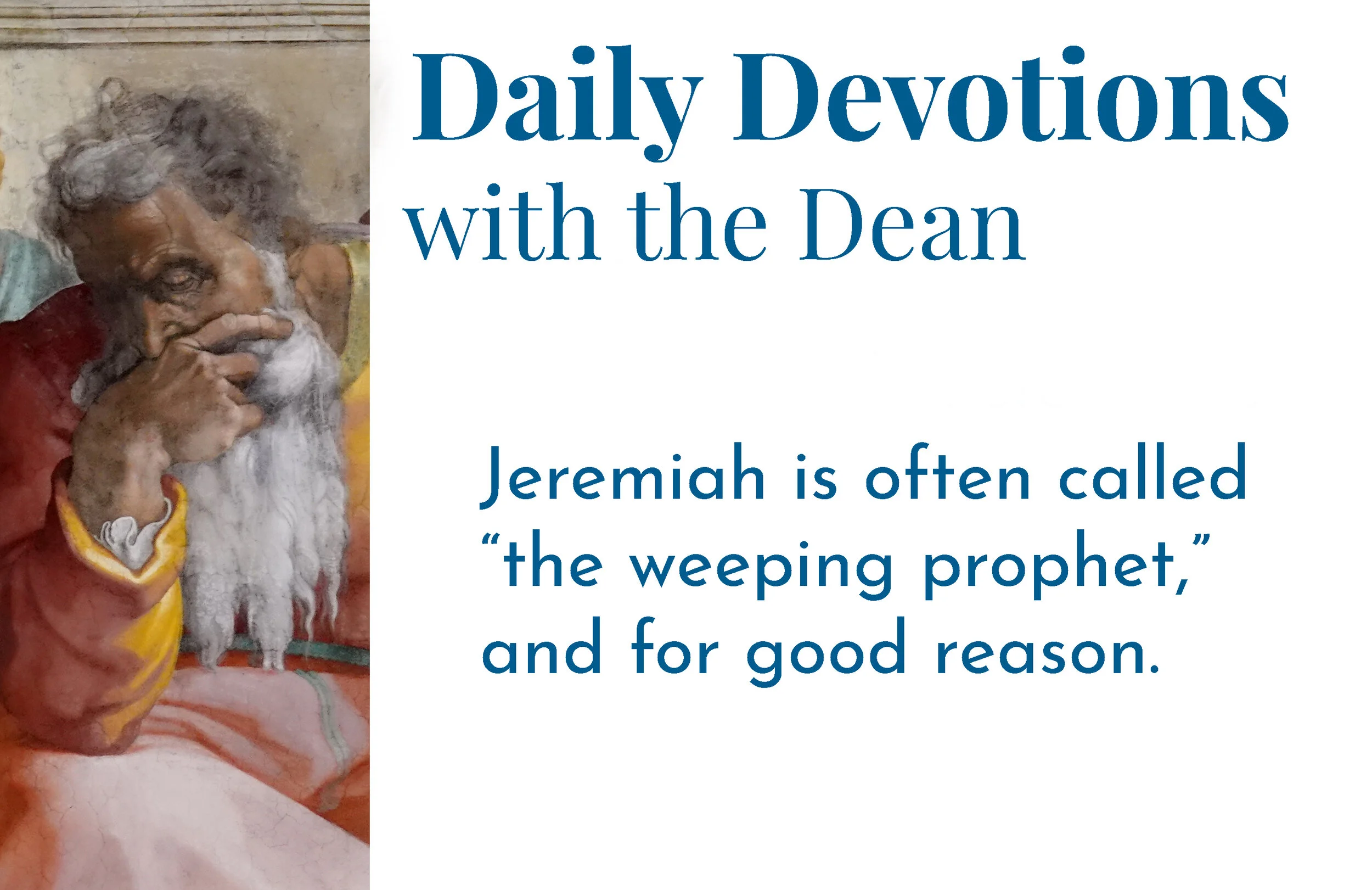
Jeremiah: God’s “weeping prophet.” I look forward every morning to immersing myself in the grand story of God’s redeeming love. I confess, however, that going through the period of the divided monarchy these past few weeks has been rough. Despite the occasional “good” king of Judah and the minority voices of “my servants the prophets,” the constant drift is toward judgment, destruction, and exile for the people of God. I’m reminded of God’s people as a whole standing on Deuteronomy’s Mt. Ebal, calling down the curses of covenant disobedience upon their heads. It’s not a pretty picture.

DDD Oct 13.jpg

It’s especially difficult to round out this portion of the history of God’s people by focusing, as we do this week, on the latter part of the career of Jeremiah. He’s often called “the weeping prophet,” and for good reason. From childhood he was called as prophet, and from the very beginning he knew that his was not to be a life of ease. “See, today I appoint you over nations and over kingdoms, to pluck up and to pull down, to destroy and to overthrow, to build and to plant” (Jeremiah 1:10). Opposition was going to come, and it was going to be fierce: “Do not be afraid of them, for I am with you to deliver you” (Jeremiah 1:8).

Yahweh touches Jeremiah’s mouth and puts his own words in his prophet’s mouth (Jeremiah 1:9). Ultimately that means Jeremiah gets treated with as much respect as the One for whom he speaks. And so, earlier this week we saw the contemptuous burning of the scroll upon which Jeremiah writes the words of Yahweh. Today, we see him arrested and falsely charged with treason, and then beaten and thrown into prison. Tomorrow we will find him cast into a muddy cistern: “Now there was no water in the cistern, but only mud, and Jeremiah sank in the mud” (Jeremiah 38:6). 

Friday’s and Saturday’s readings recount how Jeremiah is brought up from his cistern prison and given an audience with King Zedekiah. Jeremiah knows that the Babylonian captivity is inevitable, and that it is a matter of Yahweh’s restoring sabbath rest to the land, doing a “reset” of his plan for redemption through Israel. So his counsel is straightforward: Surrender. But Zedekiah is as stuck in mire as Jeremiah was physically in his cistern: “Your trusted friends have seduced you and have overcome you; Now that your feet are stuck in the mud, they desert you” (Jeremiah 38:22). Zedekiah cannot bring himself to heed Jeremiah, and the destruction the Babylonians bring is the more terrible for Zedekiah’s being “stuck in the mud.”

And still, despite the resistance, despite what must feel like failure, despite his grief over the suffering that God’s people are bringing on themselves, Jeremiah rises from his cistern to proclaim a message of hope: 

…[W]hen Babylon’s seventy years are completed will I visit you, and I will fulfill to you my promise and bring you back to this place. For surely I know the plans I have for you, says the LORD, plans for your welfare and not for harm, to give you a future with hope. Then when you call upon me and come and pray to me, I will hear you. When you search for me, you will find me; if you seek me with all your heart, I will let you find me, says the LORD, and I will restore your fortunes and gather you from all the nations and all the places where I have driven you, says the LORD, and I will bring you back to the place from which I sent you into exile. Jeremiah 29:10-14. 

There is a profound and humbling cruciformity to Jeremiah’s life, for in many ways he anticipates the ministry of Jesus, his Savior and ours. That’s why it’s altogether instructive to read and ponder Jeremiah’s life and times. 

Matthew: becoming “little Christs.” Israel’s and Jeremiah’s story is a fitting background for our ability to identify with Jesus’s instruction to the twelve disciples as he sends them out on their first mission. As God’s “peculiar possession” and “kingdom of priests,” Israel was incubating God’s plan to have all the world’s sin be gathered up and assumed in One True Israelite who could stand in for all the world’s sin. Matthew’s entire gospel is the account of this One, whose name is “Jesus, for he will save his people from their sins” (Matthew 1:21). 

Jesus sends the twelve, warning them, “A disciple is not above the teacher, nor a slave above the master; it is enough for the disciple to be like the teacher, and the slave like the master. If they have called the master of the house Beelzebul, how much more will they malign those of his household! … So have no fear of them …” (Matthew 

If I may paraphrase and extrapolate: “If they treat you badly it’s not you with whom they have issues. They are rejecting me and taking it out on you. Evil, sin, and death will be conquered by my suffering evil, absorbing sin, and embracing death. If you hold me to be your Christ, you need to respond as “little Christs,” because that’s the way we win.” 

No matter what the response is—whether we meet receptivity, resistance, or indifference—we know, per Jesus’s promise: “[E]ven the hairs of your head are all counted. So do not be afraid; you are of more value than many sparrows. Everyone therefore who acknowledges me before others, I also will acknowledge before my Father in heaven” (Matthew 10:30–32). 

Be blessed this day, 

Reggie Kidd+

Image: "Michelangelo, Jeremiah lamenting the fall of Jerusalem, detail of the ceiling of the Sistine Chapel, 1508-12" by Prof. Mortel is licensed under CC BY 2.0

To Encourage One Another - Daily Devotions with the Dean

Tuesday • 10/12/2021
Tuesday of the Twentieth Week After Pentecost (Proper 23)

This morning’s Scriptures are: Psalm 120: Psalm 5; Psalm 6; Jeremiah 36:27–37:2; 1 Corinthians 14:1–12; Matthew 10:16–23

This morning’s Canticles are: following the OT reading, Canticle 13 (“A Song of Praise,” BCP, p. 90); following the Epistle reading, Canticle 18 (“A Song to the Lamb,” Revelation 4:11; 5:9–10, 13, BCP, p. 93)


Riffing on Paul’s approach to tongue-speaking. 

Ours is a conversational God. He creates by word. He instructs by word. He promises by word. He warns by word. He rewards by word. He punishes by word. How we respond to his words is of great consequence.

As bearers of his image, we are conversational creatures too. Therefore, what we do with words is also of great consequence. 

If King Jehoiachim were not aware of the power of Jeremiah’s prophetic words, he would not have burned them. Whether he burns Jeremiah’s scroll out of sheer contempt for God’s words or out of an attempt to thwart them, Jehoiachim’s exercise is a “bonfire of the vanities.” Jeremiah’s predictions of doom come to pass

DDD Oct 12.jpg

Unlike Jehoiachim, the Corinthians are not contemptuous of God’s words. Rather, they are cavalier with them. They have received God’s words gladly, embracing the truth of the gospel and reveling in the flourishing of the gifts of the Holy Spirit among them. However, for too many Corinthians, the ministry of the Holy Spirit is being pressed to narcissistic ends. 

In his later letter to the Romans, Paul may hint that the gift of “glossolalia” (speaking in either angelic languages or human languages that a person had not learned) has the capacity to provide a safety valve for troubled souls. He says that the Holy Spirit releases groanings from our inner being (Romans 8:26). Paul describes the groanings as wordless (alalētoi), but many people argue that he has glossolalia in mind. If so, Paul holds out to individuals the prospect of therapeutic value in tongue speaking, as glossolalia could help us in the weakness of our inability otherwise to lift our subconscious struggles to the Lord.  

In Corinth, however, such “private tongues” (as they are often called) are being used for egotistical ends. People are speaking out in uninterpreted strange languages in church. Paul says (I paraphrase): “Keep that stuff to yourself. At home, that practice allows you to speak in a mysterious way to God. In church, you’re just showing off, and ‘speaking into the air.’” What Paul wants us to see is that in church, everything we do—everything—is for the good of the group that is gathered. Church is where we look to build each other up, to encourage one another, and to bring words of consolation from God to broken and wounded hearts (1 Corinthians 14:3). That’s why Paul says that in church, tongues must be interpreted if they are to be spoken at all. Otherwise, words that are to be offered are to be as distinct, purposeful, and artful as notes from a well-played flute, harp, or bugle (1 Corinthians 14:7–8).  

There are broad-ranging implications here for the ordering of worship services, and for the shaping of church life in general. 

Ego needs to get left at the door. A person doesn’t get asked to sing a solo because they need to sing a solo. A person gets asked to sing a solo because the congregation will best be served by that particular voice paired with that particular song. Same with lectors who read, eucharistizers who eucharistize, and, of course, preachers who preach. 

Stepping back another level, the church doesn’t call and ordain a person to ministry (or whatever a church’s governance calls their practice) because that person “needs” that call and ordination. Especially if a person “needs” said call and ordination! God gives gifts of ministry for, well, for ministry. 

He gives us whatever gifts we have because he expects us to use them to serve others, not ourselves! “So with yourselves; since you are eager for spiritual gifts, strive to excel in them for the building up of the church” (1 Corinthians 14:12). 

Be blessed this day, 

Reggie Kidd+

Image: Stained Glass, Cathedral Church of St. Luke, Orlando, Florida

Expect a Happy Ending - Daily Devotions with the Dean

Monday • 10/11/2021
Monday of the Twentieth Week After Pentecost (Proper 23) 

This morning’s Scriptures are: Psalm 1; Psalm 2; Psalm 3; Jeremiah 36:11–26; 1 Corinthians 13:1–13; Matthew 10:5–15

This morning’s Canticles are: following the OT reading, Canticle 9 (“The First Song of Isaiah,” Isaiah 12:2–6, BCP, p. 86); following the Epistle reading, Canticle 19 (“The Song of the Redeemed,” Revelation 15:3–4, BCP, p. 94)


“Love is patient.” Love doesn’t stand there tapping its toe with arms crossed, and saying, “Come on already!” Μακροθυμεῖ (makrothumei) is close to Exodus 34:6’s “slow to anger” (LXX, μακρόθυμος, makrothumos). Meaning: love isn’t quick on the trigger. Love’s on-ramp to anger is lllllloooonnnngggg. 

“Love is kind.” χρηστεύεται (chresteuetai). To the Greek ear, this particular use of the root word “kind” (χρηστ-, chrest-) would have sounded like the making of a verb out of the title, “Christ.” Christ’s people act in ways that remind people of the One who brought kindness from heaven to earth.

“Love is not envious.” Love isn’t resentful at somebody else’s happiness. Love doesn’t begrudge  someone else’s success. Love doesn’t get upset when somebody else does well. 

“Love is … not boastful.” Love isn’t in the self-promotion business. The word here is one of Paul’s strongest: it’s περπερεύεται (perpereuetai). It occurs only here in the Bible, but is fairly frequent in contemporary literature: “to heap praise upon oneself; to be a braggart or a windbag.” You bet Paul knew a bunch of those folks in First Church “We Have Become Kings” in Corinth!

“Love is … not arrogant.” Love isn’t “puffed up” (literally), that is, it doesn’t have a bloated ego or inflated view of itself, especially at the expense of someone else. Love isn’t contemptuous, or disdainful of others.    

“Love is … not rude.” This word might better be rendered “crude” or “indecent.” The Greek is οὐκ ἀσχημονεῖ (ouk aschemonei), and it means “behave disgracefully, dishonorably, indecently.” Love does not treat anyone in a demeaning, disgraceful, dishonorable, or indecent way. An apt word in a world of #MeToo and #ChurchToo. 

“Love … does not insist on its own way.” Love’s default is: “Happy to do it your way.”

“Love is … not irritable.” We get “paroxysm” from this Greek word. Violent convulsions of rage don’t leave much room for love. 

“Love is … not resentful.” The Greek here (οὐ λογίζεται τὸ κακόν, ou logizetai to kakon) means: “Love doesn’t keep score, counting up offenses, readying a payback.” 

“Love … does not rejoice in wrongdoing.” Put in the positive, love grieves when it sees injustice, and does not sit idly by when wrongdoing is on the rise. 

“Love … rejoices in the truth.” Love says, “Yes!” to the real. Love knows that philosopher/theologians Thomas Aquinas and Josef Pieper are right: as the Father begets the Son and the Holy Spirit proceeds from the Father and the Son, “Being” leads to “Truth” leads to “Justice.” Which is why love delights in the progression of the Eucharistic prayer: “… out of error into truth, (then) out of sin into righteousness, (then) out of death into life.” 

“Love … bears all things.” The relevant meaning for the verb στέγειν (stegein) is “keep confidential, cover, pass over in silence.” Theologian/historian Adolf Harnack is hard to beat here: Love “throws a cloak of silence over what is displeasing in another person.”

“Love believes all things.” Love is ready to extend (wise) trust. As Dietrich Bonhoeffer says, “We have learnt never to trust a scoundrel an inch, but to give ourselves to the trustworthy without reserve” (“After Ten Years: A Reckoning made at New Year 1943,” p. 12). May we be surrounded by those worthy of trust. May we, by the mercy and grace of God, prove worthy of the same.

“Love hopes all things.” Life sure feels different when you always expect … at least, in the end … a happy ending.

“Love endures all things.” Because happy endings sometimes are a long way off, and it can be a grind getting to them.

Be blessed this day, 

Reggie Kidd+

Image: Adaptation from: "Love" by Thomas Hawk is licensed under CC BY-NC 2.0

A Fix for Our Spiritual Death - Daily Devotions with the Dean

Friday • 10/8/2021
Friday of the Nineteenth Week After Pentecost (Proper 22)

This morning’s Scriptures are: Psalm 140; Psalm 142; 2 Kings 23:36–24:17; 1 Corinthians 12:12–26; Matthew 9:27–34

Jehoiakim: Thursday • 3/18/2021 • Week of 4 Lent

This morning’s Canticles are: following the OT reading, Canticle 10 (“The Second Song of Isaiah,” Isaiah 55:6–11; BCP, p. 86); following the Epistle reading, Canticle 18 (“A Song to the Lamb,” Revelation 4:11; 5:9–10, 13, BCP, p. 93)


2 Kings: The final years of the Davidic line in Jerusalem are inglorious. Josiah’s reforms are reversed by his son Jehoiachim (609–598 BC) and grandson Jehoiachin/Jeconiah (615/605–597 BC). The curses of Mount Ebal (Deuteronomy 27:15–26; 28:15–68) come upon the nation in its conquest by Babylon: “The LORD will bring you, and the king whom you set over you, to a nation that neither you nor your ancestors have known, where you shall serve other gods, of wood and stone. You shall become an object of horror, a proverb, and a byword among all the peoples where the LORD will lead you” (Deuteronomy 36–37). 

The Babylonians leave behind only “the poorest people of the land,” while carrying away “the elite of the land” and their puppet king, Mattaniah/Zedekiah, Jehoiakin’s uncle (2 Kings 24:14,15,17). 

While, as we will read in days to come, there will be an initial return and restoration of sorts under the leadership of Ezra and Nehemiah, a deeper-seated problem has surfaced. Like all the rest of the nations, Israel is as subject to sin and death as is the rest of the human race. What’s needed is a fix for the universality of our spiritual death, that is, our moral incapacity and our religious rebelliousness. When it comes to the things of God and of finding the capacity to live out what it is to bear his image, we—all of us, Jew and Gentile alike—are diseased, blind, deaf, mute, and lame.

DDD Oct 8.jpg

Matthew: Enter Jesus Christ. The point of Matthew’s account of Jesus’s healing ministry is to show how “Emmanuel” (God-with-us) takes it all into himself, turning disease into health. In today’s accounts, Jesus turns blindness into sight and gives voice to the mute. It’s a part of his fulfillment of Isaiah 53: “He took our infirmities and bore our diseases” (Isaiah 53:4; Matthew 8:17). In his victory at the cross, ultimately, he turns death into life. 

1 Corinthians: Living in the “new creation.” In consequence of which, there is what Paul calls “new creation” (2 Corinthians 5:17; Galatians 6:15). It’s a reality the Corinthians celebrate but only partially understand. In their “new creation,” they (or at least many of them) act like spoiled brats, basking in a presumed spiritual superiority. They think they’ve arrived at final Kingdom bliss, and they baptize the inequities of this world as though they were God’s confirmation of the superiority of the “haves” and the inferiorities of the “have nots.” Paul wants them to see that reality is just the opposite: God chooses the foolish over the wise, the weak over the strong, the low over the high, the despised over the favored, and the “nobodies” over the “somebodies” (1 Corinthians 1:29). 

Therefore, as Paul says, “God has so arranged the body, giving the greater honor to the inferior member, that there may be no dissension within the body, but the members may have the same care for one another” (1 Corinthians 12:25). Let the Babylonians pay attention to the elites with their puppet king, and ignore the poorest of the land. Just the opposite prevails in the Kingdom of God, by the mystery of the loving wisdom of God. 

Be blessed this day, 

Reggie Kidd+

Josiah-like Housecleaning - Daily Devotions with the Dean

Thursday • 10/7/2021
Thursday of the Nineteenth Week After Pentecost (Proper 22)

This morning’s Scriptures are: Psalm 131; Psalm 132; Psalm 133; 2 Kings 23:4–25; 1 Corinthians 12:1–11; Matthew 9:18–26

This morning’s Canticles are: following the OT reading, Canticle 8 (“The Song of Moses,” Exodus 15, BCP, p. 85); following the Epistle reading, Canticle 19 (“The Song of the Redeemed,” Revelation 15:3–4, BCP, p. 94)


2 Kings: Josiah’s war against false gods. King Josiah faces an astounding array of false gods: Baal, Asherah, all the hosts of heaven, the sun, the moon, the constellations, Astarte of the Sidonians, Chemosh of Moab, Milcom of the Ammonites. His relentless, indeed ruthless, quest to purge Judah of all false worship stands as a constant challenge to you and me to purge our hearts and lives of our own “idols,” and instead, to “turn to the LORD with all [our] heart, with all [our] soul, and with all [our] might, according to the law of Moses” (2 Kings 23:25).

The amazing potpourri that 2 Kings 23 describes is instructive. The heart that opens itself to anything and everything will become dissipated by all the demands, and glutted with meaninglessness. In our day we may be less familiar with the ones named. But the apostle Paul lists other kinds of idolatry we know all too well: “their god is their belly” … “greed, which is idolatry” … “lovers of self” (pilautoi) … “lovers of pleasure” (philēdonoi) — Philippians 3:19; Colossians 3:5; 2 Timothy 3:2,4.

DDD Oct 7.jpg

1 Corinthians: Paul’s fight to fill us with the life of God. When such idols occupy our field of vision, we are incapable of discerning the particular way the exquisite and unique manifestation of the Spirit comes our way. That’s why it’s no accident, in my view, that Paul prefaces today’s description of the delicate balance between the unity of the Giver and the multiplicity of the gifts by reminding us what it was like to be “enticed and led astray to idols that could not speak” (1 Corinthians 12:2).  

There is a glorious, even beautiful, resplendence to the internal life of the Triune God: Holy Spirit, the Lord Jesus Christ, and God the Father. From each, working in harmony with the others, come to us amazing benefits: from the Spirit, “varieties of gifts,” from the Lord Jesus, “varieties of services (diakoniai),” and from the “God who activates all of them in everyone,” “varieties of activities” (1 Corinthians 12:4–7). 

Paul wants each believer to be ready for and available to receive some unique and particular “manifestation of the Spirit for the common good” (1 Corinthians 12:7). He enumerates some of the possibilities, beginning with utterances of wisdom or knowledge, and expressions or acts of faith (see 1 Corinthians 12:8–11). 

If our hearts are preoccupied with substitutes for God (like self, pleasure, money, or food), we can’t make room for the riches the Spirit would pour in. But when the Spirit is working uniquely in each of us “for the common good,” the beauty and resplendence of God’s very life comes to expression, on earth, so to speak, as it is in heaven. 

Making room for that is worth some good Josiah-like housecleaning. 

Be blessed this day, 

Reggie Kidd+

Image: Reggie Kidd photo

It's Never Too Late to Choose Life - Daily Devotions with the Dean

Wednesday • 10/6/2021
Wednesday of the Nineteenth Week After Pentecost (Proper 22)

This morning’s Scriptures are: Psalm 119:145–176; 2 Kings 22:14–23:3; 1 Corinthians 11:23–34; Matthew 9:9–17

This morning’s Canticles are: following the OT reading, Canticle 11 (“The Third Song of Isaiah,” Isaiah 60:1-3,11a,14c,18-19, BCP, p. 87); following the Epistle reading, Canticle 16 (“The Song of Zechariah,” Luke 1:68-79, BCP, p. 92)


I once had a friend who trained hunting dogs. One day he said, “You can tell you’ve won a dog when, if you discipline them for doing something wrong, they move toward you instead of away from you.” 

From his sickbed, King Hezekiah (739–686 BC) calls to Yahweh, and is healed (2 Kings 20:1–11). His pride, however, leads him foolishly to show off the temple treasury to a Babylonian general (2 Kings 20:12–21; 2 Chronicles 34:25–26). Yahweh pronounces a severe judgment, in response to which Hezekiah repents. Despite his failings, he’s been won to Yahweh.

DDD Oct 6.jpg

Hezekiah’s son King Manasseh (709–642/3 BC) moves further and further away from Yahweh, adding one idolatry to another, and one injustice to another. Like Christopher Marlow’s self-dooming Dr. Faustus, Manasseh lowers himself to the “most vile and loathsome filthiness the stench whereof corrupts the inward soul with such flagitious crimes of heinous sin as no commiseration may expel.” And Manasseh has no interest in asking for God’s mercy. For a long 55 years he drags Judah down with him. He’s never been won to Yahweh. 

King Josiah (648–609 BC), grandson of Manasseh, upon reading the long-lost book of the Law (Deuteronomy, in the view of many scholars), asks if the book’s threatened curses have become inevitable. When the answer comes back, “Yes, but you personally will escape them,” Josiah is not content to sit back and enjoy his personal reprieve, knowing the nation he loves, and has been called to serve, will suffer after his death. If it is indeed Deuteronomy that has recently been discovered, Josiah can hold on to the promise that, despite the inevitable consequences of disobedience, there still stands Yahweh’s promise that on the far side of exile there will be a return: “Even if you are exiled to the ends of the world, from there the Lord your God will gather you, and from there he will bring you back” (Deuteronomy 30:4). Josiah knows it’s never too late to, “Choose life…” (Deuteronomy 30:19). He sets about a massive campaign of reformation because he’s been won to Yahweh. 

The apostle Paul looks for a Hezekiah-like and Josiah-like response among the Corinthians, a church he dearly loves despite their many failings and stumblings. He calls them “beloved” (1 Corinthians 4:14; 10:14). He sincerely believes they are trying to get it right, even though they wildly misunderstand his teachings about resurrection, and, therefore, about when we receive the final delivery of all the good things of our redemption (more to follow, as we continue through 1 Corinthians). He does not believe that they are like the lost generation of the exodus (1 Corinthians 10:1–13) or like fatally idolatrous Manasseh. 

Paul’s warnings, similar to the one he lays down here concerning the Table of the Lord (“If we examined ourselves, we would not be judged”—1 Corinthians 11:31), are designed to bring them to their senses—to remind them that they have indeed been won to the Lord. To that end, he takes them back to that holy night, when Jesus instituted the Lord’s supper. Paul desires that this remembrance will make it all new to them again. Week by week, you and I have the same opportunity to be renewed in God’s gracious provision on display at that Table, and to be won over yet again to his incredible love. 

Be blessed this day,

Reggie Kidd+

Image: Adapted from Reggie Kidd photo

Toward a New Unity in Christ - Daily Devotions with the Dean

Monday • 10/11/2021
Monday of the Twentieth Week After Pentecost (Proper 23) 

This morning’s Scriptures are: Psalm 1; Psalm 2; Psalm 3; Jeremiah 36:11–26; 1 Corinthians 13:1–13; Matthew 10:5–15

This morning’s Canticles are: following the OT reading, Canticle 9 (“The First Song of Isaiah,” Isaiah 12:2–6, BCP, p. 86); following the Epistle reading, Canticle 19 (“The Song of the Redeemed,” Revelation 15:3–4, BCP, p. 94)


“Love is patient.” Love doesn’t stand there tapping its toe with arms crossed, and saying, “Come on already!” Μακροθυμεῖ (makrothumei) is close to Exodus 34:6’s “slow to anger” (LXX, μακρόθυμος, makrothumos). Meaning: love isn’t quick on the trigger. Love’s on-ramp to anger is lllllloooonnnngggg. 

“Love is kind.” χρηστεύεται (chresteuetai). To the Greek ear, this particular use of the root word “kind” (χρηστ-, chrest-) would have sounded like the making of a verb out of the title, “Christ.” Christ’s people act in ways that remind people of the One who brought kindness from heaven to earth.

DDD Oct 11.jpg

Several interpretive issues in the excluded verses are still hotly disputed among scholars (especially, whether Paul is dealing with head coverings or hair styles). Part of the problem is that we don’t have the full conversation between Paul and his readers, nor are we able to recreate their social world as completely as we’d like. 

Even so, there is one principle here that is important: men and women are redeemed as men and women, not as some sort of neutered third thing. There is a mutuality and complementarity between men and women that redemption does not erase, and that should be preserved in the way we present ourselves to God in worship. Paul explicitly commends the Corinthians for the fact that men and women are both praying and prophesying in church. That is huge, and it is a direct fulfillment of Joel’s promise from Yahweh: “I will pour out my spirit on all flesh; your sons and your daughters shall prophesy” (Joel 2:28; quoted at Acts 2:17). 

At the same time, even the angelic realm needs to see the distinction between men and women when we worship. Christ has healed the rift that Satan introduced between Adam and Eve in the Garden (“the woman whom thou gavest me to eat…”) by reconciling the sexes, not by obliterating what is distinctive about maleness and femaleness respectively. What’s different now, in Christ, is that public praying and prophesying is not a distinctively male activity. Paul praises the Corinthians in this regard. 

At the Table, however, there is a distinction that is not to be tolerated: that between the “haves” and the “have nots.” Paul blasts the Corinthians because they “humiliate those who have nothing” by inviting them to the community meal late, after the “somebodies” have had their fill and gotten themselves good and drunk. The early “cool kids” get filet and cabernet; the late losers get soda and crackers (speaking metaphorically). In allowing this practice, the Corinthians contribute to the surrounding society’s division, instead of creating a new unity in Christ. They further the factionalism of the world, instead of forming the temple, the house of God’s dwelling (1 Corinthians 3:16). They dismember rather than re-member Christ’s very Body. And that’s a very, very bad thing. Paul won’t even call what they are doing “the Lord’s supper”: “When you come together, it is not really to eat the Lord’s supper” (1 Corinthians 11:20). 

Fittingly, today’s readings conclude with the Healing of the Paralytic, a display of Jesus’s authority to forgive, and a brief glimpse of the glory he’s come to introduce us to. That same authority calls us to the kind of willing obedience Josiah offers Yahweh. And that same glory lies down the path of men and women as men and women joyfully offering prayers and prophecy in the assembly of the saints. It lies down the path of “haves” and “have nots” sharing Bread and Wine as equals at the Table of the Lord. 

Collect for Proper 22: Almighty and everlasting God, you are always more ready to hear than we to pray, and to give more than we either desire or deserve: Pour upon us the abundance of your mercy, forgiving us those things of which our conscience is afraid, and giving us those good things for which we are not worthy to ask,  except through the merits and mediation of Jesus Christ our Savior; who lives and reigns with you and the Holy Spirit, one God, for ever and ever. Amen.

Be blessed this day, 

Reggie Kidd+

Image: Adapted from Nheyob, cropped by Tahc, CC BY-SA 4.0, via Wikimedia Commons

Too Many Decisions - Daily Devotions with the Dean

Monday • 10/4/2021
Monday of the Nineteenth Week After Pentecost (Proper 22) 

This morning’s Scriptures are: Psalm 106; 2 Kings 21:1–18; 1 Corinthians 10:14–11:1; Matthew 8:28–34

This morning’s Canticles are: following the OT reading, Canticle 9 (“The First Song of Isaiah,” Isaiah 12:2–6, BCP, p. 86); following the Epistle reading, Canticle 19 (“The Song of the Redeemed,” Revelation 15:3–4, BCP, p. 94)


Everybody I know is experiencing decision fatigue. Of course, there are all the issues that have to do with living through a pandemic, complicated by our uncivil political and social climate: Is it safe to go to a restaurant? Do I get a vaccine or not? Do I wear a mask in the grocery store or not? Which news services do I trust? 

But there’s more to it than that. I realized the other night that I was spending more time scrolling through Netflix or an infinity of offerings on cable,  looking for something to watch, than it would have taken to watch something. I found myself wistfully (if naively) recalling “the good old days” of the 1950s and 1960s when you had four choices: ABC, CBS, NBC, and if all else failed PBS.

DDD Oct 4.jpg

Just a parable of the feeling that there are too many decisions and too few guidelines, too few rules. 

Most of us simply have to learn how to live with this reality. Sociologist Peter Berger calls it “the heretical imperative,” the fact that in our world we must make a multitude of choices that for previous generations were pre-determined. You were born into them (class, status, occupation, whom you were going to marry, where you were going to live). 

Without the anchor of the Bible’s perspective, I’m lost. In fact, the Bible seems like it’s written to help people like us. 

“All things are lawful,” acknowledges the apostle Paul. But he’s watched the Corinthians abuse the freedom Christ has won for them. They are suing each other. Some of them are sleeping around. Some are refusing to sleep with their spouses. They are pompously parading their spiritual and temporal blessings. 

In today’s passage from 1 Corinthians, Paul counters with two considerations: 

What benefits other people? — “‘All things are lawful,’ but not all things are beneficial. ‘All things are lawful,’ but not all things build up. Do not seek your own advantage, but that of the other” (1 Corinthians 9:23–24). On many matters, this consideration makes the calculus simple: I’ll get vaxxed, and I’ll wear a mask in the grocery story, because I care about my neighbor. 

What brings glory to God?So, whether you eat or drink, or whatever you do, do everything for the glory of God” (1 Corinthians 9:31). The truth is — I know that reading a good book or playing the piano or working on a drawing project makes me more the person God has called me to be than does sitting in front of a screen. Maybe I’ll put down the remote control. 

Be blessed this day, 

Reggie Kidd+

Image: Adapted from Pedalito, CC0, via Wikimedia Commons

Words Sent to Mock the Living God - Daily Devotions with the Dean

Friday • 10/1/2021
Friday of the Eighteenth Week After Pentecost (Proper 21)

This morning’s Scriptures are: Psalm 102; 2 Kings 19:1–20; 1 Corinthians 9:16–27; Matthew 8:1–17

This morning’s Canticles are: following the OT reading, Canticle 10 (“The Second Song of Isaiah,” Isaiah 55:6–11; BCP, p. 86); following the Epistle reading, Canticle 18 (“A Song to the Lamb,” Revelation 4:11; 5:9–10, 13, BCP, p. 93)


I love three things especially about the story of Hezekiah and Isaiah in 2 Kings.

That the king consults the prophet.When the servants of King Hezekiah came to Isaiah…” — 2 Kings 19:5.” Here’s a wonderful picture of interdependence within the Kingdom of God. You complement me, and I complement you. One of us may be more of a doer, and the other more a pray-er. One a leader, the other a petitioner. One a person of action, the other a person of contemplation. We need one another in the Body of Christ.  

That the king lays Sennecharib’s letter before the Lord.Hezekiah received the letter from the hand of the messengers and read it; then Hezekiah went up to the house of the Lord and spread it before the Lord” — 2 Kings 19:14. I appreciate the physicality of the act of spreading that haughty letter out before the Lord, and crying out, “Incline your ear, O Lord, and hear; open your eyes, O Lord, and see; hear the words of Sennacherib, which he has sent to mock the living God” (2 Kings 19:16).

I’m sure that the words alone would have sufficed, and that Hezekiah could have prayed from his palace. But he goes to the temple, the place where God says he meets with his people in a particular way. And Hezekiah adds the visual and tactile dimension to the words. To paraphrase: “See, here are the very words the pagan king has sent to mock you! He’s talking about destroying this very place where you and I are meeting. You can’t let him get away with that!” The connection between Hezekiah and Yahweh is so very visceral, existential, and real. 

Scripture records this encounter because we need to see it. Likewise, we need the physicality and the earthiness of the liturgy—all its sensory aids, all its motions and all its “stuff” (sacraments and sacramentals). Without them, faith can just be mere make-believe mind games. 

That God works through contingencies beyond our ability to imagine them. Who would have thought that the deliverance of Judah and Jerusalem would come by internal conflict and division within the enemy army?  

And then, looking briefly at today’s gospel: In Scripture, Israel’s mission in the world, as a “kingdom of priests,” was to do something like what Hezekiah did. That is: to take the brokenness of the human situation and lay it before the Lord, crying out over the millennia, “How long, O God, will the adversary scoff? Will the enemy blaspheme your Name forever?” (Psalm 74:9). And year after year, offering up a sin offering—all this, from a New Covenant perspective, in anticipation of a final doing away with sin and of the restoration of fellowship forever.  

Who would have thought that God’s means of responding to that cry would have been to send his Son in the likeness of our flesh, to overcome sin and all its effects right here in the weakness of our flesh, to “take our infirmities and bear our diseases”? That is what the prophet Isaiah, to whom Hezekiah went, foresaw happening. That is what Matthew depicts in today’s Gospel reading. Jesus heals a leper, a paralytic, demon-possessed person, and all kinds of sick people. Each healing is a foretaste of his conquest of sin on the cross and his banishment of death at his resurrection. Each is a demonstration of what Isaiah had prophesied: “This was to fulfill what had been spoken through the prophet Isaiah, ‘He took our infirmities and bore our diseases’” (Matthew 8:17, quoting Isaiah 53:4). Praise be!

Be blessed this day,

Reggie Kidd+

Image: Unknown author, Public domain, via Wikimedia Commons

And Don't Disrespect God! - Daily Devotions with the Dean

Thursday • 9/30/2021
Thursday of the Eighteenth Week After Pentecost (Proper 21)

This morning’s Scriptures are: Psalm 105; 2 Kings 18:28–37; 1 Corinthians 9:1–15; Matthew 7:22–29

This morning’s Canticles are: following the OT reading, Canticle 8 (“The Song of Moses,” Exodus 15, BCP, p. 85); following the Epistle reading, Canticle 19 (“The Song of the Redeemed,” Revelation 15:3–4, BCP, p. 94)


Life seems to afford abundant opportunities to make monumentally bad decisions. One of them, Jim Croce sings, is to mess around with “the pool-shootin’ son of a gun,” Big Jim Walker: 

You don’t tug on Superman’s cape
You don’t spit into the wind
You don’t pull the mask off that old Lone Ranger
And
you don’t mess around with Jim.
(Jim Croce, 1972, from the album Photographs and Memories)

Today’s readings recall some “you don’t mess around” moments, except these passages are talking about Somebody much bigger than Big Jim Walker. 

2 Kings: You don’t mock the Deliverer of Israel. The King of Assyria has been plowing his way through the Ancient Near East. He’s brought down one kingdom after another, razing capital city after capital city. He’s destroyed the northern kingdom of Israel, and he has dispersed its citizens abroad.

DDD Sep 30.jpg

Now his army stands outside the gates of Jerusalem, ready to demolish the city of God and level the temple consecrated to Yahweh. Yet he makes a fatal mistake: he mocks Yahweh the Deliverer (in our translation, the LORD). “Do not let Hezekiah make you rely on the LORD by saying, ‘The LORD will surely deliver us, and this city will not be given into the hand of the king of Assyria.’ … Do not listen to Hezekiah when he misleads you by saying, ‘The LORD will deliver us.’ Has any of the gods of the nations ever delivered its land out of the hand of the king of Assyria? Where are the gods of Hamath and Arpad? Where are the gods of Sepharvaim, Hena, and Ivvah? Have they delivered Samaria out of my hand? Who among all the gods of the countries have delivered their countries out of my hand, that the LORD should deliver Jerusalem out of my hand?’” (2 Kings 18:30,32b–35). 

It’s hard not to imagine (pardon the anthropocentrism) Yahweh’s ears perking up just a little more every time he hears his name being mocked—four times here! As we will see in tomorrow’s (and the weekend’s) reading, this abject failure to reckon with the LORD, the Deliverer of his people, the God whose story is so vividly recounted in today’s Psalm 105 (“He turned their waters into blood … Their land was overrun by frogs … He spoke, and the locust came … He struck down the firstborn of their land … He led out his people with silver and gold”—Psalm 105:29a,30a,34a,36a,37a), will lead to an implosion within the Assyrian ranks. The Assyrian king will find himself forced to vacate the field and leave Jerusalem and Judah safe. That’s right, You don’t tug on Superman’s cape. 

1 Corinthians: You don’t demand your rights from King Jesus. It’s striking how much energy Paul expends helping entitled Christians recalibrate their understanding of what’s due them in the Kingdom of God. The “king’s kids” in Corinth want it all: justice through the courts (1 Corinthians 6), freedom either from sexual constraints (1 Corinthians 6) or from domestic responsibilities (1 Corinthians 7), license to display their supposedly enlightened consciences (1 Corinthians 8). 

Throughout 1 Corinthians, Paul calls on them to see things differently. The Christian life is not about asserting your rights. It’s about using privileges and advantages to improve the lot of others. In today’s passage, he describes how he has the right to be married and to receive a salary as a minister of the gospel … but how he foregoes that right because he does not want to put “an obstacle in the way of the gospel of Christ” (1 Corinthians 9:12). Scholars think that Paul means that if he exercised his “right” to financial support from the Corinthians, they would demand the “right” to control his message. He’s not going to play their game. He wants them to see what it is to imitate Christ who, “though he was rich, yet for your sakes he became poor, so that by his poverty you might become rich” (2 Corinthians 8:9). Jesus Christ isn’t about demanding rights, but about surrendering them for the sake of others. Right again, You don’t spit into the wind.

You don’t not act on Jesus’s words. You don’t fill a thick notebook with nice notes on the Sermon on the Mount, and fail to do what Jesus says there. After listening to him, you don’t lash out when you’re angry. You don’t hold grudges. You don’t not rein in your wandering eyes. You don’t exit out the back door when marriage gets rough. You don’t cross your fingers when you make a promise. You don’t not tame your tongue. You don’t do religious stuff so others can see how religious you are. You don’t let your possessions possess you. You don’t worry endlessly about the kingdom of self. You don’t get “judgy” towards others. You don’t do to others what you’d never want them to do to you. Because, You don’t tug the mask on that old Lone Ranger. 

And, no, just no, you don’t mess around with the Lord of the Universe. He loves you too much to let you get away with that. Lord, have mercy. Christ, have mercy. Lord, have mercy. 

Be blessed this day,

Reggie Kidd+